
Author: Filippo Valicenti - Junior Researcher
Abstract
Beginning with a historical examination of the application of the American embargo on Cuba across different U.S. administrations, the present report seeks to analyze the extent to which economic sanctions are affecting the Cuban economic system and its population. The central question addressed is whether foreign restrictive economic approaches foster or hinder development within sanctioned countries. To this end, the report draws on Pavel Vidal’s econometric findings, which indicate that U.S. economic sanctions negatively affected both Cuban household consumption and the national private sector. While also acknowledging contrasting stances, policy recommendations are advanced based on a comparative study with the Vietnamese case, emphasizing the need for accountability on the part of both the Cuban government and the United States.
Introduction
The economic relationship between Cuba and the United States has historically been dual and somehow contradictory. As evidence shows, trade exchange — whether in the form of goods of tourism — has always been present between the two countries. Despite this, since the 1960s, with Fidel Castro rising to power in Cuba, the political ideology of the country’s government has constantly — if not with few significant exceptions — been perceived as a threat by American administrations. Since then, the United States has adopted rigid restrictive approaches with the aim of establishing democracy in Cuba. Unfortunately, the consequences have been dramatic and have mainly affected the local population and the private sector, hindering social and economic development. Even if the causes of these economic difficulties cannot be solely attributed to the embargo issue — but also to domestic governmental decisions — it is argued that the two dimensions are clearly correlated and that the lifting of unilateral economic sanctions may also lead to major changes in the Cuban political system.
Theoretical framework
This report is built on a study published in 2024 by Pavel Vidal in the Journal of International Development named “Impact of Sanctions Policy Shifts: A Case Study of the United States and Cuba, 1994–2020”. In his work, Vidal discusses the economic consequences of tightening or easing sanctions on Cuba through an econometric analysis conducted using historical data from the 1990s onwards. Despite the embargo being applied, there has been trade exchange, visitors and remittances between Cuba and the United States. The aim of the study is precisely to address whether the embargo has historically affected these exchanges, to eventually show if and how Cuba’s GDP is susceptible to the easing or tightening of economic sanctions imposed by the United States. The findings suggest that the imposition of economic sanctions negatively affects household consumption and Cuba’s private sector, providing statistical evidence to the international debates around the sanctions’ adverse effect on living standards of the civil society of the sanctioned countries.
This posture also echoes the point of view of many economists — such as Dani Rodrik — who promote access to global markets and commercial integration as a strategy to boost economic and social development in emerging countries.
The report also acknowledges the posture adopted by some scholars who — in their analysis of the American embargo on Cuba — question the tendency to attribute all causes of economic and social underdevelopment solely to the embargo itself.
History of embargo and recent events
«The embargo on Cuba is the most comprehensive set of US sanctions on any country, including the other countries designated by the US government to be state sponsors of terrorism» (United States Government Accountability Office).
The embargo was firstly imposed on Cuba by the United States in 1960, after Cuba had undergone years of revolution — from 1953 to 1959 — that eventually led Fidel Castro to overthrow the regime of Fulgencio Batista. Once Castro became president, he installed communism in the country and nationalized all of the American businesses in the island under the framework of the Agrarian Reform Law, that annulled the right of foreign companies and individuals to own land in Cuba with the social aim of reducing the conditions of misery that the Cuban rural population was facing. As a reaction to this law and to the threatening ideological discrepancies, the United States stopped sugar cane imports from the country and interrupted diplomatic relationships. This event served as a key trigger to the deterioration of the relationship between USA and Cuba, but the final rupture came with the 1962 Cuban missile crisis, when an American spy plane secretly photographed nuclear missiles deployed by the Soviet Union on the Cuban territory, prompting days of direct confrontation between the USSR and the United States during what is widely considered one of the most delicate phases of the Cold War. After this event, the U.S. imposed a full economic embargo which remains in place to this day .
Initially, the economic impact of the embargo was softened by the support from the USSR, which became Cuba's main trading partner through exporting oil and importing sugar. Moreover, in 1972 Cuba joined the Council for Mutual Economic Assistance (COMECON), established by the USSR as an initiative of economic cooperation between socialist countries, operating from 1949 to 1991. This allowed the Island to maintain economic growth and deliver basic social services.
During the Eighties and especially under Reagan administration, many anti-Castro Cubans — primarily from the upper and middle class, followed later by the working class — emigrated to the U.S., where they consolidated political influence and lobbied for the tightening of the embargo as a means of opposing communism. The main Cuban lobby was the Cuban American National Foundation (CANF), which exercised significant influence in the political decisions of the American government, favoring embargo imposition.
The last decade of the 20th century — also known as Periodo especial en tiempos de paz (Special Period) — inaugurated a harsh moment for Cuba, mainly due to the dissolution of COMECON and the USSR collapse, leaving the island isolated. This situation was made even harder by the strict legal behavior assumed by the United States against the island in the form of economic pressure committed to provoke the demise of Castro’s communist government. In this sense, two restrictive laws have been drafted under President Bill Clinton’s administration.
In 1992, the Torricelli Act was signed, establishing sanctions against countries that provided assistance to Cuba, restrictions on the export of medicines and on travels and limiting remittances to $300 per quarter.
It is important to specify that remittances have been — and continue to be — one of the main sources to Cuban economic recovery, to the point that they have become a priority in the country’s economic policy agenda since the early 1990s. Remittances «represented dollar revenues to the Cuban economy estimated at 5.5% of GDP in dollars, and since 2005, this has risen to 6.8%» (Vidal, 2023). Moreover, growth in remittances was positively correlated with an increase in private sector employment.
In 1996, the Helms-Burton Act was enacted, penalizing foreign companies involved in trade activities with Cuba and blocking foreign direct investments. Moreover, the law declared that embargo would have continued until Cuba would have completely transitioned to a democracy and opened to a market economy.
According to World Bank Group’s data, during the two periods coinciding with the entry into force of the above-mentioned laws, Cuban GDP decreased. More specifically, it dropped by $28.65 to $22.37 billion between 1990 and 1993 and by $30.43 to $25.03 billion between 1995 and 1996. These evidences show that both Torricelli and Helms-Burton Acts have increased economic pressure on the country, without promoting any visible democratic transition or socio-economic development.
A turning point was marked with the rise to power of Chávez in Venezuela in 2000. As a close ally of Castro, Chávez established a strategic partnership: Venezuela supplied Cuba with subsidized oil (up to 100.000 barrels per day) to the exchange of medical and sanitary services. This alliance provided Cuba with much-needed energy security and economic relief.
Nonetheless, during the XX century the embargo continued due to the Cuban lobbies’ pressure in the United States. During the George W. Bush administration — from 2001 to 2009 — the restrictive measures against Cuba tightened through — for example — changes in regulatory framework aimed at thwarting the sale of food to Cuba and restricting travels to the Island in attempt to prevent direct transfer of dollars to the local government.
Succeeding George W. Bush, the Obama administration represented a turning point in the history of American embargo as the President shifted towards an open and cooperative relationship with Cuba. Not only travel restrictions were eased and remittances lifted, but the American Government also stimulated local goods, tourism and press on the Island with the aim of empowering the local population and fostering the growth of the private sector. Moreover, Obama removed Cuba from the list of state sponsors of terrorism, opening a major financial opportunity for the country. Empirical results show that «from 2009 to 2015, remittances experienced their highest sustained growth in the past three decades, with an average annual increase of 12.8%. During the same period, private sector employment grew at an annual rate of 20% and consumption in private markets grew at 18%» (Vidal, 2023). This evidence substantiates the argument that the Obama administration’s targeted easing of sanctions materially enabled the expansion of Cuba’s private sector, rather than merely coinciding with it. In general, President Obama built trust towards Cuba in the Western countries and fostered foreign investments. A considerable role in the normalization of the relationship between the two countries was played by the rise to power of Raul Castro in 2008, who — differently from his brother Fidel — adopted an open posture towards the United States.
Under the Trump administration a further restrictive approach against Cuba has been promoted, claiming adherence to tourism and embargo restrictions and remittance limitations. Moreover, Cuba has been reinstated in the list of state sponsors of terrorism. President Trump activated title III and IV of the Helms-Burton Act allowing lawsuits against third-country entities benefiting from commercial activities with any of Cuba’s nationalized assets, being the first American President after Bill Clinton to concretely apply the titles.
During Trump’s first term, «Cuban fiscal deficit went from 3.6% of GDP in 2010-2016 to 10.2% in 2017-2020» (Vidal, 2023). This shows that the Cuban government responded with expansionary fiscal policy to escalating sanctions, increased the amount of local currency (pesos) in circulation and eventually caused inflation. Therefore, the economic sanctions eventually end up affecting families, rather than the Government directly. These findings reinforce the claim that the tightening of sanctions acts as a constraining force on sanctioned countries’ economic performance, reversing prior gains and inhibiting private sector growth.
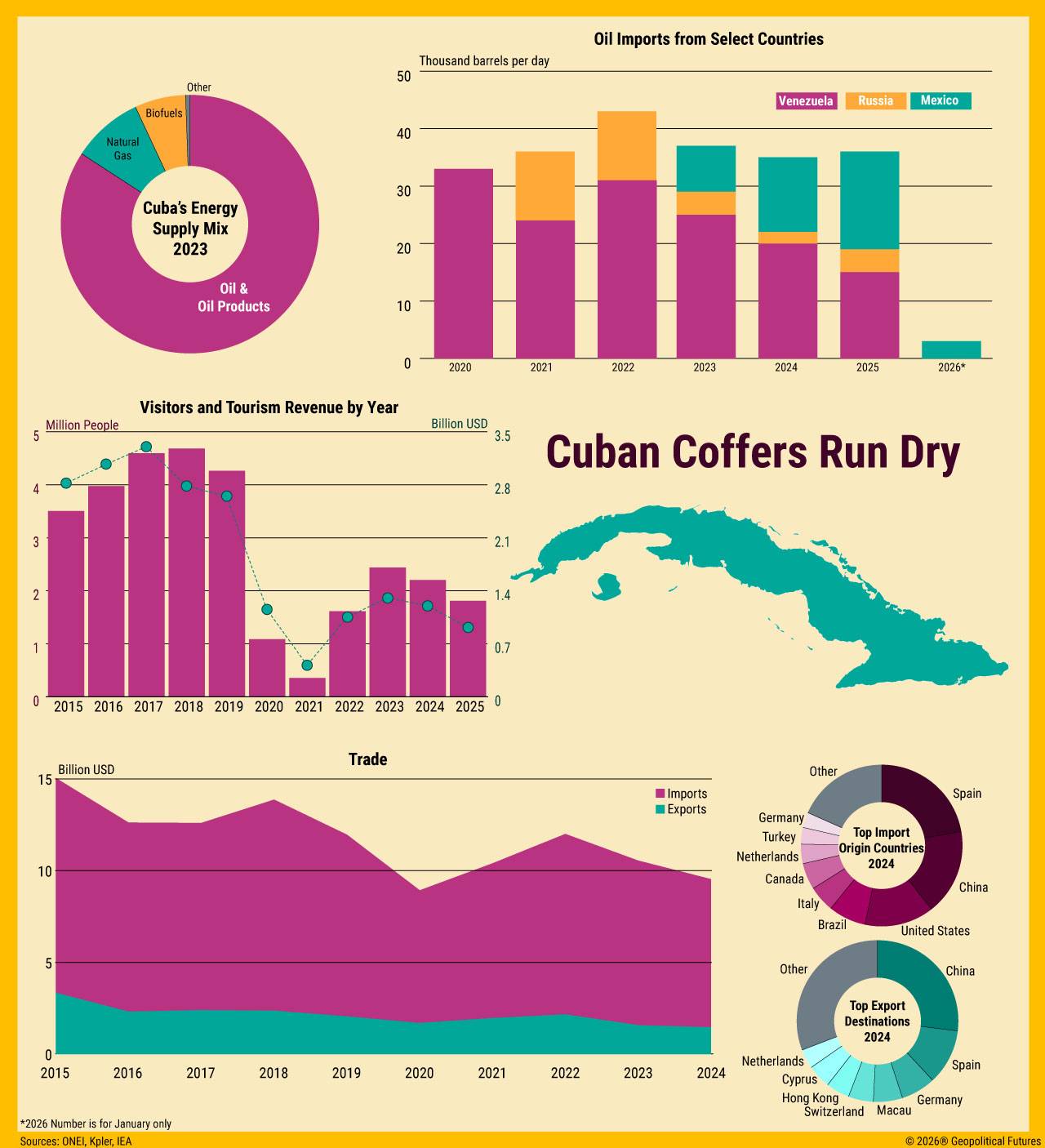
The main constraint that Cuba is currently facing is fuel shortage, which has been caused by the U.S. block of oil shipments from Venezuela, a long-standing ally to the island, as discussed before. This situation has been aggravated by the imposition of new tariffs on third-countries that sell oil to Cuba. Oil shortage has led to electricity cuts, disrupting the provisions of essential services such as hospital emergency wards and transportation. In this context, the most vulnerable segments of the population are children in need of vaccination and pregnant women, who cannot access regular medical care. Moreover, the lack of fuel and power is making it hard to refrigerate foodstuffs, supply medicine and operate water pumps.
Data from Oficina Nacional de Estadística e Información (ONEI), Kpler and the International Energy Agency (IEA) indicate a steady decline in Cuba’s oil imports from Venezuela between 2023 (approximately 25.000 barrels per day) and 2025 (around 15.000 barrels per day). As of January 2026, oil imports from both Venezuela and Russia had reportedly ceased, while overall imports fell sharply to fewer than 5.000 barrels per day, supplied exclusively by Mexico.
At the end of January 2026, Trump declared a national emergency due to the unusual threat that Cuba represents to national security and foreign policy of the United States. This is due to the fact that — according to the American President — Cuba is close to Russia and China’s strategic interests, enabling activities of surveillance on US military operations. The state of national emergency led Trump to tighten the embargo with the aim of provoking an implosion without military intervention.
In the current context, the most concerning economic restrictive measures taken by the United States seem to be the lifting of remittances and the instatement of Cuba in the list of states sponsor of terrorism. In particular, restrictions on remittances are expected to have a negative impact on the Cuban national economy, directly affecting households and employment rate in the private sector, thereby further weakening the country’s productive system. In response, Cuba may increasingly engage in asymmetrical economic relationships, potentially reinforcing its structural dependence on core economies.
Different postures in comparison
It is widely discussed that the United States has historically imposed the embargo under the objective of fostering the Cuban government’s transition towards democracy and the protection of human rights of the Cuban population. This approach has been largely disputed by the literature. Dani Rodrik suggests that economic sanctions are intrinsically a bad choice when imposed with the aim of promoting a country’s own preferences or bringing a country’s practices into line with its own. As a matter of fact, some of these sanctions aimed at depriving Cuba of commercial access to vital goods, like medicines, food, electricity and oil, undermining the enjoyment of civil and political rights. Because of this, the UN General Assembly has condemned the US embargo as a violation of the Charter of the United Nations and international law, as American unilateral sanctions on Cuba have the scope to change the Cuban internal political system, inflicting harm to the local population’s well-being. During the 21st plenary meeting of the United Nations, the representative of Barbados has stated that Cuba suffered estimated material losses amounting to $7.5 billion between March 2024 and February 2025. Such resources could have been invested to deliver basic services and guarantee economic growth.
Moreover, many scholars have claimed that economic sanctions often fail to achieve their aims and that the elites they are intended to target often remain unpunished, while the poorest sectors of the population have to deal with the outcomes. In this context, Zimbalist (2021) asserts that the American embargo has
“forced Cuba into the arms of the USSR, provided an excuse for his revolution's economic failures and tight political control of the population, and elevated Castro's reputation as a nationalist and leader of Third-World countries seeking a more just and independent relationship with the superpowers. And [it] failed, of course, to get rid of him.”
According to Francis and Duncan (2016), if the goal is to foster democratization in a country, the best strategy is opening trade rather than limiting it, as when economic institutions become more inclusive, the political institutions also will. It is in fact argued that economic hardship can be manipulated by current regimes as a tool to consolidate power. This point of view is also shared by economist Dani Rodrik’s posture, as already specified. Moreover, evidence in Vidal’s study demonstrates the high sensitivity of Cuban GDP to positive shocks in economic exchange with the United States, supporting the above explained thesis.
Generally, «individual countries and intergovernmental organizations imposing sanctions should be aware of the delicate balance between using economic coercion to induce targets to change a policy and the possible unintended damage of worsening human rights conditions» (Peksen, 2009). This is exactly what seems to be happening in Cuba: although the aim of unilateral American sanctions on the country was to remove the communist leadership and foster democracy, households and private sectors ended up being weakened and dealing with resource scarcity. Contrarily — as Peksen argues — policy makers should consider Cuba’s access to the American and international market to drive positive internal change.
On the other hand, Vidal found no evidence on the correlation between imposition of economic sanctions and decline in the value of Cuban government consumption. This means that there is an area of autonomy that remains untouched by external economic sanctions, that being Government’s spending. This can be explained by the fact that Cuba has historically found alternative commercial partners — such as Russia, Venezuela and China among others — to mitigate the effects of embargo and to help sustaining investments. However, the main problem in this context is that the Cuban government has asymmetrically distributed the impact of sanctions, which has been borne on those lacking the means to escape the impact of such sanctions, namely the civil society and the private sector.
Related to this, some scholars have studied how the structural economic crisis affecting Cuba cannot be exclusively attributed to the American embargo, but to interdimensional factors that have a lot to do with domestic institutions.
The theoretical approach underlying these postures can be traced back to the critique that Johan Galtung moved against the belief that an increase in economic sanctions is directly and proportionally correlated to major political and social collapse (what he called the “Naïve Theory of Sanctions”). Galtung argues that assuming that economic sanctions cause social and economic underdevelopment is a limited vision on reality because it does not consider the possibility that value-deprivation pushes the sanctioned country to react against a sort of external enemy, causing restructuring of the national economy, political integration and perhaps only later — or in some cases never — disintegration. This posture is what he called “Revised Theory of Sanctions”, considered to be more cautious and closer to reality.
Echoing this theoretical stream, a recent study by Espineira et al. has argued the responsibility of the Government as an active player in the deterioration of Cuban economy and social rights, stating that the effects of American embargo do not only concern economic sanctions, but also internal causes. As a matter of fact, internal authoritarian and inefficient institutions act as amplifiers to the economic hardship and social marginalization caused by the imposition of economic sanctions by external actors. For this very reason, it is crucial to consider the role played by the sanctioned countries’ local governments when considering the outcomes of coercive measures.
Further to this point, the so-called internal embargo has been brought to attention, namely the high cost that an economic model inspired by the USSR imposes on the state, threatening economic growth. Internal embargo refers to the economic and bureaucratic restrictions imposed by a government on its citizens and businesses, which limit production, trade and entrepreneurship. The concept of internal embargo is often applied to the Cuban context, as socialist administrations — especially that of Fidel Castro — have obstructed local entrepreneurship, thereby limiting productive employment and innovation. By prohibiting self-employment, Cuban administrations have impeded the effective utilization of Cuba’s well-educated labor force. Even following subsequent policy intervention which permitted thousands of previously informal enterprises to operate legally, the result has been a persistently low level of labor force qualification.
The scholars observe that some governmental decisions have deeply hindered the possibility of economic growth. An example is the refusal to adhere to Bretton Woods financial system during the Sixties, which deprived Cuba of access to financial aid from international institutions such as the International Monetary Fund or the World Bank, imposing limitations to international investments to ensure hegemonic control over the State.
On the other hand, Vidal notes that Cuba’s restricted access to international monetary aid can be largely attributed to the Helms-Burton Act, that «requires US representatives in the IMF and the World Bank to vote against Cuban inclusion and instructs the US government to withhold from the funds it contributes to any international financial institution an amount equal to that of assistance provided to the island» (Vidal, 2023).
Finally, the authors discuss the inefficient design and implementation of social policies that — from the Nineties onwards — have been oriented towards a logic of familiarization, assigning greater responsibility to families and the market in a context of resource scarcity. As a result, these policies paid less attention to social inclusion and protection, contributing to a deeply divided and unequally stratified society. Under this point of view, the detriment of social rights enjoyment by the Cuban population seems to be correlated with lack of public efforts to overcome embargo and frequent complaints to international organizations.
Overall, the comparison between the two contrasting postures highlights that economic sanctions in themselves are not reliable instruments for producing positive development. While they frequently exacerbate adverse socio-economic conditions within targeted countries and reinforce narratives of an external ideological adversary to be fought, internal governmental responsibility must be considered, so that sanctions are not instrumentalized to legitimize and perpetuate authoritarian regimes rather than fostering substantial reform.
Policy recommendations
Addressing remittances’ importance, evidence found from Vidal does not support the argument that they end up in the hands of the Cuban government. In fact, there is no significant correlation between positive shocks in such transfers and government consumption. On the contrary, the funds flow directly into the private sector and families, helping them find economic strength and independence, especially in phases of shortage. In light of this, restricting remittances would harm those who American administrations have historically claimed to protect, namely the civil society. American policy makers and future administrations should consider the crucial role that remittances play in sustaining the Cuban national economy and possibly authorizing them, taking the positive outcome observed during Obama’s tenure as a reference.
In addition, viable policy recommendations can be made through a comparative study between Cuba and Viet Nam. As a matter of fact, before the 1980s Viet Nam was characterized by a centralized economy, similar to the Cuban one. Furthermore, Viet Nam has been subject to an American commercial embargo between 1975 — right after the end of the Vietnamese war — and 1994. The economic reforms initiated in the country in 1986 under the name of “Doi Moi” (Renovation) served as a benchmark to the country’s transition toward a socialist-oriented market economy (SOME), enabling poverty reduction and boosting economic growth.
Viet Nam reform towards a more developing economy has been gradual, following a step-by-step path, ensuring stability and avoiding the risk of collapse. This approach allowed Viet Nam to shift away from a Centrally Planned Economy (CPE) model — a form of closed economy — through which trades with socialist countries only were allowed, causing cyclic shortages and failures in the domestic production system.
The Viet Nam reform process began as a bottom-up initiative with early measures encouraging trade beyond formal state channels and limiting constraints on private activities, through for example illicit contracting in agriculture. Macroeconomic stabilization was then guaranteed by Doi Moi’s reform package, in parallel with the internationalization of the national economy, the gradual liberalization of trade regime, and the forging of strategic partnership with several countries. Doi Moi reform represented a punctual exception within the comprehensive process of national reform both because it was not gradual — rather it has brought to fast structural shifts — and because it has responded to a top-down approach.
Learning from Viet Nam’s balance between gradualism and turning points and between bottom-up and top-down approaches, Cuba could establish a successful reform model through the dialogue between policy-makers, business community and civil society, with the aim of strengthening democracy. The Vietnamese model has in fact demonstrated how it is not necessary for foreign countries to impose tightening economic sanctions to boost democratic shift, as local governments can be highly performative in finding local viable ways to get there.
Furthermore, the alliances that Viet Nam has forged during the reform years offer a relevant point of reference for Cuba. In this regard, Espineira et al. argue that the Cuban government should consider a strategy of substitution of preferred market, adopting China as main commercial partner and giving it privileged access to Latin American markets. This would offer Cuba many opportunities for export agreements and investment in areas such as mining, energy agriculture, infrastructure, science and technology.
It is important to highlight that Viet Nam’s reform success has been largely enabled by active cooperation with multilateral and international organizations, such as the United Nations, World Trade Organization, etc. Building on this experience, the Cuban government should consider abandoning its historical reluctance in approaching such international institutions, as this could represent a crucial step towards political and economic integration. At the same time, American administrations should be aware that certain legal frameworks such as the Helms-Burton Act limit Cuba’s possibility to engage with international entities.
Finally, the openness to global markets in Viet Nam has been accompanied by the development of the private sector. As a matter of fact, one of the goals of Doi Moi reform was precisely the encouragement of domestic private sector and foreign direct investments. The importance of enabling competitiveness of private sector and foreign investments should be considered by American policy makers, as suggested by Peksen: it has already been discussed that embargo has had a negative impact on foreign investments — through sanctions applied to third-party countries pursuing investing activities in Cuba — as well as on the correct functioning of the private sector. Obstructing FDIs and private businesses means condemning Cuba to structural underdevelopment and dependency.
Overall, considering the resemblances in past Vietnamese economy and the actual state of Cuban economy, a transition toward a well thought SOME — defined as «a multi-component commodity production economy operated by market mechanisms under state management with a socialism orientation» (Vo Tri Thanh, 2023) — could prove highly beneficial for Cuba. As a matter of fact, SOME model would enable access to the global market while maintaining a key role played by the state economy. The Vietnamese SOME can be of inspiration also because it successfully combines economic and social policies, ensuring that economic growth would be accompanied by social progress and equality in every stage. This is a much-needed goal to be achieved in Cuba.
In conclusion, embargoes and coercive economic measures do not constitute effective instruments for promoting social and economic development, rather, they exacerbate structural inequalities and the challenges faced by sanctioned countries. In particular, when such countries are governed by rigid and authoritarian institutions, sanctions are often instrumentalized as justification for maintaining autarchic control, rather than facilitating democratic transition. Nonetheless, the comparative analysis between the Vietnamese and the Cuban case demonstrates that the two approaches commonly applied to study the U.S. embargo on Cuba should not be considered as separated, despite their underlying differences. As discussed above, both domestic governmental responsibility and accountability from foreign countries applying sanctions — in this case the United States — are needed in order to foster democracy and socio-economic development.
Source Classification
Information Content |
||
1 |
Confirmed |
Confirmed by other independent sources; logical in itself; coherent with other information on the topic |
2 |
Presumably true |
Not confirmed; logical in itself; coherent with other information on the topic |
3 |
Maybe true |
Not confirmed; reasonably logical in itself; coherent with some other information on the topic |
4 |
Uncertain |
Not confirmed; possible but not logical in itself; no other information on the topic |
5 |
Improbable |
Not confirmed; not logical in itself; contradicts with other information on the topic |
6 |
Not able to be evaluated |
No basis to evaluate the validity of the information |
|
|||||||||||||||||||||||
Bibliography
Acaso Laviña R., “Análisis del impacto del embargo económico, comercial y financiero impuesto por Estados Unidos a Cuba.” Bachelor’s Thesis, Universidad Pontificia Comillas, Facultad de Ciencias Humanas y Sociales (2018) (D-3)
Amnesty International. “THE US EMBARGO AGAINST CUBA ITS IMPACT ON ECONOMIC AND SOCIAL RIGHTS.” Amnesty International Publications (2009) (B-1)
Congressional Research Service. “Cuban Democracy Act of 1992”, H.R. 5323, 102nd Cong. (1991–1992). Washington, DC: Library of Congress. Congress.gov. https://www.congress.gov/bill/102nd-congress/house-bill/5323 (A1)
Espineira, J. Carlos et al. “El embargo y la crisis del desarrollo humano en Cuba.” ¿Cuál es el impacto real de las sanciones sobre Cuba y Venezuela? Una mirada plural alejada de la propaganda oficial, Universidad Sergio Arboleda (2025), 978-628-7730-14-4 (C-2)
Galtung, J. “On the Effects of International Economic Sanctions: With Examples from the Case of Rhodesia.” World Politics 19, no. 3 (1967): 378-416 (A-1)
Henken, Ted A. and Ritter, Archibald R. M. “Overcoming Cuba’s Internal Embargo.” Current History, 114, fasc. 769 (2015): 73-76 (B-1)
O’Driscoll, D. “Impact of Economic sanctions on poverty and economic growth.” K4D Helpdesk Report. Brighton, UK: Institute of Development Studies (2017) (C-2)
Peksen, D. “Better or Worse? The Effect of Economic Sanctions on Human Rights*.” Journal of Peace Research 46, no. 1 (2009): 59-77, DOI 10.1177/0022343308098404 (B-2)
Rehman-ur-J. “Embargo and Engagement: Assessing the Landscape of US-Cuba Relations.” Research Journal for Societal Issues 5, no. 3 (2023): 114-130, DOI: https://doi.org/10.56976/rjsi.v5i3.141 (C-1)
Rodrik, D. “The Global Governance of Trade As if development really mattered.” United Nations Development Programme (2001) (A-1)
Vidal, P. “Impact of Sanctions Policy Shifts: A Case Study of the United States and Cuba, 1994–2020.” Journal of International Development 37 (2025): 540:553. DOI: https://doi.org/10.1002/jid.3973
(A-1)
Vo, T. T. “Viet Nam: Transition to a Socialist- Oriented Market Economy.” in Kimura, F. et al (eds.), “Viet Nam 2024: Development Issues and Challenges.” Jakarta: ERIA (2023): 99-121 (A-2)
Sitography
CEIC. “Cuba Crude Oil: Imports” Accessed March 2026. https://www.ceicdata.com/en/indicator/cuba/crude-oil-imports (B-2)
CUBA Solidarity Campaign. “The Agrarian Reform, the first law of the Revolution” Cuba Solidarity Campaign. 17 May 2021. https://cuba-solidarity.org.uk/news/article/4232/the-agrarian-reform-the-first-law-of-the-revolution (D-2)
Ebata, A. “Fifty years post war, Vietnam’s future for economic success” Institute of Development Studies. 09 May 2025 https://www.ids.ac.uk/opinions/fifty-years-post-war-vietnams-future-for-economic-success/ (B-1)
History.com Editors. “President Clinton ends trade embargo of Vietnam” History. November 2009. https://www.history.com/this-day-in-history/february-3/clinton-ends-trade-embargo-of-vietnam#:~:text=President%20Bill%20Clinton%20lifts%20a,Vietnam%20during%20the%20Vietnam%20War (D-4)
Latschan, T. “Trump and Rubio have brought Cuba’s government to the brink” DW News. 28 February 2026. https://www.dw.com/en/trump-and-rubio-have-brought-cubas-government-to-the-brink/a-76158344#:~:text=Thomas%20Latschan,dw.com/p/59YGO (B-2)
ONEI, Kpler, IEA. “Cuban Coffers Run Dry” Geopolitical Futures. 2026. https://df16bd12.delivery.rocketcdn.me/wp-content/uploads/2026/02/Cuba_Economy_2026.jpg (B-2)
Sekulich, H. “Oil refinery blaze hits Cuba as fuel crisis deepens” BBC News. 14 February 2026. https://www.bbc.com/news/articles/cge89x7re74o (B-2)
Toscano, S. “Cuba: l’embargo illegale USA mette a rischio 30 mila donne incinte e 60 mila neonati” L’Indipendente. file:///C:/Users/Utente/Downloads/Cuba_%20l&%238217%3Bembargo%20illegale%20USA%20mette%20a%20rischio%2030%20mila%20donne%20incinte%20e%2060%20mila%20neonati.pdf (C-2)
United Nations “Speakers in General Assembly Highlight Impact of United States Embargo on Cuba’s Population, as Caribbean Prepares for Devastation of Hurricane Melissa” Eightieth Session, 21st Meeting (AM), 28 October 2025. https://press.un.org/en/2025/ga12722.doc.htm (A-1)
Vidal, Pacel A. “What Effects Do U.S. Sanctions Have on the Cuban Economy?” Columbia Law School. 06 February 2025. https://horizontecubano.law.columbia.edu/news/what-effects-do-us-sanctions-have-cuban-economy (B-2)
World Bank. “GDP (current US$) – Cuba”. Accessed March 2026. https://data.worldbank.org/indicator/NY.GDP.MKTP.CD?end=1999&locations=CU&start=1990 (A-1)
Riproduzione riservata®