
Marco Rizzi - Head Researcher Mondo Internazionale G.E.O. Cultura & Società
Abstract
This article investigates the tumultuous urban evolution of Skopje, North Macedonia, positioning it as a singular European case study of architectural rupture and ideological rewriting. Tracing the city’s trajectory from the 1963 earthquake, which catalyzed Kenzo Tange’s modernist “City of Solidarity” to the controversial “Skopje 2014” project that imposed a veneer of nationalist neo-classicism, the analysis explores how these top-down interventions have reshaped the collective memory and daily life of its citizens. Beyond the aesthetic clash between brutalist concrete and faux-baroque styrofoam, the article examines the deep socio-political consequences of these shifts, including the spatial entrenchment of ethnic divisions along the Vardar River, the severe environmental crisis of air pollution, and the rise of civic resistance movements like the “Colorful Revolution.” Ultimately, Skopje is presented as a resilient, unfinished palimpsest where authentic urban life persists in the margins of a crumbling stage set.
Introduction
In the canon of European capitals, Skopje occupies a singular, disquieting position. It is not just a city that has evolved but rather a city that has been violently reset, erased, and rewritten, often by forces that treat its urban fabric less as a habitat for citizens and more as a slate for ideological projection. To walk the streets of Skopje in the mid-2020s is to traverse a fractured timeline where the geological trauma of the twentieth century collides with the political theatre of the twenty-first. It is a place where the raw, heroic concrete of Japanese Metabolism wrestles with the styrofoam-backed fragility of a fabricated Antiquity, and where the vibrant, chaotic life of the Ottoman Bazaar is juxtaposed against the silent, marble stare of hundreds of bronze statues.
Skopje is a city defined by two cataclysms: the natural disaster of 1963, which levelled the city and birthed a modernist utopia, and the political project of 2014, which sought to bury that utopia under a veneer of pseudo-baroque nationalism (Ivkovska, 2025). This report explores how these seismic shifts, one tectonic, one bureaucratic, have reshaped the very soul of the city, influencing how its citizens breathe, move, protest, and identify themselves in a space that is constantly becoming something else.
The evolution of Skopje is a testament to the malleability of collective memory and the resilience of daily life. As the capital of North Macedonia, it stands at the crossroads of the Balkans, physically divided by the Vardar River into ethnic spheres, yet bound together by a shared struggle against pollution, corruption, and the uncanny sensation of living in a city that feels like a stage set. From the utopian dreams of Kenzo Tange to the “Disneyland” critique of the Skopje 2014 project, and finally to the contemporary fight for a “Green Humane City,” I trace the metamorphosis of a metropolis that is arguably the most complex architectural experiment in modern Europe (Brsakoska, 2021).
Part I: 1960s-2010s
The modern history of Skopje does not begin with a founding myth or a royal decree, but with a sudden, devastating silence. At 5:17 AM on July 26, 1963, a catastrophic earthquake measuring 6.1 on the moment magnitude scale struck the city. In precisely 17 seconds, the Skopje of the Ottoman and interwar periods ceased to exist. Over 1,000 people were killed, 3,000 injured, and nearly 80% of the city’s building stock was obliterated or rendered uninhabitable (Architizer, 2026).
The clock at the Old Railway Station, a handsome neo-classical structure, stopped at that exact moment. It remains there today, preserved as the Museum of the City of Skopje, its hands frozen in a permanent testament to the rupture. This moment of destruction, however, triggered an unprecedented geopolitical reaction. In the polarized climate of the Cold War, Skopje became a rare locus of convergence. Within days, American military field hospitals were operating alongside Soviet engineering teams. The United Nations declared Skopje a “City of Solidarity,” coordinating aid from 87 nations (Wikipedia, 2026). This was the beginning of a radical urban experiment. The erasure of the old city provided a tabula rasa for the world’s architects to project their visions of a future society.
The reconstruction of Skopje was the first time the United Nations managed a competition for the master plan of a city. In 1965, the jury selected the proposal by the renowned Japanese architect Kenzo Tange, a leading figure of the Metabolist movement. This marked the first instance of Japanese urban theory being applied to a Western metropolis (New Moment, 2026).
Metabolism viewed the city as a living organism capable of growth and regeneration. Tange’s master plan for Skopje was defined by two colossal metaphorical structures. First, the City Gate: a massive transportation hub integrating the railway, bus station, and city access points, designed to funnel the flow of people and commerce into the urban core. This was realized, in part, as the new Transportation Centre, a brutalist leviathan raised on concrete pilotis to withstand any future tremors (Architizer, 2026). Second, the City Wall, a series of high-density residential blocks encircling the city centre, evoking the defensive walls of a medieval fortress but reimagined as a container for modern community life. These apartment blocks, which still stand today, were designed to create a vibrant, dense urban perimeter that would liberate the centre for public use and cultural institutions (Architectuul, 2026).
Tange’s vision was one of heroic modernism. He imagined a Skopje where the architecture would facilitate social solidarity, a “society of the future” built on the ruins of the past. While financial constraints meant that only fragments of his master plan were realized, specifically the City Wall and the Transportation Centre, the ethos of the reconstruction fundamentally altered the city’s DNA. Skopje became a global capital of Brutalism. (Vanderessen, 2025).
The “City of Solidarity” produced a generation of local architects who synthesized Tange’s structuralism with a distinct Yugoslav sensibility. The most emblematic figure of this era was Janko Konstantinov, whose masterpiece, the Telecommunications Centre (central Post Office), remains one of the most significant brutalist structures in the world.
Constructed in stages between 1974 and 1989, the Post Office is a defiant rejection of the box. Its unadorned concrete forms resemble a fortress or an organic, blooming lotus flower. The building was designed to be experienced as a sculpture, with circular towers and textured surfaces that play with the harsh Balkan light (Archive of Destruction, 2026). Inside, the central hall featured monumental murals by Borko Lazeski, depicting the epic struggles of the Macedonian people in a modernist, Cubist style, a total work of art where the ideology of liberation was embedded in the very walls (Archive of Destruction, 2026).
For decades, this architecture defined Skopje. It was a city of raw concrete, wide boulevards, and open spaces, a “city of the future” that, by the 1990s, had begun to age. The transition from socialism to capitalism brought neglect. The concrete stained, the open spaces were encroached upon by illegal kiosks, and the “City of Solidarity” began to be perceived by the new political elite as a grey, communist aberration that needed to be “fixed” (Ivkovska, 2025).
Part II: Skopje 2014
If 1963 was a trauma of nature, 2010 marked the onset of a trauma of policy. The right-wing VMRO-DPMNE government, led by Prime Minister Nikola Gruevski, launched “Skopje 2014,” a project ostensibly aimed at revitalizing the capital but fundamentally designed to engineer a new national identity (Graan, 2013). The project sought to bypass the Slavic, Ottoman, and Yugoslav layers of history to forge a direct, unbroken lineage to the ancient kingdom of Macedon.
This was “nation-branding” conducted with jackhammers and styrofoam. The government argued that Skopje was too “grey” and lacked the monumental grandeur befitting a European capital. The solution was a flood of “neoclassical” and “baroque” architecture, styles that had virtually no historical precedent in the region (Vladov, 2026). The project was authoritarian in its implementation, bypassing standard consultative procedures and utilizing non-democratic mechanisms to impose a mono-ethnic narrative on a multicultural city (Brsakoska, 2021).
The scale of the intervention was staggering. Originally announced with a budget of €80 million, the cost of Skopje 2014 ballooned to an estimated €500-€700 million, a colossal sum for one of Europe’s poorest nations (Integrity Audit, 2026; Guardian, 2015). The project encompassed the construction of some 136 structures, including new government ministries, museums, a triumphal arch, and over 100 statues.
The spending was mired in controversy. Opposition parties and investigative journalists highlighted huge discrepancies in costs, with millions flowing to Italian bronze foundries and obscure construction firms (Transparency International Macedonia, 2013). Critics dubbed it “money laundering through monuments,” arguing that the project was a mechanism for the ruling party to extract public funds while cementing its ideological dominance (Heinrich Böll Stiftung, 2016).
The visual impact of Skopje 2014 was transformative and disorienting. The city centre was turned into a dense thicket of bronze and marble. Dominating Macedonia Square is a 24.5-meter-high statue formally titled “Warrior on a Horse” to avoid diplomatic fallout with Greece, yet unmistakably representing Alexander the Great. The monument sits atop a fountain flanked by bronze lions and soldiers, accompanied by a light and music show that plays Wagner and dramatic choral pieces (Alexander the Great Fountain, 2015). It is a spectacle of overwhelming scale, designed to dwarf the citizen and enforce a sense of awe. Additionally, a triumphal arch was squeezed into a tight urban intersection, celebrating Macedonian independence. Its reliefs depict a selective history, and its very existence as a “triumphal” arch in a city defined by survival rather than conquest struck many as historically tone-deaf (Sofia Globe, 2018). Perhaps the most controversial aspect was the “baroquisation” of existing modernist buildings. The modernist Government building, a transparent glass-and-grid structure, was encased in a faux-classical shell of white plaster and pillars. The MEPSO building and the Paloma Bjanka centre suffered similar fates (Ivkovska, 2021; New East Archive, 2026). This was perceived by citizens as an act of architectural violence: erasing the authentic history of the 20th century to impose a fabricated history of the 19th.
The result was a cityscape that felt like a “theme park” or a “Las Vegas of the Balkans.” The Guardian labelled it the “capital of kitsch,” while CNN asked if the city was being turned into a fantasy land (Guardian, 2015). For the citizens, the disorientation was profound. The landmarks of their youth were disappearing behind styrofoam masks.
Table 1: Modernism vs. Antiquisation
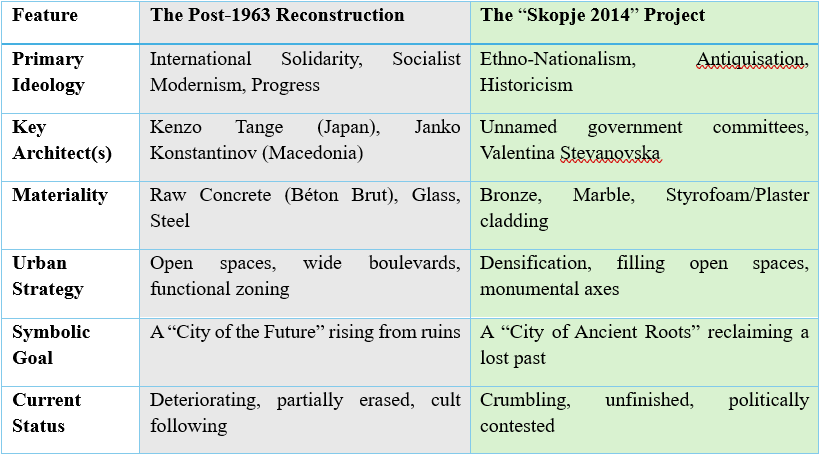
Part III: A divided city
Skopje is not just a city of stylistic clashes; it is a city of deep ethnic and spatial segregation. The Vardar River acts as a mental and physical border, separating the predominantly ethnic Macedonian, Christian south from the predominantly ethnic Albanian, Muslim north (Teen Ink, 2026; Kapusta, 2019).
The Skopje 2014 project exacerbated this divide. By concentrating the monumental investment almost exclusively on the southern bank, and by focusing on icons of ancient Macedonian and Christian heritage (such as the massive cross on Mount Vodno and the statues of saints), the project signalled to the Albanian population that they were excluded from the narrative of the capital (Véron, 2021). In response, the municipality of Čair, on the northern bank, erected its own colossus: a statue of Skanderbeg, the Albanian national hero. The city thus engaged in a “war of statues,” with Alexander staring down Skanderbeg across the stone bridge, solidifying the polarization of public space (Véron, 2021).
North of the river lies the Old Bazaar (Čaršija), the largest Ottoman bazaar in the Balkans outside of Istanbul. It is a labyrinth of cobblestone streets, hammams, caravanserais, and mosques (Blocal Travel, 2026). In contrast to the sterile, imposed order of the new centre, the Bazaar is organic and human scaled.
Historically stigmatized by the Macedonian majority as “alien” or dangerous in the 1990s and 2000s, the Bazaar has undergone a transformation. It has become a hub for nightlife and youth culture, a place where the rigidity of ethnic division softens slightly under the influence of commerce and leisure (Wanderlog, 2026). While segregation persists in residential patterns as Macedonians and Albanians are largely living in separate neighbourhoods, the Bazaar serves as a tentative interface, a place where the “other” is encountered, if not fully integrated (Véron, 2021).
However, the “Skopje 2014” project attempted to encroach even here. The installation of massive statues of Philip II and other figures at the entrance to the Bazaar was seen as an attempt to visually “conquer” the Ottoman space with ancient Macedonian symbols, further alienating the local shopkeepers and residents (Sofia Globe, 2018).
One of the most surreal elements of the 2014 project was the construction of “galley ships”. They are static, concrete-anchored structures built directly into the Vardar riverbed to serve as restaurants and hotels (Telegrafi, 2026). These vessels, intended to evoke a naval history for a landlocked city, became instant symbols of the project's absurdity.
Beyond their aesthetic dissonance, the ships posed a severe environmental risk, disrupting the river's flow and increasing the danger of flooding. In the years following the change of government, the “Galleys” became the subject of a protracted legal and physical battle. The city administration attempted to remove them, but the sheer difficulty of dismantling concrete ships from a riverbed, combined with lawsuits from concessionaires, left them as rotting hulks in 2024 and 2025. They stand as “hostages of the past,” derelict and abandoned, neither sailing nor sinking, blocking the view of the river they were meant to celebrate (Meta.mk, 2026; Telegrafi, 2025).
Part IV: Society in revolt
The resistance to the reshaping of Skopje was not immediate, but it was potent. The first major victory for civil society came with the defence of the City Shopping Center (GTC). A modernist gem designed by Živko Popovski, the GTC is an open-air mall that functions as a public street, integrating the city rather than enclosing it. When the government announced plans to wrap the GTC in a baroque façade closing its entrances and suffocating its architecture the citizens rebelled (Obieg, 2026).
The “I Love GTC” (Go Sakam GTC) initiative organized mass protests where citizens literally hugged the building, forming human chains to protect it. This was a pivotal moment: it was a rejection of the “facadism” that treated buildings as mere surfaces. The citizens argued that the GTC’s value lay in its openness and its history, not in a fake antique appearance. The movement succeeded; the GTC was the only major building in the centre to escape the baroque makeover, standing today as a scarred authentic survivor (Global Voices, 2014; Cultures of History, 2026).
The discontent boiled over in 2016 with the “Colourful Revolution” (Šarena Revolucija). Triggered by a wiretapping scandal that revealed massive high-level corruption, the protests took a unique aesthetic form. Demonstrators weaponized colour. Using paintball guns and balloons filled with paint, they targeted the pristine white baroque facades of the new government buildings and monuments (Taleski, 2022).
The “Porta Macedonia” triumphal arch became a primary canvas, splashed with vibrant reds, greens, and yellows. This was a profound act of urban reclamation. By staining the artificial whiteness of the neoclassical buildings, the citizens were stripping them of their sacred aura. They were saying, effectively, “This is not a temple; it is a fake, and it belongs to us.” The paint turned the monuments into objects of ridicule, breaking the spell of the regime’s authoritarian aesthetic (Roaming Renegades, 2026).
The Colourful Revolution was instrumental in bringing down the Gruevski government. It demonstrated that the built environment of Skopje was an active participant in the political struggle. The architecture that was meant to silence the population had instead incited them to speak (Taleski, 2022).
Part V: Environment and daily life
While the “statue wars” dominated the headlines, a silent killer was reshaping life in Skopje more profoundly than any monument. In the winters of 2023, 2024, and 2025, Skopje frequently ranked as the most polluted city in the world (UNICEF, 2024; Guardian, 2023). The city’s geography, located in a valley surrounded by mountains, creates a natural temperature inversion that traps air. However, this natural predisposition has been exacerbated by catastrophic urban planning.
The “Skopje 2014” buildings, particularly the massive neoclassical administrative blocks along the riverbank, formed a physical wall that blocked the critical wind corridors Tange had preserved. The dense infill construction prevented the Vardar breeze from flushing out the smog (ResearchGate, 2026). Combined with the reliance on wood and waste burning for heating in impoverished households, and an aging fleet of diesel vehicles, the air in Skopje became toxic.
For the citizens, pollution is a visceral, sensory experience. Residents describe the air as tasting like “burnt plastic” or “acid” (Guardian, 2023). In the winter months, the smog is so thick that the grandiose monuments disappear into a grey haze, rendering the aesthetic debate irrelevant. “I feel like a smoker, but I don't smoke,” says Desanka, a young activist, highlighting the health crisis that plagues the youth (UNICEF, 2024).
The response has been a shift in civil society from identity politics to survival politics. The “Green Humane City” (Zelen Human Grad) initiative and student groups have mobilized to demand systemic changes: the removal of concrete, the planting of trees, and the regulation of industry (City of Skopje, 2023). However, the General Urban Plan for 2022-2032 promises a “green transition,” but the trust in institutions remains low, especially with recent waste management crises in 2024 leaving the city dealing with uncollected garbage and fires at landfill sites (China-CEE, 2025; Intellinews, 2024).
Part VI: Contemporary Skopje
A decade after the peak of construction, the “Skopje 2014” project is experiencing a phenomenon of “accelerated ruination.” The haste with which the buildings were erected, often using inferior materials to maximize profit, is now visible. Facades are cracking, revealing the styrofoam and mesh beneath the plaster. The National Theatre has suffered from leaks; the Officer's Hall remains an unfinished shell; the Galley ships are rotting (100 Days and Nights, 2026; Telegrafi, 2026).
This decay has created a surreal urban landscape. Skopje is a city of “ancient” ruins that are less than ten years old. The monuments, intended to project eternity, are instead displaying the fragility of the regime that built them. The maintenance costs are astronomical, leaving the current city administration in a bind: spend millions to repair the symbols of their political opponents, or let the city centre rot (100 Days and Nights, 2026).
Yet, beneath this crumbling veneer, the “real” Skopje persists with a vibrant, defiant energy. The cultural life of the city has retreated from the sterile centre to the margins. The Youth Cultural Centre (MKC) and independent spaces like Social Centre Dunja stand as bastions of independent thought, hosting music festivals, avant-garde theatre, and art exhibitions that challenge the nationalist narrative (Reset Network, 2025).
The Old Bazaar continues to thrive as a chaotic, lively zone of commerce and nightlife, where the sound of the muezzin mixes with techno beats from basement clubs. Independent galleries like the Museum of Contemporary Art continue to uphold the legacy of the “City of Solidarity,” hosting exhibitions that reconnect Skopje with the global art world (ArtFacts, 2026).
There is also a growing appreciation for the brutalist heritage. Walking tours of “Concrete Skopje” have become popular, attracting a new generation of locals and tourists who see the Post Office and the University complex as powerful, authentic architecture worth saving (Marriott Activities, 2026; Katrinka Abroad, 2017).
Conclusion
Skopje is a city that refuses to be resolved. It is a place of constant becoming, a palimpsest where the writing is never quite dry before the next layer is applied. The “Changing Cities” narrative here is cyclical. The earthquake erased the Ottoman city; the Modernists erased the trauma; the Nationalists erased the Modernists; and now, the environment and entropy are erasing the Nationalists.
For the citizens of Skopje, this constant flux creates a unique psychological condition. It is a resilience born of scepticism. They know that the statues are hollow, that the facades are fake, and that the air is poison. Yet, they persist. They enjoy life in the shadow of crumbling styrofoam columns; they organize techno parties in brutalist halls; they paint the streets when the government stops listening.
The evolution of Skopje offers a profound lesson for the world: a city is not defined by its monuments, but by the spaces between them. The Skopje 2014 project failed to create a unified nation because it tried to impose a single, static memory on a fluid, dynamic population (Brsakoska, 2021). The future of Skopje lies not in more building, but in healing the rift between the riverbanks, healing the scarred lungs of its children, and healing the disconnect between the city’s image and its reality. Until then, Skopje remains a fascinating, heartbreaking masterpiece of unfinished dreams, a city that is always changing, yet somehow, stubbornly, remains the same.
Bibliography
- 100 Days and Nights. 2026. “Skopje 2014 Project: Scandal or Success?” Accessed January 14, 2026. https://100daysandnights.com/skopje-2014-project-scandal-or-success/. 2B
- Alexander the Great Fountain. 2015. “Statue Details.” Accessed January 14, 2026. https://www.alexanderthegreatfountain.com/AlexandertheGreatStatue.htm. 2B
- Archive of Destruction. 2026. “Department for Conservation and Restoration: Skopje Post Office.” Accessed January 14, 2026. https://archiveofdestruction.com/artwork/department-for-conservation-and-restoration/. 1A
- Architizer. 2026. “Modernist Buildings in Skopje: The Earthquake and Kenzo Tange.” Accessed January 14, 2026. https://architizer.com/blog/inspiration/collections/modernist-buildings-skopje-earthquake/. 2B
- ArtFacts. 2026. “Skopje Art Scene 2025.” Accessed January 14, 2026. https://artfacts.net/city/skopje/542. 2B
- Blocal Travel. 2026. “Brutalist Architecture and the Alexander Statue in Skopje.” Accessed January 14, 2026. https://www.blocal-travel.com/balkans/macedonia-fyrom/skopje/brutalist-architecture-skopje/. 2B
- Brsakoska, Jana. 2021. “Public Space Transformation in the Case of 'Skopje 2014'.” Urbana: Urban Affairs and Public Policy 22: 1-20. 2B
- China-CEE. 2025. “Europe's Wasteland: How Macedonia Became One of the Dumping Grounds of the Continent.” Accessed January 14, 2026. https://china-cee.eu/2025/11/28/north-macedonia-monthly-briefing-europes-wasteland-how-macedonia-became-one-of-the-dumping-grounds-of-the-continent/. 2A
- City of Skopje. 2023. “Skopje Greening Master Plan.” Accessed January 14, 2026. https://zivotnasredina.skopje.gov.mk/wp-content/uploads/2023/08/SkopjeGreeningMasterPlan_compressed.pdf. 2B
- Cultures of History. 2026. “The Skopje 2014 Project at its Tenth Anniversary.” Accessed January 14, 2026. https://www.cultures-of-history.uni-jena.de/politics/north-macedonia/the-skopje-2014-project-at-its-tenth-anniversary-a-story-of-resilience. 2A
- Gazeta Express. 2026. “Skopje 2014 Buildings Still Unfinished.” Accessed January 14, 2026. https://www.gazetaexpress.com/en/shkupi-2014-do-te-vazhdoje-te-ndertohet-edhe-me-parate-e-buxhetit-te-vitit-2025/. 2B
- Global Voices. 2014. “Macedonians Hug Skopje Shopping Centre to Protect it From Baroque-isation.” Accessed January 14, 2026. https://globalvoices.org/2014/12/30/macedonians-hug-skopje-shopping-centre-to-protect-it-from-baroque-isation/. 2B
- Graan, Andrew. 2013. “Counterfeiting the Nation? Skopje 2014 and the Politics of Nation Branding in Macedonia.” Cultural Anthropology 28, no. 1: 161–179. 2B
- Guardian, The. 2015. “Skopje 2014: The new capital of kitsch.” Accessed January 14, 2026. https://www.theguardian.com/travel/2015/apr/11/skopje-macedonia-architecture-2014-project-building. 2A
- Guardian, The. 2023. “'Air tastes like burnt plastic': Skopje's chronic pollution problem.” Accessed January 14, 2026. https://www.theguardian.com/world/2023/sep/20/air-tastes-like-burnt-plastic-skopje-chronic-pollution-problem-north-macedonia. 2A
- Heinrich Böll Stiftung. 2016. “How Skopje 2014 Ate Urban Commons.” Accessed January 14, 2026. https://www.boell.de/en/2016/11/07/how-skopje-2014-ate-urban-commons. 2B
- Integrity Audit. 2026. “Skopje 2014: Unveiling the Controversial Urban Renewal Project.” Accessed January 14, 2026. https://integrityaudit.org/blog/skopje-2014-unveiling-the-controversial-urban-renewal-project-and-its-corrupt-legacy-38. 2B
- Intellinews. 2024. “Waste and Transport Crises Leave Skopje Residents Fuming.” Accessed January 14, 2026. https://www.intellinews.com/waste-and-transport-crises-leave-skopje-residents-fuming-339254/. 2B
- Ivkovska, Velika. 2025. “Skopje's Transitions and the City's Struggle to Preserve Collective Memories.” Architektúra & Urbanizmus 53, no. 1-2. 2B
- Kapusta, G. 2019. “Ethnic Spatial Segregation in Skopje: Bridges over the Vardar.” Geographia Polonica 92, no. 1. 2B
- Katrinka Abroad. 2017. “My Favorite Building in Skopje is a Brutalist Post Office.” Accessed January 14, 2026. https://katrinkaabroad.com/2017/04/27/my-favorite-building-in-skopje-is-a-brutalist-post-office/. 3B
- Macedonia Times. 2026. “Skopje Square Crumbling.” Accessed January 14, 2026. https://macedoniatimes.news/skopje-square-crumbling/. 2B
- Marriott Activities. 2026. “Brutalist Skopje Architecture Tour.” Accessed January 14, 2026. https://activities.marriott.com/europe/north-macedonia/skopje/activities/brutalist_skopje_architecture_tour-XN68DV. 2B
- Meta.mk. 2026. “City of Skopje Will Remove the First Ship.” Accessed January 14, 2026. https://meta.mk/en/city-of-skopje-will-remove-the-first-ship-placed-on-the-bank-of-river-vardar/. 2B
- New East Archive. 2026. “Anger as Skopje 2014 Revamp Claims Another Modernist Building.” Accessed January 14, 2026. https://www.new-east-archive.org/articles/show/6604/anger-as-skopje-2014-revamp-claims-another-modernist-building. 2B
- New Moment. 2026. “The Skopje Project: Kenzo Tange and Metabolism.” Accessed January 14, 2026. https://newmoment.mk/portfolio-items/the-skopje-project/. 2B
- Obieg. 2026. “Skopje Chameleon: I Love GTC.” Accessed January 14, 2026. https://obieg.pl/en/74-skopje-chameleon. 2B
- ResearchGate. 2026. “Air Quality, Health and the City: The Case of Skopje.” Accessed January 14, 2026. https://www.researchgate.net/publication/378955290_AIR_QUALITY_HEALTH_AND_THE_CITY_THE_CASE_OF_SKOPJE. 1A
- Reset Network. 2025. “The Independent Cultural Scene in North Macedonia: Realities, Challenges and Regional Cooperation.” Accessed January 14, 2026. https://reset-network.eu/the-independent-cultural-scene-in-north-macedonia-realities-challenges-and-regional-cooperation/. 2B
- Roaming Renegades. 2026. “Macedonia's Colourful Revolution.” Accessed January 14, 2026. https://theroamingrenegades.com/macedonia-colourful-protests-skopje/. 2B
- Sofia Globe. 2018. “Removal of Monuments in Skopje.” Accessed January 14, 2026. https://sofiaglobe.com/2018/02/23/removal-of-monuments-in-skopje-whose-turn-is-next/. 2B
- Taleski, Dane. 2022. “Social Impact of Skopje 2014 and the Colorful Revolution.” Southeast European and Black Sea Studies 22. 2B
- Teen Ink. 2026. “Examining the Historical and Contemporary Causes of Ethnic Segregation in North Macedonian Society.” Accessed January 14, 2026. https://www.teenink.com/nonfiction/academic/article/1215328/Examining-The-Historical-And-Contemporary-Causes-Of-Ethnic-Segregation-And-Determining-The-Effects-In-North-Macedonian-Society. 2B
- Telegrafi. 2025. “Dismantling of Ships in Vardar River Continues.” Accessed January 14, 2026. https://telegrafi.com/en/Dismantling-of-ships-in-the-Vardar-River-continues/. 2B
- Telegrafi. 2026. “Damage to Skopje 2014 Buildings Becomes Visible.” Accessed January 14, 2026. https://telegrafi.com/en/Skopje-2014%2C-the-damage-to-the-buildings-becomes-visible/.
- Transparency International Macedonia. 2013. “Skopje 2014 Audit Report.” Accessed January 14, 2026. https://transparency.mk/en/2013/11/27/skopje-2014-at-least-eight-million-euros-could-have-been-saved/. 2B
- UNICEF. 2024. “The Quest for Clean Air in North Macedonia.” Accessed January 14, 2026. https://www.unicef.org/eca/stories/quest-clean-air-north-macedonia. 1A
- Vanderessen, Alexandra. 2025. “Skopje: Brutalist & Modernist Architecture.” Accessed January 14, 2026. https://alexandravanderessen.com/2025/08/02/skopje-brutalist-modernist-architecture/. 2B
- Véron, Ophélie. 2021. “Neoliberalising the Divided City.” Political Geography 89. 2B
- Vladov, Deian. 2026. “How Skopje's Makeover Alienated Locals.” Failed Architecture. Accessed January 14, 2026. https://failedarchitecture.com/how-skopjes-makeover-alienated-locals/. 2B
- Wanderlog. 2026. “Best Nightlife in Skopje.” Accessed January 14, 2026. https://wanderlog.com/list/geoCategory/153494/best-nightlife-in-skopje. 2B
- Wikipedia. 2026. “Reconstruction of Skopje 1963.” Accessed January 14, 2026. https://en.wikipedia.org/wiki/Reconstruction_of_Skopje_1963. 3C