
Author: Filippo Valicenti - Junior Researcher GEO Economia
Abstract
The following report analyzes the current lithium extraction panorama in Zimbabwe in relation to Chinese participation to national mining activities. Despite lithium industry having a considerable potential to stimulate national growth, Zimbabwe is continuously failing to correctly directing mining revenues and foreign investment to the benefit of local communities. This problematic situation is exemplified by the conflictual relationship between the State and small-scale local miners. The aim of the report is to analyze whether Resource nationalism 2.0 could be a viable strategy to foster internal economic growth and social inclusion of local communities.
Introduction
Zimbabwe represents one of the main lithium exporters and is the only African country among the top ten exporters of lithium worldwide. As of January 2025, the country counts six active hard rock lithium mines, the main among them being Bikita and Arcadia mining sites.
Bikita Minerals constitutes the oldest lithium extraction hub in the country, operating periodically since 1910 with tin extraction and, later in 1940s, with petalite extraction — a lithium and aluminum silicate, therefore sourced to directly obtain lithium. For a long time, Bikita Minerals has been the only African mine producing lithium, making Zimbabwe a central actor in the sourcing process of the mineral. It is located in the southern part of the country and hosts a deposit of approximately 11 million tonnes of lithium. In 2022 it was acquired by the Chinese mining and resource development company Sinomine Resource Group, which invested $180 million in the site (Mutlokwa and Okoloise, 2025).
Arcadia Lithium Mine, is located 38km east of capital city Harare, in the north-eastern part of the country and hosts roughly 42.3 million tonnes of lithium. The project is owned by Prospect Resources, an Australian company focused on the exploration and development of mining resources, which in 2022 sold 87% interest in Arcadia to the Chinese Zhejiang Huayou Cobalt, closing a deal of around $422 million (Mutlokwa and Okoloise, 2025).
It emerges that the biggest and most strategic lithium deposits in Zimbabwe are owned by foreign companies — mainly Chinese — whereas national companies only exploit a limited share of lithium in the c ountry. An example is Kamativi Mining Company, a partnership between the Chinese Sichuan Pude Technology and the national Zimbabwe Mining Development Company. Kamativi is an ex-tin extraction site, which stopped its activities in the n ineties and has recently been reopened and expanded by Zimbabwean President Emmerson Mnangagwa. The mine is expected to extract about 2 million tonnes of lithium annually. Even if Kamativi represents one of the most recent examples of national participation in the extraction process, such participation remains bound to foreign interference.
According to UN T rade and D evelopment (UNCTAD), lithium global production and demand is expected to grow from 130 to 1313 metric tonnes between 2022 and 2050. For this reason, it is noted that mineral-rich developing countries should implement measures to add local value and this is especially relevant in Africa, where governments should go beyond exporting rough materials by building internal value chains. As a matter of fact, UNCTAD has argued that “no country from Africa or Latin America is currently a major player in manufacturing or trading cathodes or battery materials” (UNCTAD, 2024)
Even though Africa holds approximately only 1% of lithium global reserves, attention should be paid to building a strong local value chain and preventing both social and environmental hazards connected to extraction processes.
In this sense, Zimbabwean President Mnangagwa seems to be acting through the so-called “Resource nationalism 2.0”, namely a political posture leaning towards a nationalization of the extraction process with the aim of creating internal economic growth. The President has recently publicly announced that Zimbabwe is no longer satisfied with the mere extraction of rough lithium and extraction quotas have been applied.
Theoretical framework
This report draws on the concept of “Resource nationalism 2.0”, arising from the foundational concept of resource nationalism, which is “commonly understood as a state-led strategy to assert greater control over subsoil assets for developmental ends” (Lebdioui and Riofrancos, 2025). The general aim of resource nationalism is to foster internal industrialization through outright nationalization, taxation during high-price cycles, and policies aimed at controlling exports , as in the Zimbabwean case.
If classical resource nationalism mainly deals with traditional minerals, oil and gas, resource nationalism 2.0 represents a new wave driven by the recent decarbonization and green energy transition efforts. Therefore, critical minerals — such as cobalt, nickel, copper, lithium and graphite — are now the focus of attention, given they are necessary for the production of electric vehicles and renewable energies.
The recent global green shift has positioned “mineral producing countries at the centre of global supply chain for green technologies” (Lebdioui and Riofrancos, 2025), hence, a debate about the sustainability of resource nationalism is currently open. It is, in fact, crucial to avoid reproducing past extractivist models that have hindered economic diversification, value creation and often violated human rights.
Global and Zimbabwean lithium market
In recent years, lithium extraction has greatly expanded due to the global effort towards a greener and cleaner energy transition. This transition is mainly represented by the production of rechargeable batteries that are used, for example, in electric vehicles (EVs) and renewable energy storage. Despite its “use for the good”, lithium extraction is not free from global debate around its sustainability, both towards environmental, fair labor, and social issues. As of 2024, world total mine production of lithium equals approximately 237 thousand tonnes and has dramatically increased from around 31.5 tonnes to 237 thousand tonnes between 2015 and 2024.
According to the Government of Canada, in 2024 lithium global use was distributed among continuous casting fluxes (1 per cent), lubricating greases (2 per cent), ceramic and glass (5 per cent) and batteries (87 per cent) (Government of Canada, 2026). Therefore, batteries accounted for the striking majority of global lithium demand in 2024.
Behind this evidence, there is a strategic actor, namely China. In point of fact, Chinese industry are responsible for approximately 60% of the world’s lithium refining capacity and 70% of lithium-ion battery production. This means that China is a central player both in the production and in the import of lithium (and other critical minerals).
Production wise, according to Zhou (2026), China has historically been a prominent player in the rare earths industry, thanks to a set of policies introduced in the 1970s, that aimed at internal control, global supply, national overall industrial development and prices influencing. As a result, “during the 1990s Chinese rare earths production increased drastically” (Morrison and Tang, 2012) and the country became the world’s dominant rare earth supplier. This primacy was further secured by the introduction of technologies, innovation and sustainable development in resource management and by the more recent National Plan for Mineral Resources (2016–2020), that set out both inward and outward-oriented policies that together “upgraded industrial structures […] and promoted engagement through trade, investment and international cooperation” (Zhou, 2026).
Concerning import, according to the World Trade Organization in 2022, China accounted for 33 per cent of the global total import of critical minerals, a trend that has been growing steadily since 2016.
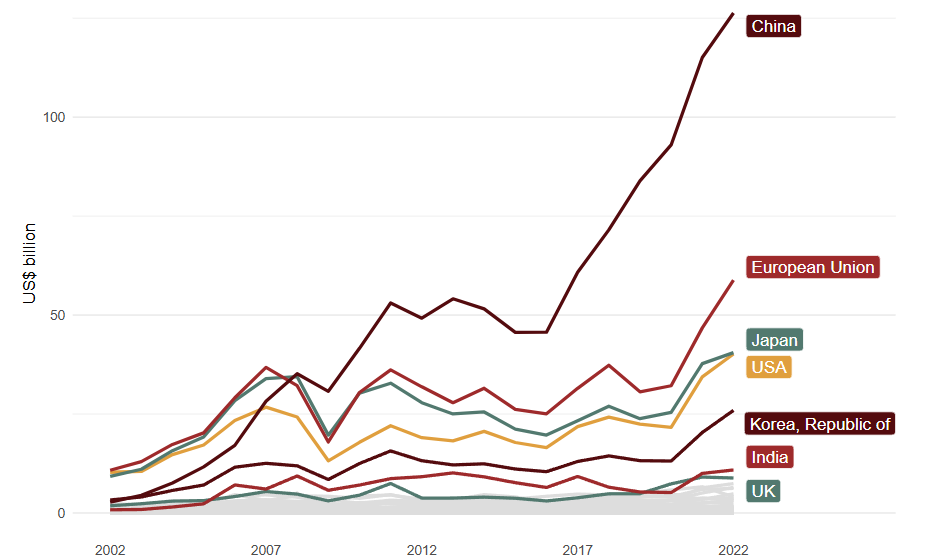
Source: WTO Analytical Database. Available at: https://www.wto.org/english/blogs_e/data_blog_e/blog_dta_10jan24_e.htm
According to a study conducted by Radomski, J et al. in 2026, concerning the Zimbabwean context, mining activity has long been central in the country’s economy, accounting for 14% of national GDP and 75% of export earnings. More specifically, lithium alone contributed $209 million to mining exports in 2023. Moreover, between 2024 and 2025, Zimbabwe has increased its lithium production from an estimated 20 to 28 thousand tonnes, highlighting a growing commitment in exploiting national lithium resources (U.S. Geological Survey, 2026). The lithium extraction in Zimbabwe is recent, since it began around 202 0 and it was driven mainly by Chinese companies and middlemen. (Takura, 2026).
As expected, Zimbabwe is subject to Chinese strategic interests: Chinese private companies have invested over one billion dollars in acquiring and developing lithium extraction projects in the country since 2021 (Radomski, J et al., 2026).
However, the Chinese interference in Zimbabwean territories has not been neutral, rather, it caused conflict among local producers. This has led to the occupation of lithium lands by artisanal and small-scale miners (ASM) – who are personally involved in extracting and trading activities with private buyers – in order to take advantage of the growing global interest in the mineral sector. The misalignment between ASM and the national framework eventually brought to conflict and eviction of the former from the occupied mining sites.
Therefore, the Government’s behavior seems to be unclear: on one hand, the presidential discourse perfectly aligns with the resource nationalism 2.0; on the other hand, the Chinese presence in Zimbabwe is highly fostered by the national i nstitutions themselves, which directly translates into the exclusion of locals, with the risk of “undermining the resource-driven national economic development” (Mkodzongi, 2024).
According to O’Donnell (2026), Chinese companies control 90 per cent of Zimbabwe’s mining sector, through acquisitions and investments, and benefit from lax oversight both on labor standards and environmental protection. This responds to a general trend of fast investment and infrastructure promises that the Chinese government makes to resource-rich countries, which in turn find themselves trapped in the dependency cycle of exporting raw resources and importing refined products.
However, Zimbabwean President Mnangagwa appears to have recognized this issue: in 2022 he proclaimed a raw ore export ban and – following his re-election in August 2023 – he reaffirmed his previous commitment to using the country's rich mineral resources to fuel industrialization. As a result, to recent restrictions posed in early 2026, China-Zimbabwe ties are shifting toward local processing, as the c ountry has now shipped its first locally produced lithium sulfate to China.
Zimbabwe’s current situation
As anticipated, the mining industry in Zimbabwe is tightly connected to the presence of Chinese investors and such presence is the result of the historical relationship between the two Countries: China has long been Zimbabwe’s main financial and trade partner and it has provided the country with weapons during the Liberation War from white colonialism between 1964 and 1979.
In recent years and due to the growing global interest in critical minerals, many local miners in Zimbabwe started reorienting their activities from gold, tantalite, chromite and emerald towards lithium extraction.
In 2022, the Chinese lithium rush in Zimbabwe came to a turning point, when Chinese nationals were buying raw lithium from artisanal miners and exporting it to China. The artisanal miners were performing illegal and unlicensed extraction of the resource, which was then smuggled through the Zimbabwe-South African border. Due to this situation, between December 2022 and January 2023, President Mnangagwa banned the export of lithium bearing ore or any form of beneficiated lithium. This measure aimed at invigorating the domestic lithium industry by setting up manufacturing plants to fabricate lithium-ion batteries and encouraging investors to establish local production facilities. This approach mirrored the effort of the government to take control of national resources in order to break the dependency chain, while still keeping fruitful relationships with foreign investors. Some manufacturing capacities have been actually built, like the Mapinga Mine-to-Energy I ndustrial P ark. However, such capacities demand a lot in terms of energy supply and Zimbabwe has faced persistent energy crisis in the past few decades, which created significant obstacles to the implementation of the plan. The situation is made further complex by the fact that Zimbabwe has no financial potential to sustain such projects: 44 per cent of the population lives under poverty conditions and the debt owed to international creditors amounts to $14.04 billion. Additionally, due to the internal political condition, over the past 20 years, Zimbabwe has been banned from access to investment from Europe, the United States and international financial institutions, such as the International Monetary Fund (IMF) and the World Bank. . As a result, China has remained the country’s main strategic partner.
It is no surprise that in March 2026, Mapinga project stalled upon withdrawing of investors due to land disputes and insufficient funding capabilities, as shared by Mining Zimbabwe shares (2026).
Furthermore, few months after the ban was issued, two mines kept operating without environmental impact assessments and artisanal miners continued to carry out illegal mining activities: there has been no public disclosure of information about environmental impact assessments conducted by Chinese companies operating in Zimbabwean mining sites and there was lack of clarity on how local communities would have benefited, defining a situation of general lack of transparency.
Nonetheless, the resource nationalism 2.0 posture was retained: indeed, in early 2026 Zimbabwean Mines Minister Polite Kambamura has suspended exports of all raw minerals and lithium concentrates with immediate effect and required commitment for more local processing as part of conditions to allow the resumption of mineral exports. This decision was adopted in order “to reduce revenue leakages in the sector” and was subsequently accompanied by the introduction of quotas and stricter requirements for selected miners, as part of a broader strategy aimed at increasing domestic value addition through local mineral processing rather than the export of raw to Asian and European markets.
According to M. Hidayat (2026), the export restriction is driving swift adjustments throughout the supply chain. In particular, the ban has cornered Chinese processors to either seek alternative suppliers at higher costs or to expand processing capacity within Zimbabwe in order to sustain production levels. In other words, the Chinese investments activity in the country has been further secured.
As a result of the recent ban, in April 2026 the Arcadia mine exported the first shipment of lithium sulphate, a higher-value battery material used in electric vehicles. This represents a significant transition from dependency towards the creation of a national value chain and it is argued that this important step could lead Zimbabwe to emerge as one of the first African countries to process battery materials. Moreover, the ban seems to have been beneficial in terms of export volume: according to the Minerals Marketing Corporation of Zimbabwe (MMCZ), lithium export rose to 240.826 tonnes in the first quarter of 2026, up from 224.610 tonnes during the same period in 2025, as shared by Gretinah and Yeting (2026).
Nevertheless, there is a concrete risk that Zimbabwe will repeat its historical mismanagement of natural resources in the context of trading lithium, continuously lacking a system of industrial and development policies in support both of the internal economic system and local communities.
As a matter of fact, Zimbabwe’s mining sector currently remains governed by the 1961 Mines and Minerals Act. This colonial-era legislation – that is under revision since 2013 – vests all mineral rights in the President of the Republic of Zimbabwe. According to the Act, mining rights can be conferred to both local and foreign individuals and companies after acquiring a license through an application to the Mining Commissioner. The Act is prominent in the national mining scenario because it supersedes all other legislations that might interfere with mining and contributes to the overall legal system “characterized by a multiplicity of taxes and uncoordinated collections by the local authorities and a number of government agencies […] which have all hindered efficient revenue collection from the mining sector” (AFRODAD, 2017).
Therefore, the cession of rights to foreign actors (Chinese companies) is embedded within the Zimbabwean legal framework, further reinforcing the difficulty for local indigenous populations to enjoy potential positive and developmental results of mining’s revenues. Consequently, “The Mines and Minerals Act has no specific provisions for community benefits and participation in mining nor does it specify that mining companies should have a Corporate Social Responsibility (CSR)” (AFRODAD, 2017).
In order to overcome this lack of social commitment, the Indigenisation and Economic Empowerment Act (IEEA) has been passed in 2008, under Robert Mugabe presidency, with the objective of requiring at least 51 per cent of shares in every foreign owned company (including mining companies) to be owned by indigenous Zimbabweans. Part of the money owned by indigenous population ought to be used for social and economic infrastructure, such as hospitals, schools and roads . However, the initiative suffered political interference, lack of financial integrity and a weak policy framework, which eventually compromised community development.
Evidence shows that despite the government’s attributing the inefficient allocation of economic resources to other stakeholders, the Indigenisation Fund has been abused by ruling political elites as a mechanism of facilitating corrupt practices.
The IEEA was amended in 2018 under the current Presidency to read that only diamonds and platinum were reserved for Zimbabwean citizens. Any minerals other than these two could be prospected for and mined by both foreign and local investors. The amendment gave the minister a wide discretion to give mining concessions to foreign investors – mostly Chinese companies – without even considering the interests of the communities and reinvigorating a patronage-based economy. This means that traditional leaders are justified to keep acting on behalf of their communities by giving consent to mining companies and the government, as argued by Adegboyega (2026).
The result is the perpetuation of the so-called politics of exclusion, that Takura (2026) defines as the process through which government officials and mining companies use discourse of belonging and indigeneity to stop artisanal miners from accessing lithium mining areas and to control the marketing of lithium ore. The author argues that artisanal miners are only formally recognized within the Mines and Minerals Act: any Zimbabwean citizen could obtain a license to be eligible to operate mining activities, but the price of such license is unbearable for most of the national population. This is why citizens end up escaping the legal framework, thereby providing the State with a pretext for persecution.
In other words, traditional leaders, mining companies and government officials used different strategies to stop artisanal miners from accessing lithium mining areas.
It is therefore possible to conclude that the noble intent of the resource nationalism 2.0 governmental approach in taking advantage of national resources – in this case lithium – to create an internal industrial system of production and refining, with the ultimate objective of bringing benefit to local and indigenous communities, is fundamentally hindered by economic crisis, political corruption and unsuccessfulness of public policies.
The current governmental approach is surely working out in terms of securing foreign investments, but there is a need to complement this effort with a system of policies oriented at correctly and ethically allocating those investments in the mining sector.
Policy recommendations and conclusions
Significant policy recommendations can be made through a comparative study between Zimbabwe and Chile.
Not only do both countries hold significant lithium reserves, with Chile possessing some of the largest globally, but they also both adopt a Resource nationalism approach to the governance of these resources.
Through the years, Chile has introduced high mineral taxation, a robust royalties system and it has utilized mining’s revenues to fund public and social oriented objectives, especially in the area of education, welfare state, social programs and macroeconomic stability.
A study from CEPAL (2022) reported evidence of the progressive role of tributary revenues from the mining sector in the decrease of national income inequality in the long-run (Gini-Index), despite the impact being relatively small. Additionally, the non-tax revenues from mining have been reported to increase public spending, being it current spending or public investments with or without social vocation. Moreover, tax revenues collected from mining activities are invested in two sovereign wealth funds: one dedicated to finance future solidarity-based, old-age and disability pensions, the so-called Fondo de Reserve de Pensiones (FRP), and one dedicated to ensuring stability of public spending during periods of slower growth, the Fondo de Estabilización Económica y Social (FEES). Finally, in order to make equitable use of the resources provided by the mining sector, Chile has adopted a territorial redistributive approach aimed at fiscally homogenizing the national territory, as to guarantee the provision of subnational public services of comparable quality.
An emblematic example of the commitment of Chilean government to putting the mining industry at the service of public and social needs is the recent “Estrategia Nacional del Litio” (National Lithium Strategy) launched in 2023, under Boric presidency, which is a governmental initiative that encourages public-private partnerships and appoints the state-owned company Codelco as strategic actor in defining such partnerships and taking control of higher shares of Atacama Salary.
The aim of the national strategy is for the State to participate in the whole production chain, fostering the use of new technologies to mitigate the hydric and environmental impact in the salaries, and to generate technological local value, while securing more participation and dialogue with indigenous communities. Despite the difficulty to find evidence concerning the actual efficiency of this initiative, given that it is a long-term policy, it is possible to argue that it represents a noticeable example for Zimbabwe.
Moreover, the effort of Chile to positively influence local communities through the mining activities is concrete, as shown by the two collaborative community development programs implemented in the cities of Calama and Antofagasta, located in the northern part of the country, where mining activities are being carried out. The programs act in the form of collaborative governance, thereby seeking open dialogue and cooperation between companies and local communities to increase the long-term quality of life of the local population, as argued by Ibáñez (2021).
As authors Scot and Price (2025) argue, the lithium sector in Zimbabwe is growing, but structurally dependent on Chinese investment, which so far have been i ncapable of benefitting local communities. In this context, the Chilean Estrategia Nacional del Litio could be an example of effective resource nationalism through the revitalization of the role of state-owned companies in shaping partnership with private actors and gaining higher control of national mining sites.
It is important to note that such higher control should be accompanied by a strong social and developmental vocation. Once again, the Chilean lithium strategy could teach the importance of engaging in active conversations with indigenous populations and, in this case, artisanal miners. This effort should be directed to the inclusion of this segment of population into the legal ecosystem. Moreover, a collaborative approach should have to be implemented with local communities, in order to enable horizontal participation in the design process of public policy and therefore addressing real societal needs. In this regard, the Chilean collaborative community development programs could serve as an important reference.
The authors go on by highlighting the importance of transparent infrastructure and social spending, which is currently very limited in Zimbabwe. The Chilean public spending system is emblematic of a country that is interested in ensuring the wellbeing of the population. The territorial redistributive spending model could be particularly considered to ensure a homogeneous development along the national territory.
Such recommendation should be taken into account especially in light of the application of the recent National Development Strategy (2026-2030), which has the explicit objective of enhancing “social development, universal access to quality health, education and other social services” (Kamba, M. 2025), objective that cannot be separated from the crucial role played by the mining industry in the country.
However, it is important to acknowledge that the Chilean participatory and cooperative approach to local development is not to be interpreted as flawless, rather there are existing challenges to be addressed.
Firstly, collaborative community development programs have been highly criticized by researchers, mainly because they faced many barriers to application, especially due to poor time management and the informality in the leadership of the private companies involved.
Secondly, conflicts between the State, foreign actors and indigenous communities are still existing nowadays, along with environmental and hydric issues deriving from the extraction process within the Atacama Desert area, where lithium and copper mining sites are located.
Therefore, it is important to acknowledge the complexity of indigenous and local integration when analyzing the role of Governments’ intention to gain greater control of their national resources.
Finally, it can be concluded that there is limited evidence showing that resource nationalism 2.0’s ambition to control resources is systematically accompanied by effective efforts to promote social and economic development of local communities. Even when governments formally declared such objectives, the practical application of development plans often proves unsuccessful. This pattern can be identified both in the Chilean and Zimbabwean case.
In Chile revenues form contribute to broader social spending; however — when it comes to more targeted cooperation with local communities living in mining areas aimed at designing and launching local development initiatives (for example, collaborative community development programs) — the implementation of such programs often suffers from lack of robust coordination among participating actors, as well as inconsistencies in aims and resources allocation.
In Zimbabwe, several public policies have been proposed with the aim of fostering local empowerment and development, most notably the Indigenisation and Economic Empowerment Act of 2008. Nevertheless, the actual implementation of these policy initiatives has systematically faced distortion of means, political corruption and, eventually, failures in effective delivery, often to the detriment of local populations.
It can be argued that in Zimbabwe resource nationalism 2.0 is succeeding in attracting and tightly retaining the flow of foreign — particularly Chinese — investments within the country. More recently, this strategy has created the possibility of opening a path of new trade opportunities of processed lithium, such as lithium sulfate. In the Zimbabwean context, lithium sulfate can be considered as an intermediate processed material in the national supply chain, serving as a bridge between raw ores and final usable battery, which is largely produced in China. This approach reflects an attempt to capture higher-value within the supply chain.
Nevertheless, persistent conflicts surrounding mining activities and legal under representation of local artisanal miners remain significant challenges. Consequently, resource nationalism 2.0 is having limited success in reconciling broader economic escalation with the inclusion and participation of local population in the benefits of such economic growth.
Source Classification
Information Content |
||
1 |
Confirmed |
Confirmed by other independent sources; logical in itself; coherent with other information on the topic |
2 |
Presumably true |
Not confirmed; logical in itself; coherent with other information on the topic |
3 |
Maybe true |
Not confirmed; reasonably logical in itself; coherent with some other information on the topic |
4 |
Uncertain |
Not confirmed; possible but not logical in itself; no other information on the topic |
5 |
Improbable |
Not confirmed; not logical in itself; contradicts with other information on the topic |
6 |
Not able to be evaluated |
No basis to evaluate the validity of the information |
Trustworthiness of the source |
A |
Trustworthy |
No doubt about authenticity, reliability or competence; has a history of total trustworthiness |
B |
Normally trustworthy |
Small doubts about authenticity, reliability or competence, nevertheless has a history of valid information in a majority of cases |
C |
Sufficiently trustworthy |
Doubts about authenticity, reliability or competence; however, has supplied valid information in the past |
D |
Normally not trustworthy |
Significant doubt about authenticity, reliability or competence, however has supplied valid information in the past |
E |
Not trustworthy |
Lack of authenticity, reliability or competence; history of invalid information |
F |
Not able to be evaluated |
No basis to evaluate the validity of the information |
Bibliography
African Forum and Network on Debt and Development (AFRODAD). “AN ASSESSMENT OF THE NATIONAL MINING LEGAL FRAMEWORKS AND POLICIES OF SADC COUNTRIES AGAINST THE AFRICA MINING VISION (CLUSTER 1: MINING REVENUES AND MINERAL RENTS MANAGEMENT). THE CASE OF ZIMBABWE.” (2017) (B-3)
Bore, O, and Mpofu, M. “Strategic to Whom? Uncovering the Hidden Costs of Lithium Extraction to Zimbabwean Communities.” Maryland Journal of International Law 40, n. 1, n.d.:36-57 (B-2)
Goodenough, K., Deady, E. and Shaw, R. “Lithium resources, and their potential to support battery supply chains, in Africa.” British Geological Survey (2021) (B-2)
Lebdioui, A. and Riofrancos, T. “CRITICAL MINERALS & RESOURCE NATIONALISM 2.0: Why the Policy is more Critical than the Mineral.” Technology, Industrialisation and Development (TIDE) Centre (2025) (A-2)
M. Gallo, L. “Asignación, distribución y uso de los ingresos fiscales derivados de la explotación minera en Chile. Un análisis de sus efectos económicos y sociales.” CEPAL (2022) (A-1)
M. Morrison, W. and Tang, R. “China’s Rare Earth Industry and Export Regime: Economic and Trade Implications for the United States.” Congressional Research Service (2012) (A-2)
Mkodzongi, G. “Lithium mining and national economic development in Zimbabwe. Prospects for resource-based national development.” Green and Transition Minerals Collection. Africa Policy Research Institute (APRI) (2024) (B-3)
Mutlokwa, H. and Okolise, C. “Socio-legal Reflections on Zimbabwe's Lithium Industry: The Role of Public Participation in Resource Governance and Environmental Justice.” PER / PELJ 2025/28), DOI: http://dx.doi.org/10.17159/1727-3781/2025/v28i0a18234 (A-1)
Takura, E. “The allure of the “white gold”: The lithium rush, artisanal mining mobilities, and the politics of exclusion in Zimbabwe, 2020-2024.” The Extractive Industries and Society 26 (2026), DOI: https://doi.org/10.1016/j.exis.2026.101865 (A-1)
U.S. Government. “LITHIUM.” U.S. Geological Survey, Mineral Commodity Summaries (2026) (A-1)
Sitogrpahy
Adegboyega, A. “China-backed miner makes history as Zimbabwe exports first battery-grade lithium product” Business Insider Africa. 28 April 2026. https://africa.businessinsider.com/local/markets/china-backed-miner-makes-history-as-zimbabwe-exports-first-battery-grade-lithium/ettstem (C-2)
ADF. “Ban on Mineral Exports Gives Zimbabwe Leverage With China” ADF. 14 April 2026. https://adf-magazine.com/2026/04/ban-on-mineral-exports-gives-zimbabwe-leverage-with-china/ (C-2)
Al Jazeera, AFP and Reuters. “Zimbabwe imposes ban on exports of all raw minerals and lithium concentrate.” A Jazeera. 25 February 2026. https://www.aljazeera.com/news/2026/2/25/zimbabwe-imposes-ban-on-exports-of-all-raw-minerals-and-lithium-concentrate (C-3)
Banya, N., and T. Muronzi, Chris and Bavier, J. “Zimbabwe to introduce lithium export quotas, sets conditions for resumption of shipments” Reuters. 08 April 2026. https://www.reuters.com/world/africa/zimbabwe-introduce-lithium-export-quotas-sets-conditions-resumption-shipments-2026-04-08/ (B-2)
Blais, C., J. Water, A. L. and Food System Lab MIT News. “Understanding the impacts of mining environments and communities” Massachusetts Institute of Technology News. 21 March 2024 (A-2)
Gobierno de Chile. “Presidente de la República, Gabriel Boric Font, presenta Estrategia Nacional del Litio.” Gobierno de Chile. 20 April 2023. https://prensa.presidencia.cl/fotonoticia.aspx?id=232596 (A-1)
Government of Canada. “Lithium facts” Natural Resources Canada. 29 January 2026. https://natural-resources.canada.ca/minerals-mining/mining-data-statistics-analysis/minerals-metals-facts/lithium-facts
(A-1)
Gretinhah and Yeting. “Zimbabwe's lithium exports surge despite ban on raw mineral exports.” The Star. 14 May 2026. https://www.thestar.com.my/news/world/2026/05/14/zimbabwe039s-lithium-exports-surge-despite-ban-on-raw-mineral-exports#goog_rewarded (D-3)
Hidayat, M. “Zimbabwe’s Lithium Export Ban Disrupts Global Supply Chains in 2026.” Discovery Alert. 02 March 2026. https://discoveryalert.com.au/zimbabwe-lithium-export-ban-2026-supply-chain/ (C-2)
Kamba, M. “President Mnangagwa launches NDS2.” Zimbabwe African National Union - Patriotic Front. 27 November 2025. https://zanupf.org.zw/news/nds-2 (C-3)
O’Donnell, L. “US “mineral mafia” report reveals the battle with China for the next industrial era.” Lowy Institute. 11 May 2026. https://www.lowyinstitute.org/the-interpreter/us-minerals-mafia-report-reveals-battle-china-next-industrial-era (B-1)
Radomski, J., Musasike, T., Chidhawu, T., Mtegha, H. and R. Chinyanga, E. “Zimbabwe’s Lithium Pivot: Promises and Pitfalls of Mining” Global Development Policy Center – University of Boston. 23 March 2026. https://www.bu.edu/gdp/2026/03/23/zimbabwes-lithium-pivot-promises-and-pitfalls-of-mining/ (A-2)
Snoussi-Mimouni, M. and Avérous, S. “High demand for energy-related critical minerals creates supply chain pressures.” World Trade Organization. 10 January 2024. https://www.wto.org/english/blogs_e/data_blog_e/blog_dta_10jan24_e.htm (A-1)
T. Muronzi, Chris. “Zimbabwe bans exports of all raw minerals and lithium concentrates, cites malpractices.” Reuters. February 25 2026. https://www.reuters.com/world/africa/zimbabwe-bans-exports-all-raw-minerals-lithium-concentrates-2026-02-25/ (B-2)
UNCTAD. “Critical minerals boom: Global energy shift brings opportunities and risks for developing countries.” UNCTAD. 26 April 2024. https://unctad.org/news/critical-minerals-boom-global-energy-shift-brings-opportunities-and-risks-developing-countries#:~:text=As%20the%20climate%20emergency%20intensifies,Secretary%2DGeneral%20Rebeca%20Grynspan%20says (A-1)
Vara, V. “Arcada Lithium Project, Harare” Mining Technology. 09 February 2023. https://www.mining-technology.com/projects/arcadia-lithium-project-harare/ (A-3)
Whitlock, Z., G. Kannan, S. and Toman, M. A. “Resource Nationalism and the Resilience of Critical Mineral Supply Chains” Resources for the Future. 10 November 2025. https://www.rff.org/publications/reports/resource-nationalism-and-the-resilience-of-critical-mineral-supply-chains/ (A-2)
Zhou, W. “China’s critical mineral strategy beyond geopolitics.” East Asia Forum. 03 March 2026. https://eastasiaforum.org/2026/03/03/chinas-critical-mineral-strategy-beyond-geopolitics/ (A-3)
Zimbabwe Broadcasting Corporation. “Kamativi mine expansion project.” Facebook. n.d. https://www.facebook.com/matangira1/videos/%EF%B8%8F-kamativi-mine-expansion-project-the-kamativi-mine-is-located-in-hwange-distric/2293728377786554/ (D-3)
Riproduzione Riservata ®