
Abstract
After the 2022 water crisis, which significantly impacted the Po river basin and the entire Italian territory, the government developed first Decree Law No.39/2023, followed by Law No.68/2023 to manage drought-related crises. However, this type of short-term, crisis-driven legislative response clashes with international guidelines, which emphasise long-term perspectives focused on prevention, adaptation, and mitigation. This article analyses the Italian case as representative of Southern Europe's challenges in addressing drought and water scarcity.
Ginevra Tanto (Junior Researcher - G.E.O. Environment)
Introduction
Law No.68/2023 is the first regulation aimed at directly managing drought-related crises. Yet its implementation stressed a tension that extends far beyond Italy: how should governments balance climate-related urgent crises with the long-term, integrated water strategies that international frameworks insist are necessary?
Italy's drought crisis offers a window into this global governance challenge, as one of Europe's most drought-vulnerable countries, it sits at the intersection of scientific evidence, new political commitment, and implementation gaps. By examining how Italy has responded, and how that response aligns with or diverges from frameworks developed by international and regional organisations, it is possible to understand whether global water governance is equipped to translate policy into practice.
Between 1991 and 2020, natural water availability in Italy declined by 20% annually (Catini et al., 2024). In 2022 alone, rainfall hit its lowest point since 1951 (Braca et al., 2023), while the Po River, Italy's largest and most reliable water source, experienced what hydrologists classified as severe and extreme hydrological drought (Permanent Observatory on Water Use, 2022). For this reason in 2023, the Meloni’s government proposed Decree Law No. 39/2023 and consequently enacted Law No. 68/2023, which established new specialised bodies to manage drought and water scarcity-related crises. Specifically, a new Steering Committee with the main powers to declare and manage water emergencies, a National Special Commissioner to adopt urgent measures and coordinate emergency response at both national and regional levels, and Permanent Observatories on Water Use, which collect, update and share information on water resources in specific river basin districts (MASE, 2024).
North-South Gap as a Drought-related Governance Problem
As a matter of fact, the Italian water crisis is not evenly distributed. Although northern regions have experienced unprecedented dry spells, southern regions, including Sicily, Calabria and Apulia, face chronic water stress. As an example, in 2024, drought affected 42% of Sicily's non-irrigated crops and 66% of Calabria's (Greenpeace, 2024).
This uneven exposure maps onto Italy's deeper North-South divide, according to the ISTAT's 2024 well-being report, northern regions cluster above national averages in wealth and infrastructure development, conversely, the South and Islands lag consistently. As a consequence, when water stress is layered onto this existing inequality, the result is not a shared national crisis but a geographically stratified one.
The social geography of Italy's drought exposes a critical blind spot in how the country's crisis response is designed. Law 68/2023 established centralised crisis management through a Steering Committee and National Commissioner. The logic is intuitive: emergencies demand swift, coordinated decision-making, though this approach risks deepening exactly the inequality that increases southern regions’ vulnerability. When drought is treated as a temporary emergency requiring top-down management and control, regional variation is underestimated. Policies designed for Po Valley irrigation may not fit Sicilian chronic water scarcity, and infrastructure investments chosen by central authorities may not reflect local knowledge about what communities actually need.
The evidence from the ISTAT and other agencies suggests that regional disparities in water access are not temporary anomalies but structural features requiring sustained, differentiated and long-term-based policy responses.
Multi-element discourse: Economy, Health, and Social Issues
At the European level, agriculture is the most exposed sector as it accounts for nearly half of all water deficit impacts (Motta et al., 2025).
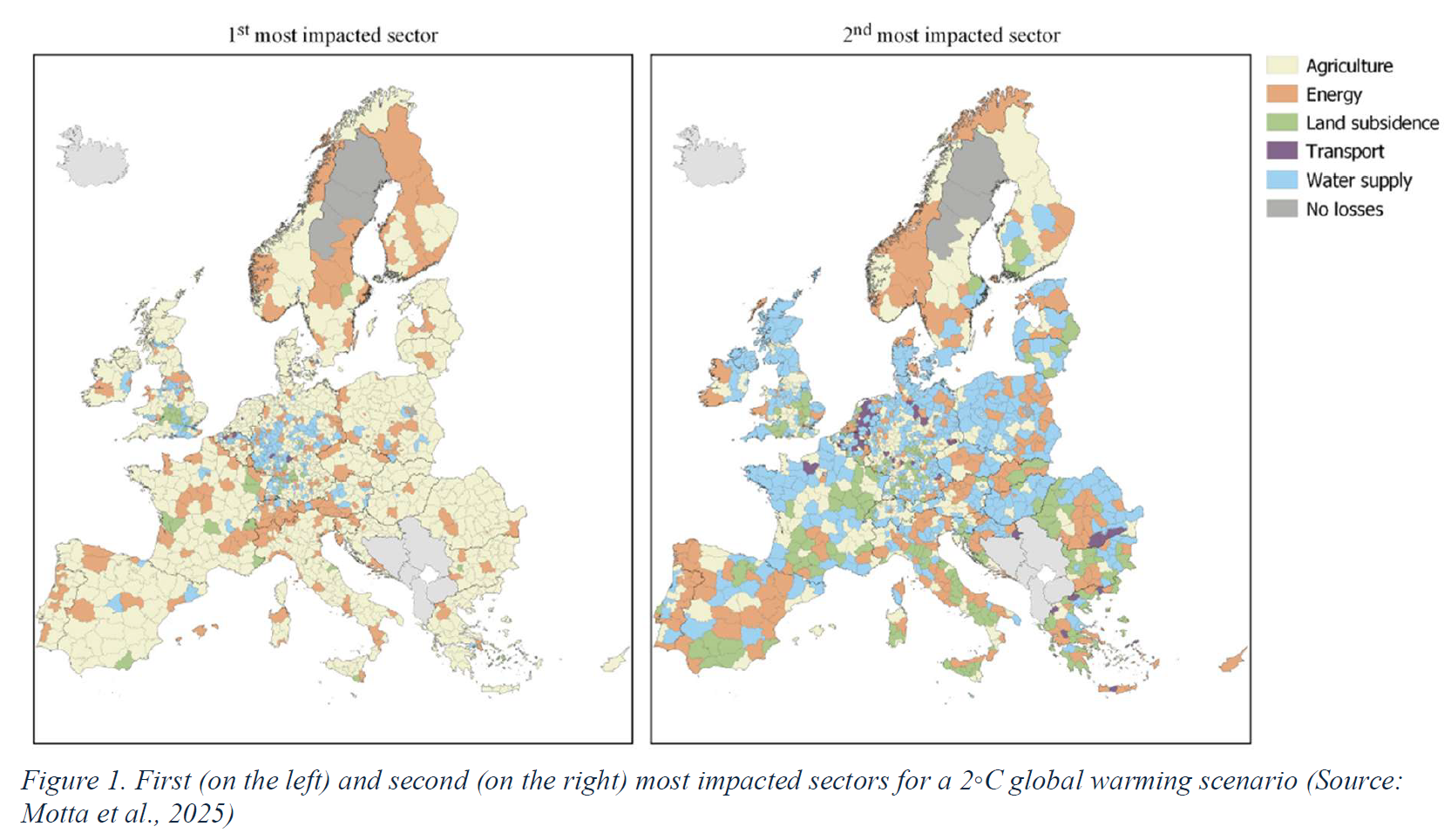
In Italy, the 2022 Po crisis alone damaged 40% of agricultural production and cost €6 billion (Giuffrida, 2023). As a matter of fact, the regions hit hardest, Emilia Romagna and Veneto, are among the nation's most productive, revealing that even highly developed agricultural regions lack resilience to extended drought.
The problem intensifies southward: Sicily, Calabria and Apulia face economic compounding stress as less rainfall, ageing water infrastructure, and lower investment in modernisation create a vicious cycle. Climate-induced yield declines threaten not only crop quantities and prices but also the availability of traditional Mediterranean diet products, linking water scarcity to cultural and nutritional dimensions of Italian life (Coldiretti, 2023).
In 2022, hydroelectric power, which historically secured Italy's renewable energy portfolio, collapsed from 45 TWh to 30 TWh, the lowest contribution in decades (Barbella, 2023). While GSE’s 2023 report outlined a temporary recovery (+43%), the 2024 Italian National Energy and Climate Plan projected a -36.3% contraction due to renewed drought (INECP, 2024). The cascading effects matter as much as direct impacts, thus drought-stressed water-dependent sectors compensate by intensifying energy consumption for filtration, irrigation, and purification. Recent analysis by Fasolino et al. (2025) documents how this secondary effect drives energy costs upward for all water users. In 2022, the resulting price spike for energy-intensive water management was “dramatic”, according to researchers. The crisis spreads from one sector to another, revealing the hidden interdependencies in modern economies.
Beyond agriculture and energy, drought's health impacts complicate the picture. The 2022 crisis degraded water treatment efficacy. Treatment plants struggled to function as fluvial levels dropped, allowing dangerous pathogens, such as salmonella, and faecal coliform, to concentrate in supply systems (Levantesi, 2022). Moreover, heat-related mortality, correlated with drought and heat waves, is a constant threat. In 2022, Italy recorded 295 deaths per million inhabitants, well above the European average (SkyTG24, 2023), and by 2023, excess mortality from heat waves in central and southern Italy had increased by 9% (ANSA, 2023).
Climate-related mental health effects in Italy include higher mortality amongst individuals with pre-existing mental health conditions, increased suicide risk, PTSD, and depression (Massazza et al., 2022). Farmers, a directly impacted social category, facing alternating droughts and floods in regions like Emilia Romagna report high levels of anxiety, burnout, and stress (Crosby Medlicott, 2023). Overall, vulnerable populations, including elderly people, children, low-income households, bear disproportionate indirect burdens (De La Feld, 2024) when drought prolonged periods hit.
The UN's framework recognises these issues, emphasising that water scarcity based on specific geographical and socio-economic factors, including infrastructural differences and internal disparities requires targeted long-term approaches (FAO, 2012; UN-Water, 2019). However, Italy's emergency framework, by design, centralises rather than distributes authority, act in the immediate more than create basis for prevention, highlighting the gap between global water governance and national response.
The Preventive and Cooperative Global Frameworks Guidelines
Global frameworks, developed by the UN, OECD, and the European Union, converge on several key principles, though the main one is: climate governance must move from reactive, short-term crisis management, to proactive, long-term adaptation.
The UN framework, articulated through UN-Water, calls for moving away from reactive and sector-related mechanisms towards a cohesive and proactive water management, based on long-term mitigation and adaptation solutions (UN-Water, 2019). Additionally, the UNCCD's primary recommendation is to adopt a proactive perspective to deal with vulnerability before a possible crisis intensifies (UNCCD, 2019). Both are about building systems that prevent from escalation into emergencies.
To achieve this institutional coordination across sectors and levels is crucial. The OECD emphasises cooperation between institutions for addressing increasing drought risk and recommends mechanisms to achieve multilateral policy agreements between stakeholders (OECD, 2025). Furthermore, related policy areas, including energy prices, trade agreements, agricultural subsidies, poverty reduction strategies, must be monitored for their impact on water availability (FAO, 2012).
Equity needs to be the design principle, FAO's guidance is explicit: substantial regulations must protect equity and shared benefits within society, and policies should account for internal disparities and ensure that burdens are distributed fairly (FAO, 2012). In other words, when some regions face permanent water stress while others face temporary drought, immediate one-size-fits-all crisis management fails.
Lastly, multilevel cooperation and data exchange are a priority. To achieve a stable policy programme, trans-national and multi-stakeholder collaboration is essential. In addition, also transparent data sharing and coordinated planning across administrative levels are crucial (UN-Water, 2019).
In alignment with the UN and OECD frameworks, the European Union developed the Water Framework Directive (2000), which calls member states to address drought through river basin authorities that manage water resources while generating shared economic benefits. Furthermore, the newly adopted European Water Resilience Strategy prioritises water demand reduction, social empowerment through inclusive governance and education, and real-time monitoring through observatories like the European Drought Observatory (European Commission, 2025) as preventive guidelines for future resilience.
The Italian Institutional Gap
Italy's Law 68/2023 prioritises crisis management and centralised commissioner authority. Although it creates monitoring mechanisms and acknowledges infrastructure development, the decisional architecture is top-down and emergency-focused. The primary operational logic remains crisis management rather than proactive, integrated adaptation. In this sense, the lack of alignment with supranational frameworks is not due to a lack of will, but rather to a fundamental flaw in institutional design: the law was built to manage crises, not to prevent them. New specialised and coordinated bodies can help emergency responses and infrastructure decisions, though they are incapable of taking into account regional differentiation, sectoral integration, and multilevel cooperation, which are elements that global frameworks identify as crucial.
The fundamental question is therefore not whether Italy's current approach is imperfect, but whether it is fundamentally misaligned with the nature of the challenge itself. Italy's regional disparities, sectoral interdependencies, and increasing health and social problems all point in the same direction: emergency response alone will not solve structural water scarcity.
For this reason, Italy must treat Law 68/2023 not as the solution, but as a foundation, and its emergency mechanisms should be maintained, but they must be complemented by institutions designed for long-term adaptation. This requires strengthening regional and local authority in water planning as starting points to differentiate adaptive management, not subordinate to central emergency decisions, but equal partners in governance. Furthermore, integration of water policy with energy, agriculture, health, and poverty reduction strategies region by region, is necessary to recognise that water scarcity cannot be managed in isolation. It requires transparent, real-time data systems, like those the EU's monitoring infrastructure supports, to enable coordinated planning across administrative levels and time horizons.
Conclusion
This institutional limitation reveals a deeper question: can short-term, centralised crisis management ever produce the long-term, differentiated adaptation that climate governance demands? The answer is no. Emergency frameworks, by definition, flatten regional variation and prioritise speed over sustainability.
Italy is one example of what all countries in Southern Europe are facing, and how the gap between what global frameworks recommend and what national governments implement is widening. This void exists due to institutional structures designed for short-term crisis management, which cannot be retrofitted for long-term climate adaptation.
If Italy can bridge this gap, translating global guidance into national solutions that are genuinely proactive, integrated, and regionally attuned, it might offer a model for water-stressed regions facing similar choices. If it does not, the crisis will deepen, and the inequalities it reveals will become defining features of the next decade. The choice is not between different crisis management strategies; it is between accepting climate change as a manageable emergency or recognising it as a permanent condition that demands permanent institutional innovation.
Bibliography
(B-1) ANSA (2023, August 16). Eccesso di mortalità da ondate di calore, +9% al Centro-sud. https://www.ansa.it/canale_saluteebenessere/notizie/sanita/2023/08/16/eccesso-di-mortalita-da-ondate-di-calore-9-al-centro-sud-2_8cd626a3-ca12-4cee-be0b-2086824ddfe1.html
(B-1) Barbabella A. (2023, March 16). La siccità spegne le centrali, idroelettrico al minimo storico. Huffingpost https://www.huffingtonpost.it/dossier/terra/2023/03/16/news/la_siccita_spegne_le_centrali_idroelettrico_al_minimo_storico-11587188/?ref=HHTP-BH-I11577208-P13-S1-T1
(A-1) Braca G., Mariani S., Lastoria B., Piva F., Arch F., Botto A., Casaioli M., Forte T., Marchetti G., Peruzzi C., Tropeano R., Vendetti C., Bussettini M. (2023). Bilancio idrologico nazionale: focus su siccità e disponibilità naturale della risorsa idrica rinnovabile.
(A-1) Catini F., De Corso S., Lotti A., Braca G., Bussettini M., Lastoria B., Mariani S., Maschio G., Pace E., Paris P., Piva F. (2024). Acqua tra risorsa e pericolo. https://sinacloud.isprambiente.it/portal/apps/storymaps/stories/7dccdae135854c99890ad09309f229fb
(B-2) Coldiretti (2023, December 28). Clima: dagli eventi estremi 6 miliardi di danni all’agricoltura nel 2023. https://www.coldiretti.it/economia/clima-dagli-eventi-estremi-6-mld-di-danni-allagricoltura-nel-2023
(B-1) Crosby Medlicott L. (2023, November 17). Floods, droughts, and panic attacks: Climate change is taking its toll on Europe’s farmers. Euronews https://www.euronews.com/2023/11/18/floods-droughts-and-panic-attacks-climate-change-is-taking-its-toll-on-europes-farmers
(B-1) De La Feld S. (2024, May 16). Droughts, floods, and poor water quality. 30 percent of southern Europe already under permanent water stress. Eunews https://www.eunews.it/en/2024/05/16/droughts-floods-and-poor-water-quality-30-percent-of-southern-europe-already-under-permanent-water-stress/
(A-1) European Commission (2025, June 4) Communication from the Commission to the European Parliament, the Council, the European Economic and Social Committee and the Committee of the Regions: European Water Resilience Strategy. https://eur-lex.europa.eu/legal-content/EN/TXT/?uri=CELEX%3A52025DC0280&qid=1750857768458
(A-1) European Commission (2000, December 22). Directive 2000/60/EC of the European Parliament and of the Council of 23 October 2000 establishing a framework for Community action in the field of water policy.
(A-1) FAO (2012). Coping with water scarcity. An action framework for agriculture and food security. FAO Water Reports 38.
(A-2) Fasolino N.G., Pellegrini E., Raggi M., Viaggi D. (2025). Dynamics in action: Exploring economic impacts of drought through a systemic approach. Journal of Environmental Management 380 125111. Doi: https://doi.org/10.1016/j.jenvman.2025.125111
(B-1) Giuffrida A. (2023, February 17). Italy faces another year of severe drought after little winter rain or snow. The Guardian
(A-2) Greenpeace (2024). Sud a secco: il bilancio estivo sulla siccità italiana.
(A-1) GSE – Ufficio Statistico e Monitoraggio Target (2025). Energia da fonti rinnovabili in Italia nel 2023. https://www.gse.it/documenti_site/Documenti%20GSE/Rapporti%20statistici/Rapporto%20Statistico%20GSE%20-%20Energia%20da%20FER%20in%20Italia%20-%20anno%202023.pdf
(A-1) ISTAT (2024). Well-being and Inequalities in Italy. https://www.istat.it/wp-content/uploads/2024/11/Well-being-and-inequalities.pdf
(A-1) King-Okumu, C. (2019). Drought Impact and Vulnerability Assessment. A Rapid Review of Practices and Policy Recommendations. D.Tsegai (UNCCD), F. Pischke (GWP), R. Steafanski (WMO), M. Salman (FAO) (Eds.).
(B-1) Levantesi S. (2022, July 14). Italy must prepare for a future of chronic drought. Nature. https://www.nature.com/articles/d43978-022-00089-y
(A-1) Massazza A., Ardino V., Fioravanzo R.E. (2022). Climate change, trauma and mental health in Italy: a scoping review. European Journal of Psychotraumatology, Vol.13, 2046374. Doi: https://doi.org/10.1080/20008198.2022.2046374
(A-1) Ministry of the Environment and Energetic Security. (2024). Siccità. https://www.mase.gov.it/portale/siccit%C3%A0
(A-1) Motta C., Naumann G., Gomez D., Formetta G., Feyen L. (2025) Assessing the economic impact of droughts in Europe in a changing climate: A multi-sectoral analysis at regional scale. Journal of Hydrology: Regional Studies 59 102296. Doi: https://doi.org/10.1016/j.ejrh.2025.102296
(A-1) OECD (2025). Global Drought Outlook. Trends, Impacts, and Policies to Adapt to a Drier World. https://www.oecd.org/content/dam/oecd/en/publications/reports/2025/06/global-drought-outlook_28488e98/d492583a-en.pdf
(A-1) Permanent Observatory on Water Use in the Po Basin and River. (2022). Bulletin No.02/2022.
(B-1) SkyTG24 (2023, July 10). In Europa 61mila morti per l’ondata di caldo 2022, in Italia il tasso più alto. https://tg24.sky.it/salute-e-benessere/2023/07/10/morti-per-il-caldo#:~:text=Lo%20Stivale%20%C3%A8%20stato%20anche%20il%20Paese,europea%20stimata%20in%20114%20decessi%20per%20milione.
(A-1) UN-Water (2019) Climate Change and Water. UN-Water Policy Brief (2019). https://www.unwater.org/sites/default/files/app/uploads/2019/10/UN_Water_PolicyBrief_ClimateChange_Water.pdf
Content Information
1 Confirmed | Confirmed by other independent sources; logical in itself; coherent with other information on the topic. |
2 Presumably true | Not confirmed; logical in itself; coherent with other information on the topic. |
3 Maybe true | Not confirmed; reasonably logical in itself; coherent with some other information on the topic |
4 Uncertain | Not confirmed; possible but not logical in itself; no other information on the topic |
5 Improbable | Not confirmed; not logical in itself; contradicts with other information on the topic |
6 Not able to be evaluated | No basis to evaluate the validity of the information |
Trustworthiness of the source
A Trustworthy | No doubt about authenticity, reliability or competence; has a history of total trustworthiness. |
B Normally trustworthy | Small doubts about authenticity, reliability or competence, nevertheless has a history of valid information in a majority of cases. |
C Sufficiently trustworthy | Doubts about authenticity, reliability or competence; however, has supplied valid information in the past. |
D Normally not trustworthy | Significant doubt about authenticity, reliability or competence, however has supplied valid information in the past. |
E Not trustworthy | Lack of authenticity, reliability or competence; history of invalid information. |
F Not able to be evaluated | No basis to evaluate the validity of the information. |