
Authors
Simona Chiesa - Senior Researcher Mondo Internazionale G.E.O. Cultura & Società
Rosa Santa Serravalle - Senior Researcher Mondo Internazionale G.E.O. Cultura & Società
Abstract
This article examines the persistence of Colombia’s armed conflict through the lens of illicit economic drivers, with particular attention to the evolution of narcotrafficking. By tracing the historical trajectory from the marijuana boom to the consolidation of the cocaine economy, it explores how drug trafficking has exploited structural state fragility to evolve into a parallel system of governance. While narcotrafficking represents one of the most significant and enduring challenges confronting the Colombian state, the article emphasizes that the causes of conflict are multiple and cannot be reduced to economic factors alone. Drawing on Greed and Grievance theories, the study highlights how commodity price shocks and the availability of “lootable” resources shape incentives for violence, while also examining the role of political corruption and the natural resource curse in exacerbating institutional weakness and social fragmentation. Ultimately, the article argues that militarized responses such as Plan Colombia have failed to dismantle the underlying economic foundations of the conflict, underscoring the need for a shift toward inclusive development strategies and a deeper understanding of the adaptive nature of illicit markets.
Key words: Narcotrafficking, Economic Development, Corruption, Guerilla, Socio-Political Crisis, Illegal Market.
Introduction
Narcotrafficking has long been a defining feature of Latin America, particularly in the Andean Region, where the large-scale production and illicit trade of drugs have evolved into a deeply entrenched economic activity. While psychoactive substances circulated widely in everyday life during the 1960s and 1970s, it was in the 1980s that the drug economy experienced an unprecedented expansion, profoundly reshaping political, economic, and institutional dynamics across the region (UNODC, 1998). Colombia, in particular, emerged as a central node within global drug markets, becoming internationally stigmatized as a so-called narco-state, a label that reflects both the scale of illicit activity and its penetration into formal structures of governance (Villanueva, 2020).
The historical trajectory of narcotrafficking in Colombia cannot be understood without reference to the structural weakness of the state. For decades, the Colombian government has struggled to exert effective authority over its entire national territory, a condition that has generated chronic instability and facilitated the emergence of alternative centers of power. In peripheral and rural areas, where state presence has been limited or entirely absent, armed actors have repeatedly filled the resulting governance vacuum, consolidating control over local populations and resources. These conditions have enabled drug-trafficking networks and insurgent groups to flourish, accumulate economic power, and embed themselves within political and economic institutions, thereby further eroding state capacity (Ibid.).
The entanglement between illicit economies and armed violence has produced far-reaching consequences for Colombia’s development. Drug trafficking has not only financed armed groups but has also distorted patterns of economic growth, contributing to widespread corruption, the weakening of the judicial system, and the normalization of impunity. The vast financial resources generated by the drug trade have facilitated its diffusion into multiple spheres of social life, including popular culture, media structures, electoral processes, and party politics, reshaping the distribution of power both locally and nationally. As a result, narcotrafficking has functioned not merely as a criminal enterprise, but as a parallel economic system capable of influencing state institutions and development trajectories (Melo, 1998).
Public and media discourses, often driven by sensationalism or security-centered narratives, have tended to obscure these underlying dynamics. By focusing on episodic violence or high-profile criminal figures, such representations frequently fail to capture the structural and economic foundations of the drug trade, as well as the complex interactions between illegal markets, armed actors, and state institutions. This reductionist framing limits a deeper understanding of why armed violence persists despite decades of counter-narcotics and security interventions (Ibid.).
Narcotrafficking thus constitutes one of the most significant and enduring challenges confronting the Colombian state. Its repercussions extend well beyond security concerns, affecting public health, environmental sustainability, arms trafficking, forced displacement, and, crucially, state legitimacy. In areas where governmental authority remains weak or absent, armed groups often assume functions typically associated with the state, including the provision of employment, protection, and basic services. Over time, this dynamic reshapes local forms of accountability, as communities come to perceive these non-state actors, rather than public institutions, as the primary sources of order and survival (Villanueva, 2020).
The persistence of such arrangements has not only undermined Colombia’s internal stability but has also damaged its international reputation, constraining its ability to attract foreign investment and fully integrate into global markets. Within this context, addressing the economic foundations of narcotrafficking and armed violence emerges as a prerequisite for any sustainable peace or development strategy.
This article therefore examines how Colombia’s economic growth has been conditioned, distorted, and, at times, paradoxically fueled by illicit economies, situating the Colombian case within the broader global political economy of narcotrafficking.
Historical Context: Illicit Economies, State Fragility, and Political Conflict in Colombia
The evolution of Colombia’s illicit drug economy unfolded through a series of distinct yet interconnected phases, each embedded within specific political, institutional, and social configurations. The first phase, commonly referred to as the marijuana bonanza, emerged in the early 1960s with small-scale cultivation oriented primarily toward the United States market. By the late 1960s and 1970s, marijuana exports had become a significant (though still informal) source of foreign currency in an economy frequently affected by balance-of-payments constraints (Melo, 1998). Despite the formal illegality of drug consumption and trade, enforcement remained weak, and early traffickers were rarely stigmatized. In coastal regions in particular, individuals who accumulated wealth through marijuana trafficking were often perceived as socially mobile outsiders who had succeeded beyond the confines of traditional elite structures. Violence existed but was largely contained within trafficking organizations and did not yet constitute a generalized threat to state authority (Quijano Millán, 2013; Lemus, 2014).
This initial phase gradually overlapped with the emergence of cocaine trafficking in the mid-1970s. Drawing on logistical experience and transnational connections developed during the marijuana trade, Colombian traffickers began refining and exporting cocaine between 1973 and 1975. Coca paste was imported primarily from Peru and Bolivia, chemical precursors from Europe and the United States, and finished cocaine from the U.S. market, initially via air routes. Over time, processing facilities shifted from urban centers to rural and jungle areas, reinforcing the spatial displacement of illicit activities into regions characterized by weak state presence. Although large revenues initially entered the domestic economy, an increasing share of profits was retained abroad or laundered through international financial centers (Quijano Millán, 2013).
The cocaine economy rapidly assumed an oligopolistic structure. While hundreds of smaller actors participated in cultivation and processing, access to international distribution networks (particularly in the United States) was controlled by a limited number of large organizations. These groups coordinated export routes, regulated competition, and enforced compliance through violence, most visibly under figures such as Pablo Escobar. At this stage, however, corruption rather than open confrontation remained the primary mechanism through which traffickers secured state tolerance. Thousands of officials within the security forces, judiciary, and political system benefited from bribery, allowing the drug economy to expand largely unchecked (Angrist et al., 2007; Quijano Millán, 2013).
Between 1974 and 1978, major trafficking organizations consolidated in Medellín, Cali, Valle del Cauca, the Caribbean coast, the Eastern Plains, and southern Colombia. Successive governments underestimated the political and institutional implications of this expansion. Under Presidents Alfonso López Michelsen and Julio César Turbay Ayala, state responses oscillated between ambivalence and selective repression. Although anti-marijuana campaigns were launched and an extradition treaty with the United States was signed in 1979, enforcement remained inconsistent, and mechanisms facilitating dollar laundering persisted. By 1982, drug trafficking had reached its first major peak, generating an estimated 10 to 25 per cent of Colombia’s total export earnings. Concentrated illicit wealth fueled conspicuous consumption, reshaped urban real estate markets and rural landownership patterns, and generated widespread economic dependency across service sectors. Public fascination, social complicity, and sporadic violence coexisted within a context of limited institutional resistance (Quijano Millán, 2013; World Report, 2011).
From the late 1970s onward, coca cultivation expanded within Colombia itself, particularly in frontier regions such as Caquetá, Putumayo, and the Eastern Plains. While domestic production never fully replaced imported coca paste, it stabilized supply chains and deepened traffickers’ territorial and social embeddedness. State eradication efforts, including aerial spraying with glyphosate, proved largely ineffective, as cultivation continued to expand amid contradictory official estimates and limited administrative capacity (Dube and Vargas, 2013).
The escalation of drug trafficking unfolded within a political system already marked by structural fragility. Since 1958, Colombia had functioned as a constrained democracy shaped by the National Front agreement, a consociational elite pact designed to end La Violencia (1946–1958) through power-sharing between Liberal and Conservative parties (Hartlyn, 1993). While initially effective in stabilizing elite competition, the National Front gradually entrenched exclusion, factionalism, and clientelism. Rapid urbanization, industrialization, demographic change, and expanding access to education between the 1960s and 1980s eroded traditional partisan identities and exposed the inability of established parties to channel emerging social demands (Quijano, 2013).
Despite improvements in technical and economic governance, the state’s territorial reach remained uneven, particularly in peripheral regions where illicit economies flourished. Weak judicial institutions, limited administrative capacity, and widespread corruption reduced the effectiveness of law enforcement and facilitated the penetration of criminal capital into political and social life. These structural weaknesses predated the rise of the cocaine economy but were dramatically intensified by it, as drug revenues exacerbated existing patterns of institutional decay and political exclusion (Hartlyn, 1993; World Report, 2011).
Conflict Actors
Colombia’s protracted armed conflict cannot be attributed to a single cause or actor but instead reflects the interaction of multiple armed groups operating within a fragmented political and economic landscape. Guerrilla organizations such as the FARC and the ELN, which emerged in the early 1960s, initially mobilized around grievances related to political exclusion, land inequality, and state repression. Over time, however, their strategies and sources of financing evolved, increasingly incorporating economic practices such as kidnapping, extortion, and participation in the drug trade (Hartlyn, 1993).
Paramilitary groups, originally formed as self-defense organizations linked to landowners and later supported by sectors of the state, likewise became deeply embedded in illicit economies. Both guerrillas and paramilitaries appropriated resources through drug trafficking, illegal taxation, and predation on public funds, particularly in regions rich in natural resources or strategic corridors for narcotics production and transport. These dynamics blurred the distinction between political and criminal violence, as armed actors combined ideological narratives with economic incentives (Dube and Vargas, 2013; Ballentine et al., 2005).
The availability of drug revenues transformed the balance of power between armed groups and the state. Cocaine profits enabled non-state actors to recruit combatants, acquire weapons, and sustain prolonged military campaigns, while simultaneously corrupting local authorities and undermining civilian governance. As a result, violence increasingly reflected struggles over territorial control and economic rents rather than purely ideological confrontation (Collier and Hoeffler, 2004; Quijano Millán, 2013).
Plan Colombia and the Evolution of State and International Drug Governance
By the late 1990s, the convergence of armed conflict, drug trafficking, and state fragility prompted a shift toward more militarized and internationally coordinated responses. Plan Colombia, launched in 1999 with substantial support from the United States, marked a turning point in the governance of drugs and security. Framed as a comprehensive strategy to combat narcotrafficking, insurgency, and institutional weakness, the plan emphasized military assistance, aerial eradication, and security sector reform (Collins, Alarcón, 2021).
While Plan Colombia contributed to improvements in state capacity and the weakening of some armed groups, it also reinforced the centrality of coercive approaches to drug control. The persistence of coca cultivation, displacement of violence across regions, and adaptation of trafficking networks highlighted the limits of supply-side strategies. Moreover, the emphasis on security often overshadowed structural issues such as rural inequality, political exclusion, and uneven development that had long sustained both illicit economies and armed conflict (Dube and Vargas, 2013; Ballentine et al., 2005).
International drug governance thus evolved in tandem with Colombia’s internal conflict, shaping and being shaped by domestic political dynamics. Rather than resolving the underlying causes of violence, these interventions became embedded within a longer historical trajectory characterized by contested state authority, fragmented sovereignty, and the enduring entanglement of political conflict and illicit economies (Collins, Alarcón, 2021).
Understanding the causes of conflict in Colombia: the socio-political and economic drivers of illegal narcotrafficking
“If it weren’t for the armed groups, I think we could reach a consensus on what the region needs to progress. But all the armed groups want is to control the economic question, and all are willing to massacre or murder or force people from their homes to win.”
Gloria Cuartas, major of Apartadó (quoted in Angrist et al. 2007).
Colombia has suffered a violent conflict for more than 50 years. Some authors argue that the conflict began with “La Violencia”, a civil war between the two most important political parties in the 1950s (Quijano, 2013). In the early 1960s two guerrilla organizations emerged, known as the Revolutionary Armed Forces of Colombia (FARC) and the National Liberation Army (ELN), both based on communist ideas (Lemus, 2014).
Weak institutions make a country vulnerable to violence. One hypothesis is that these systems have difficulty in adapting to change because agreements are personal and need to be renegotiated when leaders die or lose power, or when new internal and external pressures force a change in the division of economic or political benefits (World Report, 2011).
To explain the reasons of the outbreak’s civil war, its consequences and how to prevent/resolve them, economists draw on economic theory and econometric tools as support to explain the reasons and their models. They assume that agents act rationally to maximise their own utility (Swee, 2016). In situations of conflict, actors such as governments and rebel groups make their decisions based on the actions of the other parties involved. Economic conditions, including widespread poverty or sudden increases in national wealth, can shape these incentives and encourage rival groups to resort to armed confrontation. Hirshleifer (1988) explained this concept through his contest model in which competing groups allocate labour endowments between production and combat. Combat helps the group attain a fixed payoff that is conditional on victory. The model thus predicts that lower productivity (poverty) or a bigger reward (e.g. natural resources and foreign aid) makes combat more attractive (Swee, 2016). As will be explained in the next section, the former reflects an opportunity cost effect, which potentially differs across groups, while the latter reflects a prize effect, which is uniform across groups.
As noted by Collier and Hoeffler (2004), civil wars start when rebel groups see economic opportunities to fight. These opportunities involve three things: financing, recruiting and geography. Their analysis uses the share of primary commodity exports in a country’s GDP to measure how dependent it is on natural resources. Natural resources are the main way rebels get money. This lies at the heart of their famous greedy rebel mechanism. In this view, greed means having the economic chance to start war, not having social or political grievances. However, as will be analysed below, there is no empirical evidence showing the validity of such interpretation (Murshed et al.).
Economic, political, and security factors can all exacerbate the risks of violence. Some of these factors are domestic, such as low incomes, high (youth) unemployment, and inequality of different sorts. Many factors may originate outside the state, such as external economic shocks or the infiltration of international drug cartels or foreign fighters (World Report, 2011). Economic factors play a major role in driving conflict. Limited economic opportunities, abundant natural resources, widespread corruption, and rapid urbanization all contribute to conditions in which violence can emerge and persist. Findings from Dube and Vargas (2006) show, for example, that a fall in coffee prices induces farmers to switch from coffee into coca production, and violence increases as illegal groups fight to control rents from the drug trade.
Drug trafficking produces vast profits that allow criminal groups to infiltrate institutions and shape political and social systems, even in otherwise strong states. Those who suffer the greatest burden are usually the urban poor, who are the most vulnerable to recruitment and who live in neighbourhoods severely impacted by criminal violence. With their substantial financial resources, drug cartels have more power than the governments attempting to fight them. Indeed, in many countries, these organizations hold considerable influence over local authorities and, in some cases such as in Colombia, even national decision-making.
The cocaine violence turned into war amongst small criminal organisations over the profits of the illegal drugs. It is straight forward to claim that cocaine markets are part of the causes of the violence in Colombia. Violence rises when the price of cocaine in the market being supplied increases (Quijano Millan, 2013).
A central feature of the Colombian conflict is that the armed groups appropriate resources through several avenues. Both the paramilitaries and guerrillas are financed by the cocaine trade, as well as kidnapping, extortion, and predation on public funds. Qualitative evidence suggests that predation is particularly high in regions with natural resources (Dube and Vargas, 2013).
Overall, conflicts harm economic development. They affect economic productivity by devastating cities and infrastructures, interrupting economic activities, deterring investment, and curtailing government spending.
How conflict constrains a country’s economic development: Greed and Grievance economic theories
Every society experiences pressure and instability, but only some fall into cycles of repeated violence.
Considering the theory presented and supported by Le et al. (2022) there is a negative statistical association between natural wealth and per capita economic growth in resource-rich countries. They argued that countries with abundant natural resources tend to grow more slowly than resource-poor countries.
Natural resources make conflict more likely unless a country has very large resource wealth. This led researchers to introduce the concept of natural-resource curse. On the one hand, a rise in income may reduce conflict by increasing wages and reducing labour supplied to criminal or conflict activity. This notion, that wages represent the opportunity cost of fighting, is consistent with previous cross-country evidence that growth reduces the risk of civil war. On the other hand, more income means there is more to fight over (Collier and Hoeffler,1998 and 2004).
Collier and Hoeffler’s study “Greed and Grievance in Civil War” (2000) argues that civil wars are often driven more by economic opportunities than by political or social grievances. Their most influential finding is that countries highly dependent on natural resource exports tend to face a higher risk of conflict, though this may reflect broader problems of underdevelopment rather than resources alone. They show that wars last longer where governments are weak, corruption is high, and institutions allow armed groups to access resources with little cost. Later analyses suggest that the link between resources and conflict may reflect low development, low state capacity, and poor socioeconomic conditions, all of which increase the chances that wars will start and persist.
The greed perspective views conflict as driven by the desire to improve one’s own economic situation through access to material wealth or valuable resources. This motivation is often reinforced by factors such as economic inequality, corruption, and historical grievances. According to Dube and Vargas (2013), the primary cause of violence in this framework is the pursuit of material wealth, power, or control over resources.
Through their studies, Collier and Hoeffler presented the causes of the conflict and the relationship between the economic growth in the developing countries and the civil war.
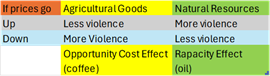
Collier & Hoeffler’s (2004) model
As the chart shows, when prices rise, violence decreases in agricultural areas but increases around natural resources. When prices fall down, the opposite happens. This is due to two mechanisms:
- Opportunity-cost effect (agriculture): Higher prices for crops like coffee give people better legal income, reducing motivation to join armed groups and lowering violence in farming areas.
- Rapacity effect (natural resources): Higher prices for resources like oil make them more profitable for armed groups, increasing violence in regions where these resources are found.
Dube and Vargas (2013) establish that the nature of the resource’s production technology matters for the incentive effect; by studying the effect of commodity price shocks on violence in regions of Colombia, they show that positive price shocks in capital-intensive natural resources like oil and gold cause the expected increase in conflict from the incentive effect, but that positive shocks to labour-intensive resources like coffee actually reduce conflict. The authors propose a labour market driven mechanism in which civilians who might otherwise have become involved with the insurgency have an improved outside option in coffee production.
Building on these findings, other scholars have highlighted how poverty traps and structural weaknesses prevent developing countries from escaping cycles of violence. This dynamic creates a “vicious cycle of poverty,” which Collier and Hoeffler’s model illustrates clearly: whether prices rise or fall, economic harm is produced in one sector or another, ultimately reinforcing instability and hindering sustainable development.
The “greed or grievance” idea has strongly influenced policy debates on the economic causes of civil war. These studies found that countries with high dependence on natural resources (measured by primary commodity exports as a share of GDP) face a higher risk of conflict. While some may participate in war economies to “do well out of war” others may do so out of the sheer need to survive, while still others may be coerced for their labour and land. Furthermore, individual motivations may change over time as conflicts mutate. Conflicts that begin as predominantly grievance based may over time be complemented and, for some, even surpassed by pecuniary motives (Ballentine et al. 2005).
If Collier & Hoffler focused more on Greed’s theory, Murshed et al. explained the grievances theory. In civil wars, grievances are motivations linked to injustice. They often come from group identity: people care about how their group compares to others. Grievance theories are usually divided into relative deprivation, polarization, and horizontal inequality, though the concepts often overlap:
- Relative deprivation: It is the gap between what people think they deserve and what they believe they can achieve. When aspirations rise but opportunities don’t (e.g., educated youth who can’t find jobs), frustration can lead to violence;
- Polarization: Violence is more likely when society splits into two very different groups that are internally similar but very different from each other;
- Horizontal inequality: Large inequalities between groups (ethnic, religious, linguistic, etc.) increase the risk of civil war and sectarian conflict.
Although greed and grievance are regarded as competing views, they may be complementary, as greed may lead to grievances and vice versa. The greed or grievance explanations (or some hybrid form of both) may be necessary for the outbreak of civil war, but arguably they are not sufficient (Murshed et al).
Therefore, Ballentine et al. (2005) offer an alternative perspective on the dynamics of war, suggesting that a productive way to understand how natural resources influence both the onset and duration of armed conflicts is to examine the specific types of resources involved and the ways in which they serve the interests of conflict actors. A central distinction is drawn between lootable and non-lootable resources, each of which tends to be associated with different conflict patterns.
Lootable resources, such as alluvial diamonds, drugs, timber, and coltan, can be extracted and transported with minimal skills and limited organizational capacity. These characteristics make them attractive to small insurgent groups and are commonly linked to non-separatist rebellions, as observed in contexts like Sierra Leone, Colombia, and Afghanistan. Their accessibility often sustains and prolongs violence by enabling armed groups to finance their operations with ease, while simultaneously fostering internal fragmentation and weakening discipline within rebel movements.
In contrast, non-lootable resources (including deep-shaft minerals, kimberlite diamonds, oil, and gas) require substantial capital and technological investment. They are more frequently associated with separatist conflicts. This association is shaped by the fact that local populations typically suffer the environmental and social burdens of extraction and often belong to marginalized ethnic communities, generating deep-seated grievances. At the same time, the profits derived from these resources tend to flow to central governments and foreign enterprises. When such revenues are captured by corrupt elites or distributed inequitably, the resulting economic exclusion can intensify resentment and contribute to the emergence of separatist violence.
Overall, many economists have tried to explain the causes of the outbreak of internal conflict, nevertheless their economic theories present limitations. Indeed, they focus more on natural resources without considering the socio-political perspective. The Colombian case illustrates these points well. Armed groups rely on many sources of funding (such as drugs, extortion, kidnapping, and illegal taxation) , not just on natural resources. This shows that conflicts can emerge and endure even without abundant resource wealth. In Colombia, the guerrillas originally took up arms as a response to political and socioeconomic exclusion, but their motivations, as well as those of the paramilitaries, became more ambiguous over time, mixing political aims with economic interests.
Conclusion
This article has argued that the persistence of Colombia’s armed conflict cannot be understood solely through the lens of ideological confrontation or institutional failure, but must be situated within the long-term entanglement between illicit economies, state fragility, and political violence.
From the early marijuana boom to the consolidation of the cocaine economy, drug trafficking progressively reshaped Colombia’s political economy by embedding armed actors within transnational markets, reinforcing territorial fragmentation, and generating durable incentives for violence in regions historically marked by weak state presence. Rather than constituting an external shock, the illicit drug economy became structurally integrated into local governance arrangements, conflict dynamics, and patterns of social and economic dependency (Méndez, 2012; Franz, 2016; Suárez & Santos, 2018).
The Colombian case illustrates how armed violence endured not simply because illicit resources financed insurgency and counterinsurgency, but because the drug economy altered the strategic environment in which multiple actors (guerrillas, paramilitaries, criminal organizations, and segments of the state) operated. Control over territory, populations, and trafficking corridors transformed violence into a regulatory mechanism within what has been described as a fragmented war system, in which no single actor could impose a stable monopoly of force (Richani, 2020).
In this context, counter-narcotics and counter-insurgency policies often reinforced existing asymmetries, displacing rather than dismantling illicit production and perpetuating cycles of militarization and adaptation (Crandall, 2008; Rosen, 2014).
The economic theories of greed and grievance provide valuable insights into these dynamics, particularly in highlighting how access to resources, opportunity costs, and economic shocks shape incentives for armed mobilization. However, the Colombian experience exposes the limitations of approaches that treat natural resources as static endowments or focus primarily on conflict onset. Illicit markets such as cocaine differ fundamentally from many legal commodities: they are transnational, highly adaptable, and embedded in clandestine financial and logistical networks that outlast individual armed groups. International actors have played a central, even if ambivalent, role in this process. From early cooperation within the global drug control regime to the militarized turn embodied in Plan Colombia, external interventions contributed to strengthening certain state capacities while simultaneously reinforcing the securitization of drug policy and the conflation of counter-narcotics with counter-insurgency objectives. Although these strategies succeeded in dismantling major cartels and reasserting state authority in selected areas, they did not fundamentally disrupt the economic foundations of armed violence. Instead, illicit production and trafficking adapted geographically and organizationally, underscoring the limits of enforcement-centered approaches in the absence of sustained state-building and inclusive development in peripheral regions (Guáqueta, 2005; Tickner, 2007; GAO, 2008).
Taken together, these findings suggest that narcotrafficking should be understood neither as a purely exogenous obstacle to development nor as a straightforward engine of economic growth, but as an ambivalent force that has profoundly shaped Colombia’s political economy. Illicit drug markets have generated income, employment, and forms of local order in marginalized areas, while simultaneously deepening inequality, institutional corruption, and exposure to violence. This dual character helps explain both the resilience of war economies and the difficulties of consolidating peace in the aftermath of formal conflict resolution (Britto, 2020; Borda, 2016; Zorro-Sánchez, 2017).
Future research should therefore focus on the post–peace agreement reconfiguration of illicit economies, including the fragmentation of armed groups, the emergence of new criminal actors, and the diversification of illegal markets beyond cocaine. Particular attention should be paid to the growing relevance of synthetic drugs, evolving trafficking routes, and the role of global financial and regulatory systems in sustaining illicit profits.
Understanding how these transformations intersect with ongoing state-building efforts will be crucial for assessing whether Colombia’s transition can move beyond the structural conditions that have long sustained armed violence (Collins, 2017; UNGA, 2016; Global Commission on Drug Policy, 2014).
References
Angrist, Joshua D.; Kugler, Adriana D. (2007). Rural windfall or a new resource curse? coca, income, and civil conflict in Colombia. IZA Discussion Papers, No. 2790, Institute for the Study of Labor (IZA), Bonn. Retrieved from: https://nbn-resolving.de/urn:nbn:de:101:1-20080401406 -2B
Ballentine, K., & Nitzschke, H. (2005). The Political Economy of Civil War and Conflict Transformation. Retrieved from: https://berghof-foundation.org/files/publications/dialogue3_ballentine_nitzschke.pdf -2B
Blattman C., Miguel E., (2010). Civil War. Journal of Economic Literature, Vol. 48, No. 1, pp. 3-57. Published by American Economic Association. Retrieved from: https://www.jstor.org/stable/40651577 -1B
Borda, S. (2016). Colombia’s Multilateral Drug Policy During the Two Uribe Administrations: Towards Prohibitionist Activism in an Era of Détente. In Gaviria, A and Mejia, D (Eds.), Anti-Drug Policies in Colombia: Successes, Failures, and Wrong Turns, Vanderbilt University Center for Latin American Studies. Nashville: Vanderbilt University Press. DOI: https://doi.org/10.2307/j.ctv167556h.11 -2B
Britto, L. (2020). Marijuana Boom: The Rise and Fall of Colombia’s First Drug Paradise. Univ of California Press. DOI: https://doi.org/10.1525/9780520974265 -2B
Collins, J. Alarcón, K. T. (2021). Colombia, the Drug Wars and the Politics of Drug Policy Displacement - from La Violencia to UNGASS 2016. Journal of Illicit Economies and Development. LSE Press. Volume:3 Issue:2. Page/Article: 190-201. Retrieved from DOI: 10.31389/jied.93 -2A
Collier P., and Hoeffler A. (1998). On Economic Causes of Civil War. Oxford Economic Papers, Oct., 1998, Vol. 50, No. 4 (Oct., 1998), pp. 563-573. Retrieved from: https://www.jstor.org/stable/3488674 -2A
Collier P. and Hoeffler A. (2000). Greed and Grievance in Civil War. Policy Researcher Working Paper 2355. The World Bank Development Research Group. Retrieved from: https://documents1.worldbank.org/curated/en/359271468739530199/pdf/multi-page.pdf - 2A
Collier, P., & Hoeffler, A. (2004). Greed and Grievance in Civil War. Oxford Economic Papers, 56(4), 563–595. Retrieved from: http://www.jstor.org/stable/3488799 -2B
Crandall, R. (2008). The United States and Latin America after the Cold War. New York: Cambridge University Press, Cambridge. Retrieved from: https://scispace.com/pdf/the-united-states-and-latin-america-after-the-cold-war-1kd6786vxi.pdf -2B
Dube O., and Vargas F. J., (2013). Commodity Price Shocks and Civil Conflict: Evidence from Colombia. The Review of Economic Studies , October 2013, Vol. 80, No. 4 (285), pp. 1384-1421. Retrieved from: https://www.jstor.org/stable/43551562 -2B
Dube O., Vargas J., (2006). Resource Curse in Reverse: The coffee crisis and armed conflict in Colombia. Retrieved from: 2006-46 ISSN 1657-7191 -2B
Franco S., Suarez C.M., Naranjo C.B., Baez L.C., Rozo P., (2006). The effects of the armed conflict on the life and health in Colombia. Ciência & Saúde Coletiva, 11(2):349-361. Retrieved from: https://doi.org/10.1590/S1413-81232006000200013 -2C
Franz, T. (2016). Plan Colombia: Illegal drugs, economic development and counterinsurgency – A political economy analysis of Colombia’s failed war. Development Policy Review, 34: 563–591. Retrieved from: DOI: https://doi.org/10.1111/dpr.12161 -2B
GAO (2008). Plan Colombia. Washington, DC: Government Accountability Office.-1A
Guáqueta, A. (2002). Dimensiones políticas y económicas Del Conflicto Armado En Colombia: Anotaciones teóricas y empíricas. Colombia Internacional, no. 55 (May): 19-36. Retrieved from: https://doi.org/10.7440/colombiaint55.2002.01 -2B
Guáqueta, A. 2005. Change and Continuity in U.S.-Colombian Relations and the War against Drugs. Journal of Drug Issues, 35: 27–56. Retrieved from: https://doi.org/10.1177/002204260503500102 -2C
Hartlyn, J. (1993). Drug Trafficking and Democracy in Colombia in the 1980s. ICPS - Institut de Ciències Politiques i Socials. Mallorca, 244. “n. 1a. 08008 Barcelona.Retrieved from: https://www.corteidh.or.cr/tablas/16400.pdf -2A
Hirshleifer, J. (1988). The analytics of continuing conflict. Synthese 76, 201–233 (1988). Retrieved from: https://doi.org/10.1007/BF00869589 -2A
Hirshleifer J., (1991). The Technology of Conflict as an Economy Activity. The American Economic Review, May, 1991, Vol. 81, No. 2, Papers and Proceedings of the Hundred and Third Annual Meeting of the American Economic Association. pp. 130-134. Retrieved from: https://www.jstor.org/stable/2006840 -2A
Kimbrough E.O., Laughren K., Sheremeta R., (2017). War and conflict in economics: Theories, application and recent trends. Journal of Economic Behavior & Organization 178 82020) 998-1013. Retrieved from: https://doi.org/10.1016/j.jebo.2017.07.026 -2C
Kutan A.M. and Mehmet E., Y., (2016). Armed conflict and financial and economic risk: evidence from Colombia. Risk Management, August 2016, Vol. 18, No. 2/3 (August 2016), pp. 159-187. Published by Palgrave Macmillan Journals. Retrieved from: https://www.jstor.org/stable/26624326 -2B
Le, Thai-Ha & Bui, Manh-Tien & Uddin, Gazi Salah, 2022. Economic and social impacts of conflict: A cross-country analysis. Economic Modelling, Elsevier, vol. 115(C). Retrieved from:https://www.researchgate.net/publication/362610666_Economic_and_social_impacts_of_conflict_A_cross-country_analysis -2B
Lemus N., (2014). Conflict-Induced Poverty: Evidence from Colombia. Economics, Universidad del Rosario, Calle 12c No. 4-69, Bogotá, Colombia. PEPS 2014; 20(1): 113–142. Retrieved from: DOI 10.1515/peps-2013-0056 -2A
Melo, J. O. (1998). The Drug Trade, Politics and The Economy: The Colombian Experience. Latin America and the Multinational Drug Trade (pp.63-96). Retrieved from: DOI 10.1007/978-1-349-26047-8_5 2-B
Méndez, Á. (2012). Negotiating intervention by invitation: How the Colombians shaped US participation in the genesis of Plan Colombia. Retrieved from: https://files01.core.ac.uk/download/pdf/9994853.pdf - 2C
Murshed M.S., and Tadjoeddin M.Z., (n.d). Revisiting the Greed and Grievance explanations for violent internal conflict. J.E.L Codes: D72, D74, O10, O40. -2C
Quijano Millan J.A., (2013). Essays on the economics of the Colombian armed conflict and violence. University College of London (UCL). Retrieved from: https://discovery.ucl.ac.uk/id/eprint/1431699/1/1406FullDocument.pdf -3B
Richani, N. (2020). Fragmented Hegemony and the Dismantling of the War System in Colombia. Studies in Conflict and Terrorism, 43: 325–350. Retrieved from: https://doi.org/10.1080/1057610X.2018.1462135 -2B
Rosen, JD. 2014. The losing war: Plan Colombia and beyond, SUNY series, James N. Rosenau series in global politics. Albany, NY: SUNY Press. Retrieved from: https://api.pageplace.de/preview/DT0400.9781438453002_A40625151/preview-9781438453002_A40625151.epub -2C
Suárez, T. Santos, J.M. (2018). The ‘Intermesticity’ of the US-Colombia Anti-Drug Strategy under Plan Colombia. Retrieved from: https://www.regents.ac.uk/sites/default/files/2018-11/rwp1803-su%C3%A1rez-t.pdf -2C
Swee L.E. (2016). Economics of Civil War. The Australian Economic Review, vol. 49, no. 1, pp. 105–11. The University of Melbourne, Melbourne Institute of Applied Economic and Social Research Published by John Wiley & Sons Australia, Ltd. Retrieved from: DOI:10.1111/1467-8462.12141 -2B
Tickner, A. (2007). US foreign policy in Colombia: bizarre side effects of the “War on Drugs”. In Welna, C and Gallón Giraldo, G (Eds.), Peace, Democracy, and Human Rights in Colombia. Notre Dame, Ind: University of Notre Dame Press. Retrieved from: https://doi.org/10.7440/colombiaint65.2007.04 -2C
The Global Commission on Drug Policy (2014). Taking Control: Pathways to Drug Policies That Work. New York City: GCDP.-1A
The World Bank (2011). World Development Report. Conflict, Security and Development. Retrieved from: https://documents1.worldbank.org/curated/en/966731468161352341/pdf/589880PUB0WDR0000public00BOX358355B.pdf -1A
UNGA (1998). Political Declaration 1998 (No. A/RES/S-20/2). New York: United Nations. -1A
UNODC - United Nation Office on Drugs and Crime (1998). ECONOMIC AND SOCIAL CONSEQUENCES OF DRUG ABUSE AND ILLICIT TRAFFICKING. Number 6. Retrieved from: https://www.unodc.org/pdf/technical_series_1998-01-01_1.pdf 1-A
Villanueva, S. (2020). How does Narcotraffic affects Colombia's Politics and Economy. Retrieved from: Academia.edu / https://doi.org/10.13140/RG.2.2.16791.43681- 2B
Zorro-Sánchez, C. (2017). Alternative Development Policies in Colombia (1982–2009). In Gaviria, A and Mejia, D (Eds.), Anti-Drug Policies in Colombia: Successes, Failures, and Wrong Turns, Vanderbilt Center for Latin American Studies Series. Vanderbilt University Press. DOI: https://doi.org/10.2307/j.ctv167556h -2B