
Translated by Irene Cecchi
Russia’s invasion of Ukraine has undoubtedly disrupted the global geopolitical order —particularly in Europe— affecting relations between countries and shaking many of their political and economic certainties.
One of the war’s consequences has been the renewed attention the European Union and its member states have paid to countries that had previously been almost absent from their political discourse and news coverage. These include countries like Azerbaijan and Kazakhstan, to which Europe has turned in an effort to diversify its gas supply, previously almost entirely dependent on Russia.
More broadly, in recent times, the EU seems to be showing increased interest in former Soviet Union members in Central Asia, as demonstrated by the first Central Asia–Brussels summit, held in Samarkand, Uzbekistan, in April of last year. The summit, focused on natural resources, energy and trade, also included the other four countries in the region: Kazakhstan, Tajikistan, Turkmenistan, and Kyrgyzstan.
The war in Ukraine has not only led to increased political and economic interest in these countries but it has also had indirect effects on a phenomenon that seems geographically and conceptually distant: maritime migration routes leading to the southern coast of Italy, particularly Sicily and Calabria. It is fair to ask: how can a war in Eastern Europe affect the journeys of people coming from the Middle East and Africa, who embark on the Turkish coast to reach Italy by crossing the Mediterranean?
As migration experts know well, migration routes constantly change. A few years ago, for example, the Egyptian route or the land-based Balkan route were particularly active. The latter —actually a network of various paths— has gradually lost importance, with fewer people choosing it for several reasons. First, the Balkan route can take years to complete and is dangerous due to natural terrain, often consisting of forests. In addition, the border wall between Serbia and Hungary promoted by Orbán, and the illegal pushbacks by Croatian and Slovenian police, have made the route increasingly difficult.
As for sea routes, in addition to the always-active Libyan route, an alternative has emerged to the central Mediterranean routes: the one from Turkey across the Ionian Sea and through Greece. This route, long used though less covered by the media, is known as the eastern route. Smugglers set off from the Turkish coasts of Izmir or Bodrum, pass through Greek waters —sometimes picking up passengers there— and land on the eastern coasts of Calabria and Sicily.
As highlighted in the report "From Sea to Prison" by Arci Porco Rosso and Borderline Europe (2021), this is "the most consistent maritime entry point for migrants from the Middle East and Central Asia to Italy". The eastern route is known for the presence of smugglers from Eastern Europe, who can easily reach Turkey and captain the boats carrying mostly Syrians, Iraqis and Afghans. Until 2022, the majority of these smugglers were Ukrainian or Russian, with some exceptions from other Eastern European countries such as Moldova, Serbia, and Georgia. These were trained captains with real navigation experience, well-paid by traffickers.
Because of the war in Ukraine, human traffickers organizing these journeys faced an unexpected problem: the shortage of Ukrainian and Russian smugglers, who were either fighting on the front lines or generally unable to leave their countries. Additionally, news has spread in both Ukraine and Russia that anyone arrested for aiding illegal immigration could face several years in prison so fewer people are willing to take that risk.
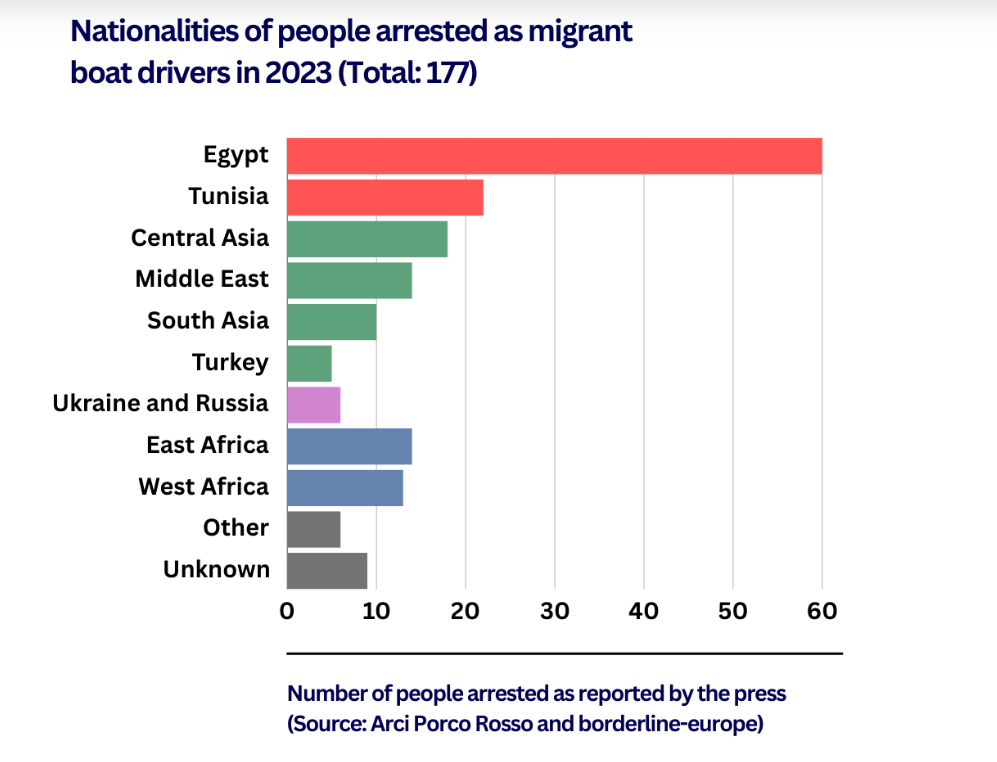
As a result, NGOs and several lawyers have noted that in 2023, there were few arrests of Eastern European smugglers, while arrests of Central Asian smugglers increased significantly. According to the 2023 report by Arci Porco Rosso and Borderline Europe, of 68 smugglers arrested on this route, at least 18 were originally from Kyrgyzstan, Uzbekistan, Kazakhstan, Turkmenistan, Azerbaijan and Tajikistan. Traffickers have begun recruiting smugglers in Central Asia, luring them to Turkey and placing them in charge of the boats, offering them payment as if it were a normal job. However, these people —often themselves deceived or even victims of trafficking— typically have no knowledge of the migration routes to Europe or the Italian legal system. Many who captain the boats do not realize that what seems to them like just another job is in fact a criminal offense under Italian law.
As previously mentioned, migration routes are constantly shifting—and so are the nationalities of the people involved. This phenomenon clearly illustrates how everything is interconnected and how every event can have consequences for people and places that are geographically very distant. The war in Ukraine has, in fact, influenced a seemingly unrelated phenomenon and is now the main reason why smugglers from landlocked countries are being arrested on the southern coasts of Italy.
Mondo Internazionale APS - Riproduzione Riservata ®2025
Share the post
L'Autore
Silvia Pasetto
Categories
Tag
Asia Centrale Migrazioni scafisti Mediterraneo