Translated by Benedetta Calice
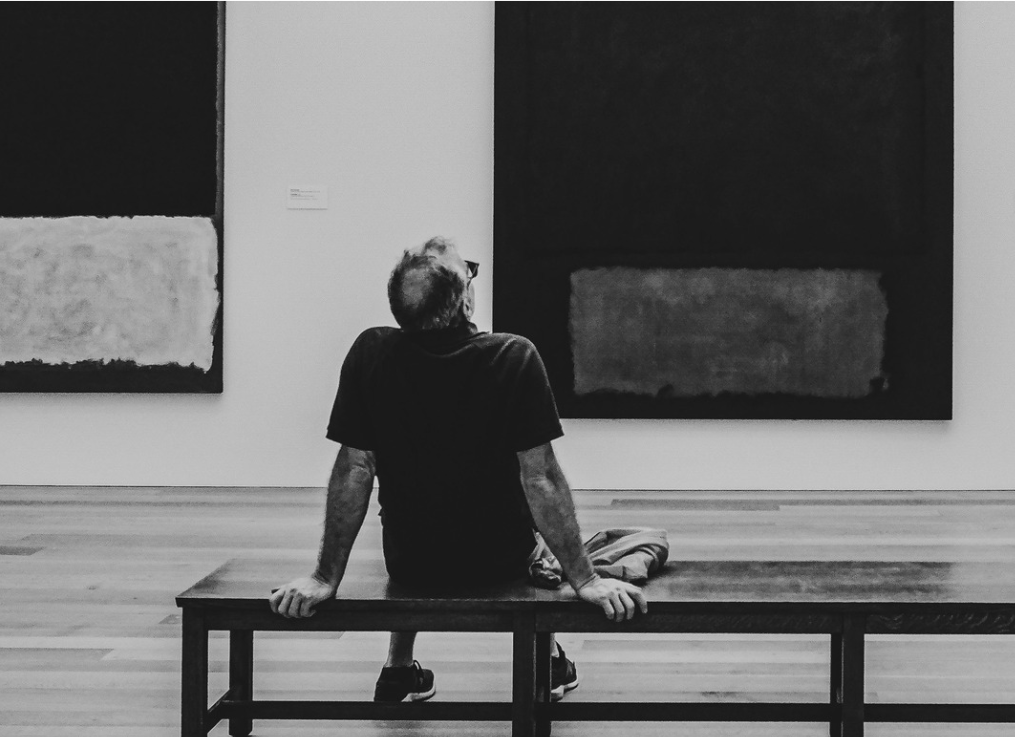
Standing before a painting by Mark Rothko, time seems to slow down. Large swathes of colour, blurred edges, a light that seems to filter from within the canvas: it is not simply a matter of ‘looking at a painting’, but of entering a space of contemplation that speaks to the emotions, without resorting to words or recognisable symbols. It is precisely this ability to communicate beyond linguistic and cultural barriers that makes the Rothko exhibition in Florence – open at Palazzo Strozzi from 14 March to 23 August 2026 – a prime example of how contemporary art becomes a vehicle for cultural messages and internationalisation.
Who is Rothko?
Mark Rothko (born Markus Rothkowitz in Daugavpils, in what is now Latvia, in 1903; died in New York in 1970) is one of the founding figures of American Abstract Expressionism, alongside Pollock, Kline and de Kooning. The son of a Jewish family who emigrated to the United States when he was ten years old, Rothko carried within him a sense of rootlessness that would recur constantly in his works.
Until the 1930s and 1940s, he continued to paint suspended, theatrical figures, reminiscent of Surrealism and Expressionism. Then came the turning point: forms dissolved, colour took over, and the famous floating rectangles emerged, which would become his signature. Rothko did not paint ‘abstract forms’; he created emotional spaces: he said he wanted to paint ‘tragedy, ecstasy, fate’ – weighty words that convey the radical nature of his artistic vision.
For Rothko, art was not meant to be ‘beautiful’ but inevitable. He did not seek detached contemplation; he wanted the viewer to be drawn in, confronted with their own human condition.
The exhibition: over 70 works, a comprehensive journey across three venues
The Florence retrospective is one of the largest ever dedicated to Rothko in Italy. Curated by Christopher Rothko (the artist’s son) and Elena Geuna, it brings together over seventy works from private collections and leading international museums: MoMA and the Metropolitan Museum in New York, the National Gallery in Washington, the Tate in London and the Centre Pompidou in Paris. Many of these works are being shown in Italy for the first time. The exhibition at Palazzo Strozzi traces Rothko’s entire career in chronological order, right up to the large abstract canvases of the 1960s, with suspended fields of colour that alter the perception of space.
The exhibition extends to two ‘satellite’ venues in Florence, creating a unique dialogue between Rothko and the Italian artistic tradition:
- At the Museum of San Marco, five works are on display in five cells frescoed by Beato Angelico, echoing Rothko’s visit in 1950, when he was deeply impressed by Angelico’s paintings;
- In the Vestibule of the Laurentian Library, designed by Michelangelo, two works by Rothko engage with the architectural space, evoking the relationship between painting and architecture that Rothko had also explored in his studies for the Seagram Murals.
The exhibition design plays on light: at San Marco, spotlights create a ‘theatricality’ that encourages a spiritual and transcendent interpretation; at the Laurenziana, natural light alone intensifies the canvases’ immersion in the architectural space.
Art and soft power: how an exhibition enhances a country’s image
The concept of soft power, popularised by Joseph Nye, describes a country’s ability to influence others through cultural appeal, values and institutions, rather than through military or economic force. During the Cold War, the United States made ‘cultural diplomacy’ a cornerstone of its strategy: exhibitions, shows, literary magazines and music were used to promote the American model and set it against the Soviet one. Abstract Expressionism, in particular, was used as a symbol of creative freedom, individuality and openness, in stark contrast to the Socialist Realism imposed by the Soviet Union.
The exhibition is organised by the Fondazione Palazzo Strozzi, in collaboration with the Museo di San Marco (Ministry of Culture) and the Biblioteca Medicea Laurenziana, and supported by public bodies (the City of Florence, the Region of Tuscany, the Metropolitan City of Florence and the Chamber of Commerce) and private organisations (Fondazione CR Firenze, Intesa Sanpaolo as Main Partner, and the Hillary Merkus Recordati Foundation).
Abstract art as a universal… and ambiguous language
In Rothko’s paintings there are no recognisable subjects, texts, national symbols or historical narratives. There are fields of colour that vibrate, blurred edges and a light that seems to emanate from within. This makes the work universally accessible: a person from any culture can experience an emotion without having to decode any figurative language.
Rothko said: “I think that colour, aided by light, enters into a relationship with the soul and brings about unexpected emotional consequences.” He does not seek to represent the world, but to evoke it, to pass through it, to transform it. His canvases become spaces for meditation, surfaces that invite the viewer to enter, to lose themselves, to confront their own emotions.
Who decides what the messages are? Funding, curatorship and storytelling
An exhibition of this scale is never ‘neutral’. The way it is presented, which works are selected and what narrative is conveyed through catalogues, press releases and public events depends on a network of stakeholders with differing interests. For example, the curators (Christopher Rothko and Elena Geuna) play a decisive role in shaping the artistic narrative and selecting the works. Meanwhile, the lending museums (MoMA, Tate, etc.) have their own strategies for international visibility and for consolidating their brand identity.
Transparency regarding who provides funding, who makes the decisions and which narratives are prioritised is crucial to a country’s cultural credibility. When private funding becomes predominant, there is a risk that curatorial decisions will be influenced solely by image-related interests.
Public engagement: art as a tool for inclusion and internationalisation
For an exhibition such as this to have a genuine impact in terms of internationalisation, it must engage a diverse range of audiences: foreign visitors (supported by educational materials in their own languages), schools, young people and local communities (through initiatives designed to make the exhibition accessible, such as dedicated evening sessions and local events).
Palazzo Strozzi offers a programme of in-depth talks and public activities, as well as a catalogue published by Marsilio Arte. Discounted admission is available for Intesa Sanpaolo customers and their companions, and holders of the exhibition ticket are entitled to reduced-price entry to the Gallerie d’Italia.
However, there remains a risk of cultural elitism: exhibitions of this kind may be perceived as aimed at a cultured, international audience rather than the general public. To transform the exhibition into a tool for inclusive cultural diplomacy, it is essential to invest in cultural mediation, arts education and programmes that also reach sections of the population that are traditionally excluded.
Conclusion: colour that transcends boundaries
Standing before a Rothko painting at Palazzo Strozzi, the visitor is not simply confronted with a 20th-century masterpiece. They are confronted with an emotional vocabulary that transcends national borders, languages and generations. Rothko does not want his paintings to be ‘understood’: he wants them to be experienced. He asks for time, immersion and vulnerability. In an age dominated by rapidly scrolling images, fragmented attention and identities built on luminous surfaces, his canvases demand the opposite: presence.
The exhibition is not merely an aesthetic event. It is a symbolic framework for international dialogue: a place where colour becomes a bridge between cultures, where the Florentine Renaissance tradition enters into dialogue with American abstraction, and where cultural diplomacy becomes a physical and mental experience, room by room.
Mondo Internazionale APS - Riproduzione Riservata ® 2026.