
Translated by Benedetta Calice
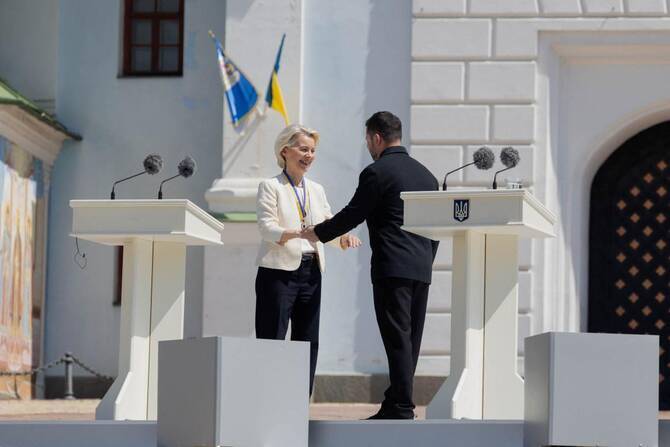
On July 15, Ukrainian President Zelensky welcomed European Commission President Ursula von der Leyen to Kyiv, where the two sides met to sign a new military partnership that is crucial not only for Ukraine’s defense but also for the future of the European defense sector. The new agreements between Ukraine and the EU have been consolidated into the Drone Deal, through which the defense industries of both parties will be able to integrate their production chains more easily, thereby strengthening the sharing of know-how and technical expertise on remotely piloted military systems and on technologies designed to counter them.
A New Industrial Synergy
The purpose of the Drone Deal is to enable the Ukrainian defense industry to access the production capabilities of European industries, while sharing the high level of information and practical expertise gained during four years of conflict. The agreement provides for the harmonization of the legislative framework governing the joint production of drones and anti-drone systems in various European countries and in Ukraine, thereby removing bureaucratic obstacles to cooperation and facilitating the integration of production in the long term. The advantage for European industries is that they can produce in larger volumes using more modern technologies, while Ukrainian industry will benefit not only from increased production volumes - thanks to greater capacity within the EU - but also from the ability to produce and store military drones and systems safe from Russian missiles that could strike them on Ukrainian soil. Some of Europe’s leading companies will be involved in the Drone Deal and. to facilitate the launch of the partnership, the European Commission has also authorized 1 billion euros in funding to be provided to Ukraine for the production of drones and related systems.
Not just Drone Deal: integration goes beyond conflict
The Drone Deal isn’t the only development in the Ukraine-EU relations: the European Commission has announced other measures to ensure support for Ukraine’s defense against the Russian invasion, such as the advancement of BraveTech EU and Ukraine’s entry into the European Defense Fund.
Launched in 2025, BraveTech EU is the initiative through which Ukraine and the European Union are collaborating to advance technological innovation in the defense sector through joint funding and cooperation in research and development, with the aim of producing new weapons and defense systems, while reducing the time to deployment. Through advanced design and testing, companies on both sides can access research funding and more easily find partners and suppliers with whom to collaborate on the development of new technologies. During the recent meeting between von der Leyen and Zelensky, new projects were announced that will be developed as part of “Phase 2” of the BraveTech EU program, which focuses on the development and testing of new technologies.
Moreover, it was announced that Ukraine is now a full member of the European Defense Fund (EDF), with a budget of 7.3 billion euros, and the European Defense Industry Program (EDIP), both European initiatives designed to support the development and cooperation of defense industries. Although the EDIP already provided for a mechanism dedicated to the development of Ukraine’s industrial manufacturing sector—through a 300-million-euro fund—Ukraine’s full access to the EDF signals the EU’s intention to integrate Ukraine’s defense industry into that of the EU, promoting its development and growth with a view to moving beyond the war and addressing the changing needs of European defense in the years ahead, while fostering greater interdependence between the markets and supply chains of both sides.
The strategic importance of drones
In the view of many observers, the conflict between Russia and Ukraine has entered a new phase in recent months, characterized by attacks that are increasingly concentrated in inland areas (and no longer limited to the front lines), targeting primarily energy and military infrastructure, and by a contest that is increasingly being measured by the two countries’ ability to sustain the war effort. From this perspective, drones and their production (including through the European partnership) are of strategic importance in supporting Ukraine’s defense: ensuring higher production volumes, as well as the security of reserves, is essential to enable Ukraine not only to defend itself but also to launch attacks. During 2026, Ukrainian drones successfully carried out more than 190 attacks on Russian oil refineries, reducing the country's oil production capacity by about one-third. Drones have become essential to ensuring Ukraine’s ability to strike strategic targets in Russia, with remote attacks reaching distances of over 2,500 km. The strategic advantage Ukraine has gained through attacks on Russian energy infrastructure is compounded by the international realignment - particularly that of the United States - in support of Ukraine: During the recent NATO summit, held in Ankara on July 7 and 8, President Donald Trump officially granted Ukraine the necessary license to produce Patriot air defense systems—a decision of great political significance in reaffirming U.S. support for Ukraine, despite Washington’s distancing itself due to the priority it has assigned to the war in Iran as part of its foreign policy. The promotion, both by Europe and the United States, of Ukraine’s independent production of defense systems signals a further shift from an emergency phase, characterized by direct aid for the country’s defense, to the creation of an institutional system capable of operating in the long term; and Ukraine’s production of Patriot systems could further define the new phase of the ongoing war.
The home front
The changes in Ukraine are not limited to alliances and foreign policy. On July 12, just a few days after the NATO summit and the EU summit, President Zelensky announced a cabinet reshuffle: the Ukrainian parliament approved a new cabinet, which included the resignations of, among others, Defense Minister Mykhailo Fedorov and Foreign Minister Andrii Sybiha. The fourth government reshuffle since the outbreak of the conflict in 2022 was triggered by the resignation of Prime Minister Yulia Svyrydenko, which was motivated by a shift in the country’s political strategy and certain conflicts with the President.
Ukraine is heading toward a period of transformations that are set to structurally redefine both the balance of its domestic politics and its foreign policy. The reshuffling at the top of Kiev’s institutions and recent diplomatic achievements demonstrate the urgent need to adapt to a rapidly changing strategic landscape. In this transitional context, the industrial partnership with the European Union and the signing of the Drone Deal represent much more than a response to a temporary emergency: they are a clear sign of a new era of joint defense and militarization, which will lay the groundwork for a continental security architecture destined to consolidate and endure well beyond the end of the current conflict.
Mondo Internazionale APS - Riproduzione Riservata ® 2026
Share the post
L'Autore
Cristel Vinciguerra
Tag
UE droni USA NATO