
Translated by Giulia Girardi
Every year, on June 12th, the World Day Against Child Labour brings together governments, civil society, local communities, and individuals in order to strengthen global efforts to end child labour. Established by the International Labour Organisation (ILO) in 2002, the annual. Observance comes at a crucial moment this year, following the Sixth Global Conference on the Elimination of Child Labour, held in Marrakech from 11 to 13 February 2026. The ILO’s Director-General, Gilbert F. Houngbo, emphasised the urgent need to accelerate progress in order to honour international commitments to human rights. He also reiterated that these commitments must now be translated into concrete action, especially considering that nearly 138 million children are still victims of child labour, including 54 million engaged in hazardous work. The ILO is calling for tangible action to change this reality. The slogan “Red Card to Child Labour: Equal Treatment for Children, Decent Work for Adults” encapsulates the urge for stronger action to promote quality education, social protection, decent work, and stricter legislation, alongside more effective enforcement of existing laws.
Stolen Childhoods: What Is Child Labour?
Child labour can be defined as a form of work that deprives children of their childhood, their dignity, and negatively affects their physical and psychological development. Many children live in areas devastated by war and natural disasters, where they struggle to survive — scavenging through rubble or working on the streets. Others are recruited as child soldiers and forced to fight in wars started by adults. Ending child labour is possible. The ILO Conventions provide a legal framework for protecting children by encouraging governments to implement targeted measures aimed at eliminating child labour and exploitation. The most significant measures are: ILO Convention No. 182 (1999), which recognises the urgent need to eradicate the worst forms of child labour through immediate and effective action; ILO Convention No. 138 (1973), which established the minimum age required for children to be regularly employed. Equally important is the ILO Declaration on Fundamental Principles and Rights at Work (1998), which calls on member States that have not yet ratified these conventions to respect, promote, and enact the principles they encapsulate. As a matter of fact, although many countries have ratified the ILO Convention, there is still a significant gap between the act of formal ratification and the effective implementation of these measures.
The eradication of child labour has been one of the core priorities of the International Labour Organisation since its founding in 1919. Furthermore, Target 8.7 of the United Nations 2030 Agenda for Sustainable Development — officially approved in September 2015 — encapsulated the commitment of all the involved countries to adopt immediate measures in order to eliminate the worst forms of child labour by 2025. However, in 2026 — eleven years later —, the problem remains unsolved.
Analysis and Trends in Child Labour: All The Data
Child labour is then a persistent global issue. The most recent data — dating back to 2024 — clearly show that approximately 138 million children are engaged in child labour worldwide. Within these children, 54 million are involved in hazardous activities, which dramatically affect their health and safety. Although child labour is more prominent in low-income countries, more than half of all child labour happens in middle-income countries. Studies show that child exploitation is concentrated primarily in rural areas, with approximately 61% of all the children working in agriculture.
Since 2000, child labour has been cut in half, declining from 246 million to 238 million in 2024. Since 2020, a further reduction of 20 million children has been recorded. Nevertheless, progress has been far too slow, and the 2030 Agenda target, aimed at eradicating child labour by 2025. From a regional perspective, Asia and the Pacific have experienced a decline in the number of children engaged in child exploitation, although the overall incidence rate has remained the same. Sub-Saharan Africa continues to be the region most severely affected, with approximately 87 million children involved in child labour practices. This area has been experiencing limited progress due to rapid population growth, widespread poverty, armed conflict, and weak social welfare.
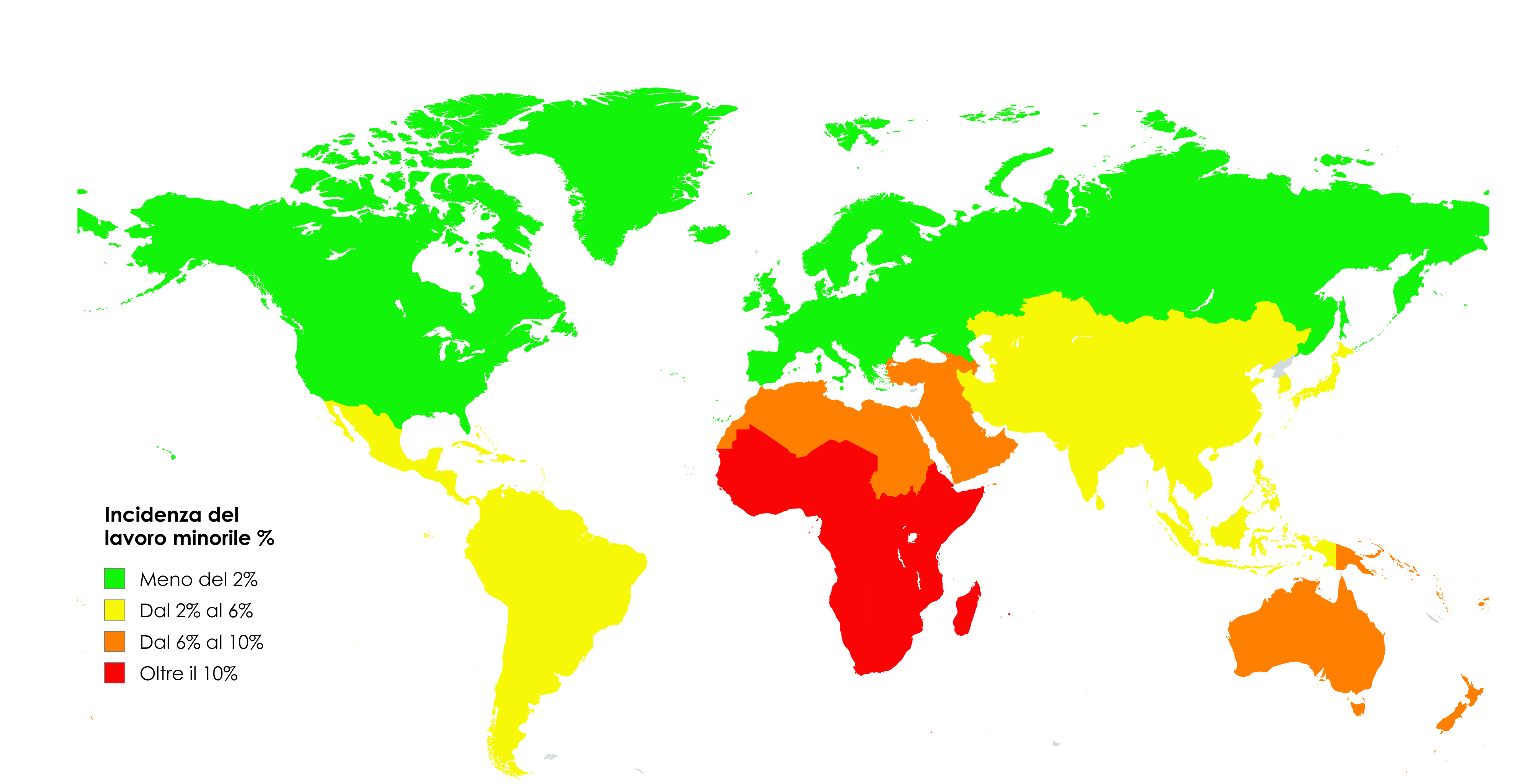
Source: Author’s elaboration based on data from the joint ILO-UNICEF report Child Labour: Global Estimates 2024, Trends and the Road Forward (p. 54, “SDG regions” table). The figures refer to SDG macro-regions rather than considering national statistics.
The map above is based on data from the latest joint ILO-UNICEF report, Child Labour: Global Estimates 2024, Trends and the Road Forward, which estimates a total of 137.562 million children engaged in child labour worldwide, representing 7.8% of the global child population aged 5 to 17. As the map shows, the geography of child labour is marked by striking regional disparities. Sub-Saharan Africa records the highest incidence rate in relation to the total child population (aged 5-17) living within the region. The accompanying table presents both the number of children engaged in child labour and the incidence rate, which represents the proportion of working children in relation to the total child population (aged 5-17) in each region.
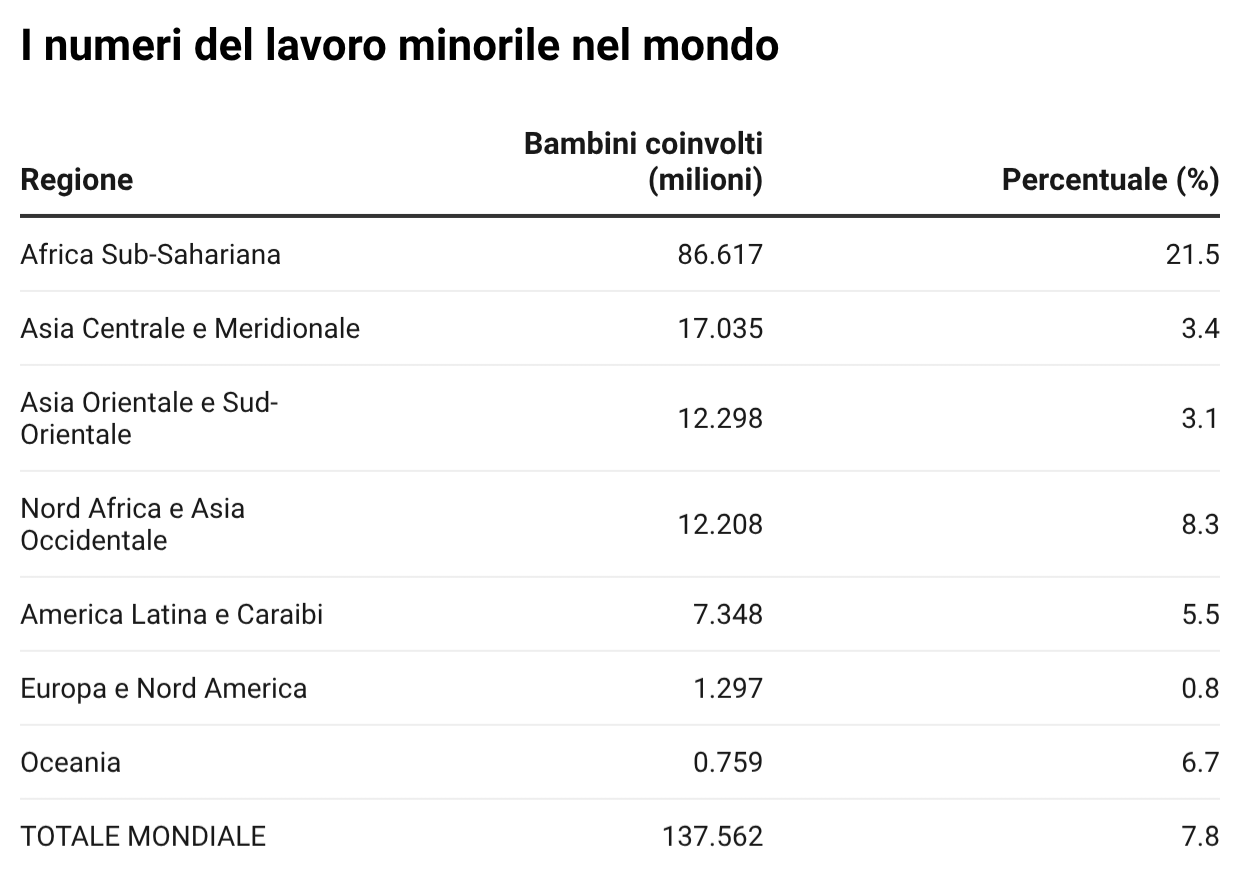
Source: Author’s elaboration based on data from the joint ILO-UNICEF report Child Labour: Global Estimates 2024, Trends and the Road Forward (p. 54, “SDG regions” table). The figures refer to SDG macro-regions rather than considering national statistics.
The table shows that Europe and North America account for nearly 1.3 million children engaged in child labour, and approximately 759.000 in Oceania. However, if these figures are considered only in relation to each region’s total child population, the picture changes significantly. In this case, in Europe and North America, the incidence rate is just 0.8%, whereas in Oceana it rises sharply to 6.7%. This clearly demonstrates how lower absolute numbers can sometimes hide a far more severe social impact when viewed in proportion to the size of local child populations.
Why Do Children Give Up Their Future?
The primary drive of child labour is survival. Children are often forced to work because of their families’ economic hardship and financial insecurity, frequently caused by extreme poverty or the loss of employment among adult and family members. Refugee and migrant children are particularly vulnerable. They are often easy targets for traffickers and exploiters, especially when travelling without the protection of an adult. More broadly, child labour deprives children of their fundamental rights, including access to eduction and healthcare. While agriculture remains the largest sector employing child labour — accounting for 61% of all cases — children are also engaged in domestic work, cleaning services, and small-scale trade (27%). The remaining 13% are employed in industry and mining, where they are often exposed to hazardous and exploitative working conditions.
Time to Act: Five Steps to Eradicate Child Labour
To accelerate the elimination of child labour, UNICEF and the International Labour Organisation (ILO) are calling on governments to take action across five key areas: 1) Strengthen social protection by establishing economic safety networks that will prevent vulnerable families from relying on child labour to survive; 2) Enhance child protection systems by reinforcing mechanisms that identify, prevent, and respond to situations where children are at risk of exploitation; 3) Guarantee access to quality education by ensuring universal educational opportunities, particularly in rural communities and areas affected by conflict or humanitarian crises; 4) Promote decent working conditions for adults by ensuring fair wages and respect for labour rights, enabling families to meet their needs without depending on their children’s income; 5) Increase corporate accountability by rigorously enforcing legislation to eliminate child labour throughout global supply chains and commercial production processes.
The enduring tragedy of child labour is a powerful reminder of how much still needs to be done to enhance the future of millions of children.
Mondo Internazionale APS – All Rights Reserved © 2026
Share the post
L'Autore
Gabriele Bellono
Autore per l'area tematica "Diritti Umani" di MI POST
Categories
Tag
lavoro minorile sfruttamento minorile diritti dell'infanzia ILO unicef