
Translated by Beatrice Mereta
In recent years, the effects of the climate crisis have become increasingly visible and tangible. Heat waves, floods, hurricanes, fires, desertification and droughts are affecting the planet with growing intensity. But one of the most significant and least addressed consequences is the forced displacement of millions of people. These are the so-called climate migrants, a constantly growing category of people who are still not fully recognised by international law.
Who are climate migrants?
To date, there is no universal and legally recognised definition of the term “climate migrants”, but in general it refers to all those who move because of environmental phenomena linked to climate change. These displacements can be caused by sudden events such as floods, hurricanes or fires, but also by slower but equally impactful transformations such as desertification, sea level rise, water salinisation or prolonged drought. In many cases, these phenomena compromise the ability to cultivate the land, fish, access drinking water or live in safe and healthy conditions. This is why they push people to migrate both within their own country (internal migration) and across national borders (transnational migration).
The International Organisation for Migration (IOM) also provides a definition of climate migrant, defining it as a person forced to move, temporarily or permanently, due to environmental changes that endanger their safety, livelihood or home. This definition is now widely accepted at an operational level but is not yet recognised by international law. Currently, there is no legal status for climate migrants, nor are there any protection mechanisms comparable to those provided for refugees. The 1951 Geneva Convention only protects those fleeing persecution for political, religious, ethnic or social reasons; environmental causes are not included, which is why we refer to them as migrants and not refugees. It is important to emphasise, however, that those who migrate for climate reasons do so not by choice, but because they are forced to do so by unsustainable living conditions. The United Nations High Commissioner for Refugees (UNHCR) has repeatedly stressed that the absence of legal recognition constitutes a serious gap in protection. The paradox is clear: millions of people move every year due to extreme weather conditions, but they do not fall into any official category that guarantees them rights, protection or international assistance. Yet these environmental crises are becoming increasingly frequent and devastating.
The most vulnerable regions
The areas of the world most affected by climate migration are in Asia and Africa, where the effects of climate change are compounded by economic fragility, political instability and the low resilience of local systems.
In Bangladesh, for example, rising sea levels are submerging entire coastal villages, while seasonal cyclones and water salinisation are compromising fishing, agriculture and access to drinking water. According to the World Bank, by 2050 the country could have over 13 million internal climate migrants.
In India, on the other hand, climate change is increasingly evident in the form of extreme heat waves. In the summer of 2022, temperatures reached peaks of over 49°C in some areas of the north of the country. The impact on agriculture was devastating: crops were burned, water resources were reduced and there were power blackouts. This prompted many people to leave the most affected rural areas in search of better living conditions in the cities.
Pakistan was also severely affected: between June and October 2022, monsoon rains caused floods that submerged a third of the country. Over 8 million people were forced to leave their homes. The phenomenon has been described as one of the worst environmental disasters in the country's recent history, and what made the situation even more dramatic was the fact that many of the affected families were already living in extreme poverty.
In the Horn of Africa, on the other hand, the main problem is drought. In countries such as Somalia, Ethiopia and Kenya, the prolonged lack of rain is bringing entire communities to their knees. According to Amref, over 23 million people are facing severe food insecurity. Pastoral communities are losing their livelihoods and are forced to migrate in search of water, food and basic living conditions. In Somalia, more than 1.4 million climate refugees were recorded in 2022 alone.
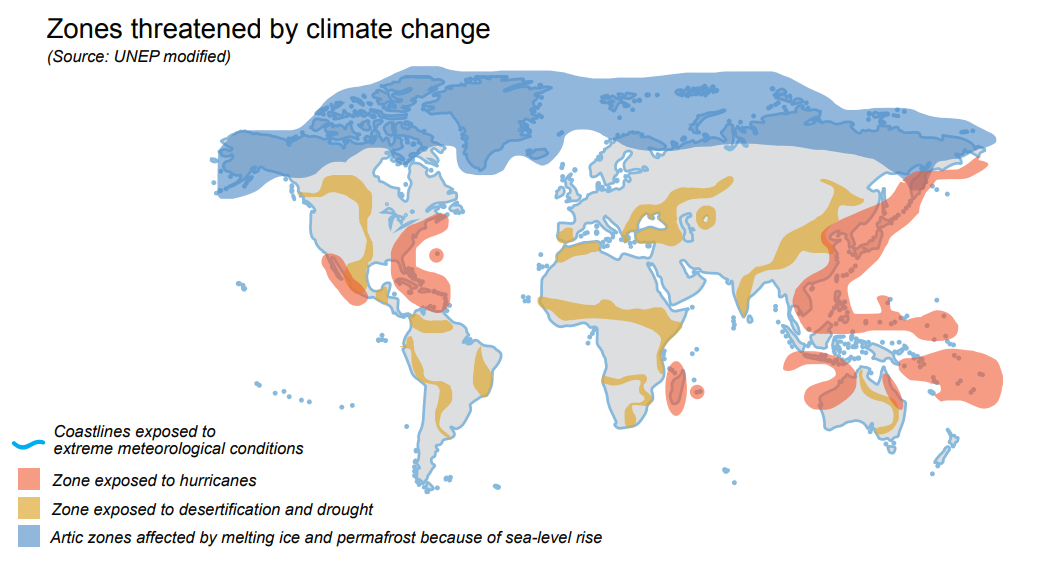
Image source: italiaclima Data source: UNEP
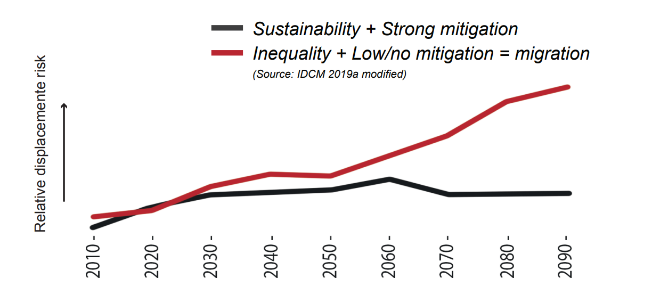
Image source: italiaclima Data source: IDCM 2019a
Possible responses
Faced with such a vast and ever-growing phenomenon, current responses are fragmented and often inadequate. The IOM and other United Nations agencies propose a strategy based on three main pillars.
The first concerns recognition and legal protection. Today, millions of people affected by environmental disasters do not enjoy any international protection. This regulatory gap needs to be filled. Some countries, such as New Zealand, have introduced special visas for those migrating due to extreme weather events, but these are still isolated initiatives. The debate on a possible extension of refugee status or the introduction of new forms of protection is open but faces strong political resistance.
The second pillar is prevention and adaptation. Investing in local solutions to reduce the vulnerability of communities is essential: this means improving access to water, promoting sustainable agricultural techniques, building resilient infrastructure and creating early warning systems. According to the IOM, strengthening local resilience is one of the most effective ways to avoid large-scale forced displacement.
The third guideline is managing migration as a form of adaptation. In many contexts, mobility can be a positive strategy. Promoting safe, orderly and regular migration reduces the use of irregular and dangerous routes and supports development in countries of origin, thanks to remittances and the skills acquired by migrants.
Climate change is not a future threat: it is a reality that is already reshaping the geography of human life and mobility. Understanding, governing and anticipating these dynamics is one of the central challenges of our time.
Mondo Internazionale APS – All rights reserved ®2025
Share the post
L'Autore
Virginia Giacomin
Categories
Tag
IOM Climate migrants #migration climate change