
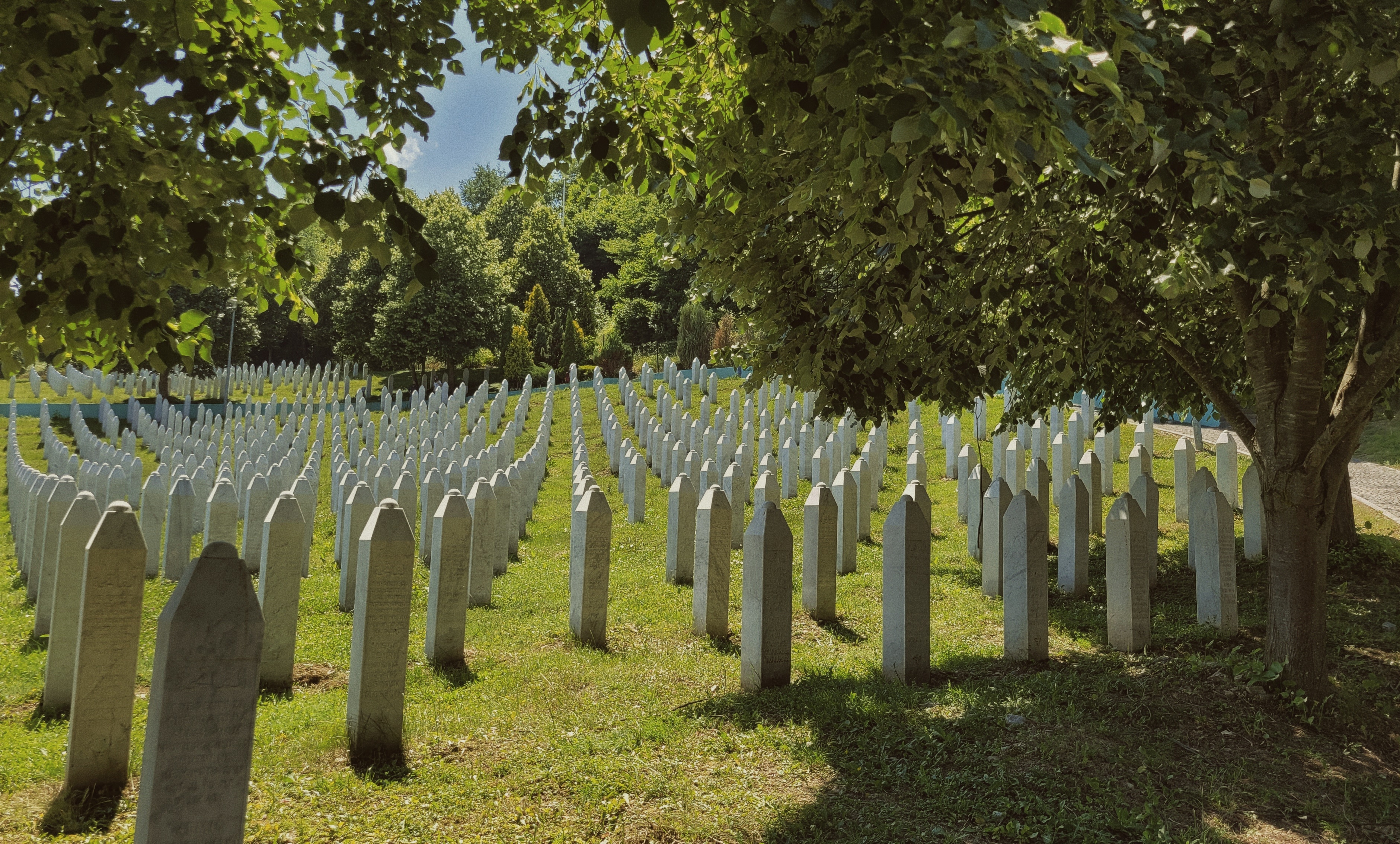
Cemetery of Srebrenica-Potočari, where 6,772 of 8,372 victimis of the genocide that occurred in July 1995 are buried
Translated by Federica Conti
Every step you take in Srebrenica connects you with the genocide and confronts you with negationism.
Srebrenica, Bosnia-Herzegovina. We are in Republika Srpska, a territorial entity in Bosnia where the majority of the population is Serb. At the beginning of the 90s, nearly 36,000 people lived in Srebrenica: three-quarters were Bosnian Muslims and one-quarter Serb. The urban centre had nearly 8,000 residents. Today, however, the number of residents is fewer than 2,000. The Muslims who remained or returned to Srebrenica represent less than half of the population (42-44%), and in Republika Srpska as a whole, they make up 12 per cent of the population.
In order to understand how the demographic decrease of the muslim population happened, we have to come back to the 90s and understand how in a few days a genocide happened.
July 1995: 'while Europe was going to the beach'
The horrific event happened between July 11 and July 15, 1995, 'while Europe was going to the beach, and history was about to finish', as Paolo Rumiz will write in Maschere per un massacro. Following the surrender of the Bosnian enclave, eight thousand Muslim men were taken away and massacred by special forces under the command of Serbian General Mladić. Their bodies were then thrown into mass graves in a systematic operation carried out with trucks and fuel provided by the United Nations.
The phrase 'UN, United Nothing' still appears on the walls of the former Dutch UN peacekeepers' compound, which is now the Potočari Memorial Centre. During the hellish summer of 1995, thousands of civilians desperately sought safety and protection there.
The massacre carried out by the Bosnian Serb forces in Srebrenica was the most horrific to take place in Europe since 1945. Yet it would take months before the world fully acknowledged what had happened. Survivors recounted the events, intelligence services were aware of the facts, and spy satellites had captured images of the mass graves. Nevertheless, reports documenting the massacre remained locked away in the drawers of international embassies until well into September.
“Krivaja 95”: Chronicle of a Foretold Massacre
As early as late June 1995, American and French intelligence services reported that General Mladić was amassing troops and military equipment around the UN-protected 'safe area', yet no action was taken. On 1 July, the Army of Republika Srpska entered the 'safe area', where around 40,000 refugees, displaced by the ethnic cleansing campaign in the Drina River Valley, had sought shelter.
The population of the enclave consisted of three groups: local residents, pre-war inhabitants of Srebrenica who had refused to abandon their homes; and internally displaced people, who had been forced to leave Muslim villages by Serb forces. There were also refugees who had arrived from across eastern Bosnia after spending more than a year hiding in the forests.
On 6 July, the Bosnian Serb forces launched their offensive. At around 3:00 a.m., Operation Krivaja 95 began. The town of Srebrenica and the observation posts of the Dutch battalion serving with UNPROFOR (United Nations Protection Force) were among the targets of the bombardment. The Dutch peacekeepers were caught off guard and failed to respond. Worse still, they cooperated. They handed over a list of local residents and Muslim Bosniaks employed by the battalion, including interpreters, cooks, and drivers. Even they could not be saved by the United Nations.
11 luglio 1995: the surrender and 'death parade'
In the days that followed, the UNPROFOR checkpoints surrounding Srebrenica fell one by one. It was a surrender. Between 9 and 10 July, on the orders of Radovan Karadžić, President of Republika Srpska and Supreme Commander of its armed forces, the final assault began. By the afternoon of 11 July, Srebrenica had fallen.
The population decided to evacuate the enclave and split into two groups. The first, consisting of around 25,000 people - mostly women, children, the elderly, and the wounded - headed for the Dutch UN base at Potočari. The second, made up of approximately 15,000 men and boys, formed a column stretching nearly ten kilometres with the aim of reaching the 'free territories' and the city of Tuzla, in what would later become known as the Marš smrti (Death Parade).
The Serbian's plan was to kill all Bosniak Muslim males over the age of fourteen. The journey to Tuzla through the dense forests of the Drina Valley became the largest and most brutal manhunt in modern European history. Few people survived. The head of the column, armed with only a handful of weapons, managed to reach the free territory after six days, while other groups wandered through eastern Bosnia for months after the fall of Srebrenica. The last group did not reach Tuzla until April 1996, several months after the signing of the Dayton Peace Agreement. Most, however, were killed in artillery attacks, captured, or forced to surrender.
The number of confirmed victims stands at approximately 8,372, although the final toll remains incomplete. The victims were initially buried in mass graves at the execution sites. Then, in the autumn of 1995, as the end of the war drew near, the Bosnian Serb leadership began systematically destroying the evidence: bodies were exhumed and reburied in secondary and tertiary mass graves. As a result, the human remains were severely fragmented, and identifying the victims took years - sometimes decades. Around 950 men are still missing, while 2,167 have yet to be identified.
According to evidence collected by Missing Persons Institute of Bosnia and Herzegovina, there are cases in which the skeletal remains of a single individual have been recovered from as many as five different secondary and tertiary mass graves, some located up to 30 kilometres apart.
Inat, the force to resiste
Rejha Avdić was in Potočari on 11 July 1995 with her five children. She lost ten close relatives, as well as her husband, who had joined the column attempting to reach Tuzla. 'I live waiting for the day when my loved ones' remains are finally found. The day when I will at least know where they are, where I can go to pray for them. Justice is slow. But I will never give up.'
Rejha was among the first survivors to fight for truth and justice. She is a member of the association Women of Srebrenica (Žene Srebrenice) and works closely with an interregional network of peace organizations, including Women in Black (Žene u crnom), which also has a presence in Belgrade. 'When the war ended, I thought I would never set foot in Serbia again. But meeting them changed my mind.'
Today, beyond the boundaries of the Srebrenica-Potočari Memorial Centre and Cemetery, there is little to indicate that an act of genocide took place there thirty-one years ago. There are no public reminders of the victims and few signs warning against the repetition of such crimes. Those who survived and remained -or chose to return - live alongside people responsible for the deaths of their relatives or on streets named after Serbian war criminals, who are still regarded by many in the area as national heroes.
In 1999, Rejha Avdić rebuilt the home that had been destroyed during the Serbian occupation.'It's smaller now, but I came back.' Her return embodies the Bosnian concept of inat - a deeply rooted form of defiance, and identity resilience. It is the refusal to disappear in the face of oppression or attempted erasure, because 'If I don't like seeing them, my Serbian neighbours like seeing me back here even less.'
On 11 July 2026, on the day of commemoration, eight new burials will take place for people identified over the past year. There will also be 48 reburials of the newly discovered remains of individuals who had already been identified and buried in Potočari.'I will not stop fighting until the very last man from that column has been found.'
Negationism and digital fascism
In 2021, in Bosnia and Herzegovina, the crime of negationism was introduced, with sentences of 6 months to 5 years in prison, but 'law is not enough: implementing procedures and interpretation are needed,' says the jurist Edin Ikanović, author of the report Srebrenica Genocide Denial and a survivor of a massacre as a child.
Indeed, it is more efficient than the activity that began in 2020, which aimed to monitor and produce an annual report on negationism in the media. In the first year, 800 cases of genocide denial were identified among politicians, academics, and figures in the Serbian media. The emergence of authors with both a first and last name proved to be more efficient, as the number of negationists was reduced the following year.
Denying genocide is not just a political strategy, but also a psychological defence mechanism. As journalist and writer Dragan Bursać explains: 'Admitting that my people committed a crime means confronting feelings of guilt, sorrow, and moral collapse of the identity. For many people, this is unbearable.' This is why the crime is denied, trivialised or blamed on the victim. When even this attempt fails, those who talk about the crime are attacked, as is known very well by Bursać himself.
Dragan is of Serb-Bosnian origin and has consistently and publicly condemned the atrocities committed by Serbian forces. He has refused to align himself with the dominant nationalist narrative in his region: 'Acknowledgement does not humiliate a nation, it sets it free. It lifts the burden of genocide from future generations'.
Due to his views considered those of an 'anti-fascist partisan', Bursać has become one of the most threatened journalists in the Balkans. Yet he continues to speak out because 'writing is a time machine: perhaps you are not writing for 90 per cent of your contemporaries, but without truth there can be no peace. Without acknowledgement, there can be no liberation. And without liberation, there is no future for Bosnia.’
*This journey was undertaken with the guidance of Andrea Rizza Goldstein, a Balkans expert, linguistic and cultural mediator, and Diego Saccora from the associations Buongiorno Bosnia and Along the Balkan Route.
Mondo Internazionale APS - Riproduzione Riservata ® 2026
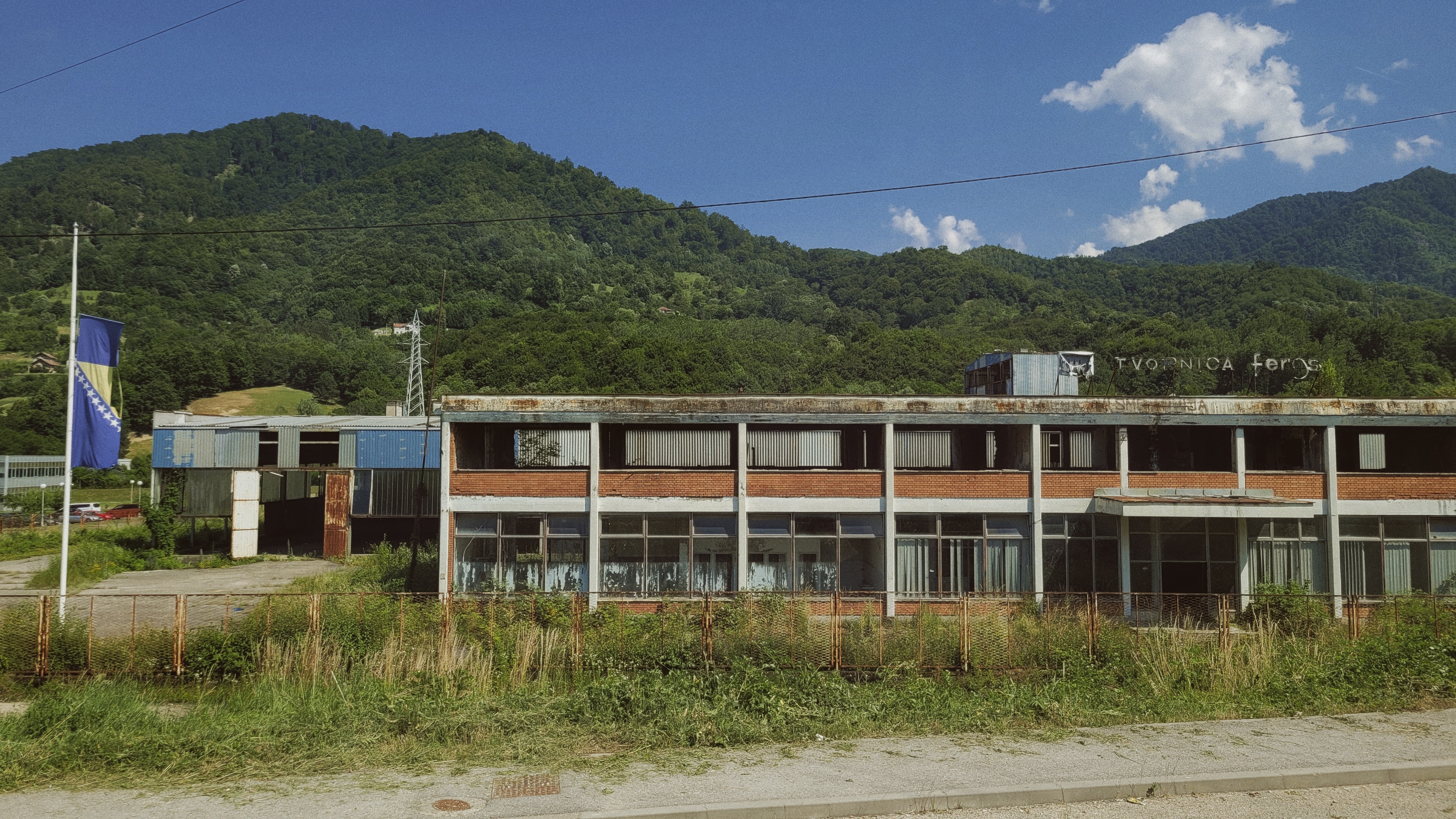
This is an exterior view of the former battery factory in Potočari, where the inhabitants of the enclave - mostly women, children and elderly people - sought refuge with the Dutch Battalion (Dutchbat) during the summer of 1995..
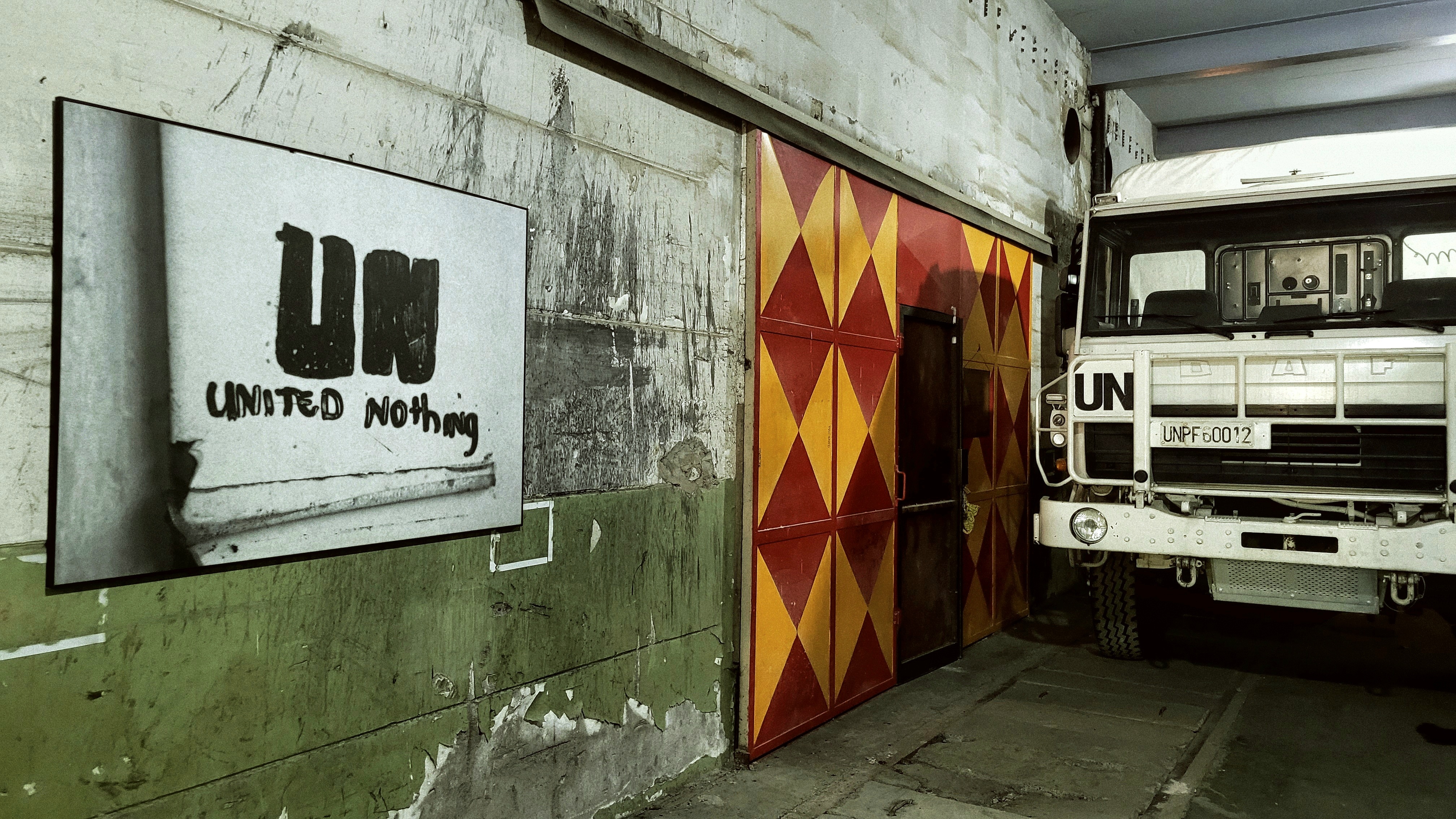
Compound of the Dutchbat, the Dutch battalion of the UNPROFOR (United Nations Protection Force) peacekeepers.
“Admitting that my people committed a crime means confronting feelings of guilt, sorrow, and moral collapse of the identity. Acknowledgement does not humiliate a nation, it sets it free. It lifts the burden of genocide from future generations.
”
- Dragan Bursać
Share the post
L'Autore
Giuliana Băruș
Studi in Giurisprudenza e Diritto Internazionale a Trieste.
Oltre che di Diritto (e di diritti), appassionata di geopolitica, giornalismo – quello lento, narrativo, che racconta storie ed esplora mondi – fotoreportage, musica underground e cinema indipendente.
Da sempre “permanently dislocated – un voyageur sur la terre” – abita i confini, fisici e metaforici, quelle patrie elettive di chi si sente a casa solo nell'intersezionalità di sovrapposizioni identitarie: la realtà in divenire si vede meglio agli estremi che dal centro. Viaggiare per scrivere – soprattutto di migrazioni, conflitti e diritti – e scrivere per viaggiare, alla ricerca di geografie interiori per esplorarne l’ambiguità e i punti d’ombra creati dalla luce.
Nel 2023, ha viaggiato e vissuto in quattro paesi diversi: Romania, sua terra d'origine, Albania, Georgia e Turchia.
Affascinata, quindi, dallo spazio post-sovietico dell'Europa centro-orientale; dalla cultura millenaria del Mediterraneo; e dalle sfaccettate complessità del Medio Oriente.
In Mondo Internazionale Post è autrice per la sezione “Organizzazioni Internazionali”.
Categories
Tag
Srebrenica 1995 Bosnia Herzegovina Serbia Yugoslavia Negazionismo genocide srebrenica Potočari Balkans