The village that remains within
Maria Lai and Marc Chagall in dialogue in Ulassai
Translated by Stefania Madera
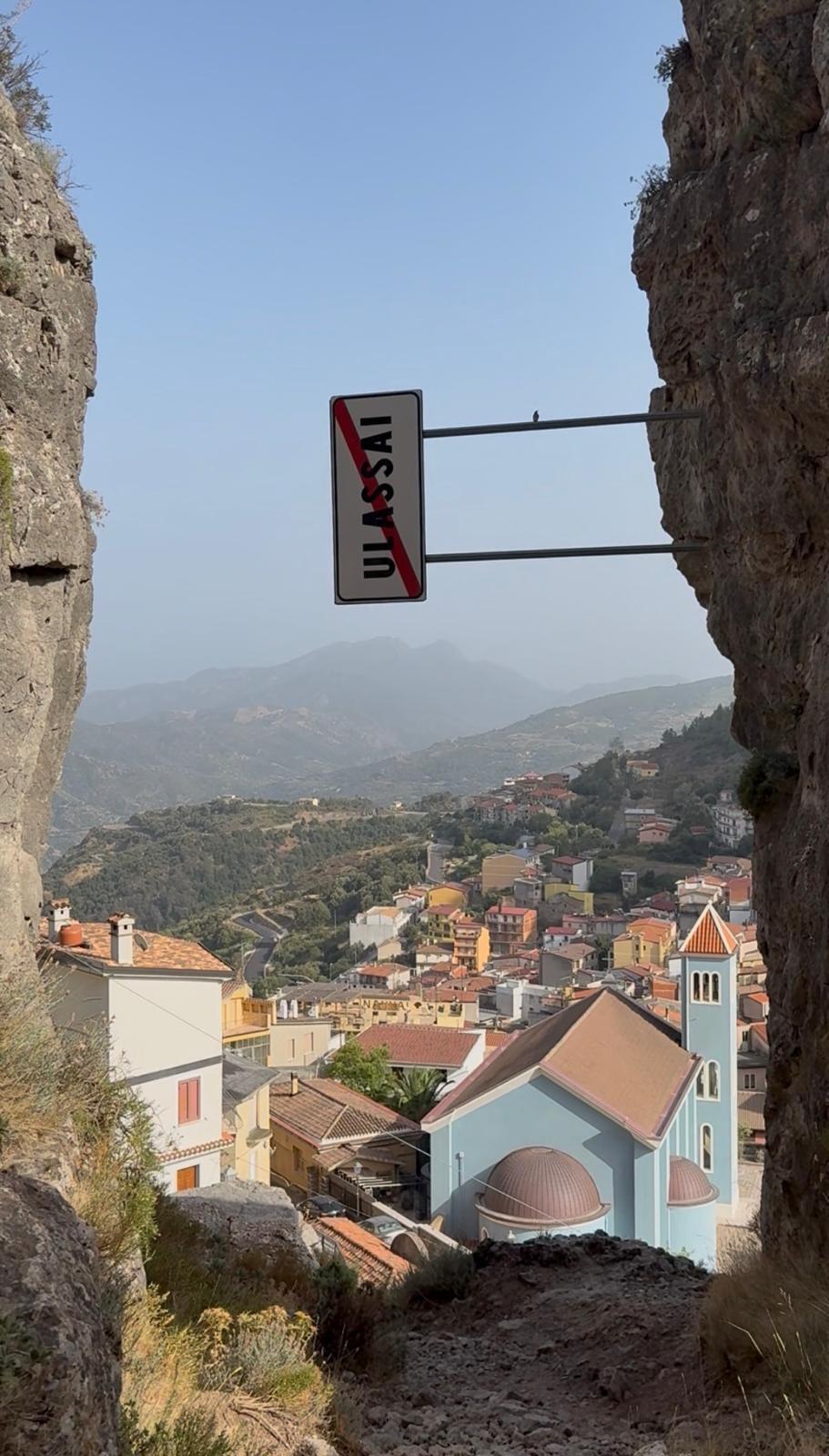
A village is not defined solely by its houses, streets or the landscape that surrounds it. It can continue to exist within those who have left it, transforming into a language of memory. For Maria Lai, Ulassai represented precisely this: not an immovable origin to be preserved, but a living root, capable of nourishing the imagination even across the distance. It is within this idea of village as inner geography that, in Ulassai, Maria Lai’s work encounters that of Marc Chagall in the exhibition named “Chagall with Maria Lai. The inner landscape”.
Lai trained between Rome and Venice, and spent long periods in places far from Sardinia. Yet, her artistic research continually returns to the island’s gestures, stories and materials. Thread, the loom, bread, fairy tale and indecipherables writings are not folkloric references, but tools for reconnecting inner life and world, individual and collective memory. Practices traditionally associated with women’s work thus become carriers of knowledge and open themselves up to a public and relational dimension.
In Legarsi alla montagna (“To Tie Oneself to the Mountain”), created in 1981, Lai transforms a commission from the Municipality of Ulassai for a monument to the townspeople who had fallen in war. In place of a memorial that fixes memory in stone and is dedicated to the dead, she creates a “monument for the living”, entrusted to participation of the local community. The work stems from Sa Rutta de Is’Antigus (“The Cave of the Ancients”), a story of a young girl that, chasing a blue light ribbon carried by the wind, emerges from a cave just before it collapses. Fragile and unable to hear any weight, the ribbon becomes an image of art: it does not protect from danger, but it can point the way. The project takes shape through conversations, hesitations and resistances, until fabric is distributed throughout the village. Each family chooses how to connect with its neighborhoods: the ribbon remains taut where there is no friendship, forms a knot where a bond exists, and becomes a bow, embracing su pani pintau (the traditional, intricately decorated ceremonial bread) where there is affection and love. Doors, windows and streets thus form a collective weave, which is then extended to the mountain. The participation does not stage a harmonious community: it makes its real fabric visible , made up of proximity, conflicts and distances that must be respected. Lai’s intention is not to erase fractures, but to entrust each person with responsibility for their own way of relating to others. For one day, Ulassai can see itself as a community and recognize that belonging to the same place does not mean being the same, but consciously inhabiting what units and what divides us.
Marc Chagall, too, carried a village with him. Born in Vitebsk and raised in a jewish family, he built his own imagination among wooden houses, animals, violinists, rituals and stories. His departure for Paris, the wars, anti-Semitism and exile did not erase that world. The more the real place became unreachable, the more it returned as an inner geography. Chagall did not reproduce Vitebsk as it was; he saved it by reinventing it.
In Woman Circus Rider on Winged Horse (The Circus), a 1956 lithograph, Chagall brings together a small community in motion within the circus ring. At its centre, a large winged horse seems to lift away from the ground, while a woman circus rider struggles to find a balance without any secure support. Around them, musicians, spectators, acrobats and animals crowd together; the figures overlap and the perspective gives a way to the logic of dreams. But the flight is not a freedom without consequences: the horse’s lightness coexists with the precariousness of the body riding it, just as the audience’s sense of wonder coexists with the strain of those who expose themselves to risk. For Chagall, the circus is not merely entertainment, but a representation of a human vulnerability. No one truly exists alone: the horsewoman needs the horse, the acrobats need the rhythm of the musicians, and the performer's gesture depends on the gaze of the observer. It is a temporary community, united not by harmony but by mutual dependence. Lai makes relationships visible by entrusting them to the inhabitants; Chagall observes a symbolic community and shows how every balance depends on the presence of others.
From this shared loyalty to their places of origin comes “Chagall with Maria Lai. The inner village”. The exhibition does not seek formal similarities, nor does it downplay the differences between the two artists. Rather, the “with” in the title opens up a space of relationship: Lai sews and ties knots, Chagall suspends and sets flying. One makes relationships materially perceptible; the other frees people, animals, and villages from gravity. Both transform memory and storytelling into a way of questioning belonging.
That this encounter takes place in Ulassai is by no means incidental. Maria Lai does not become a local counterpoint to an international master; rather, it is Chagall who enters her poetic territory. The relationship between centre and periphery is reversed. Ulassai is not a peripheral place that temporarily receives great art, but the place from which it becomes possible to reread the work of one of the protagonists of the twentieth century.
Vitebsk and Ulassai thus become portable villages: places that continue to live because someone tells their stories, sews them, paints them and transforms them. The Identity that emerges from their encounter is not a closure within one’s origins, but the ability to move through the world without losing the thread that allows us to recognize ourselves and, sometimes, to return.
Mondo Internazionale APS - Riproduzione riservata ® 2026
Image source: Photo taken by Antonella Sanna