
Translated by Valeria D’Alessandro
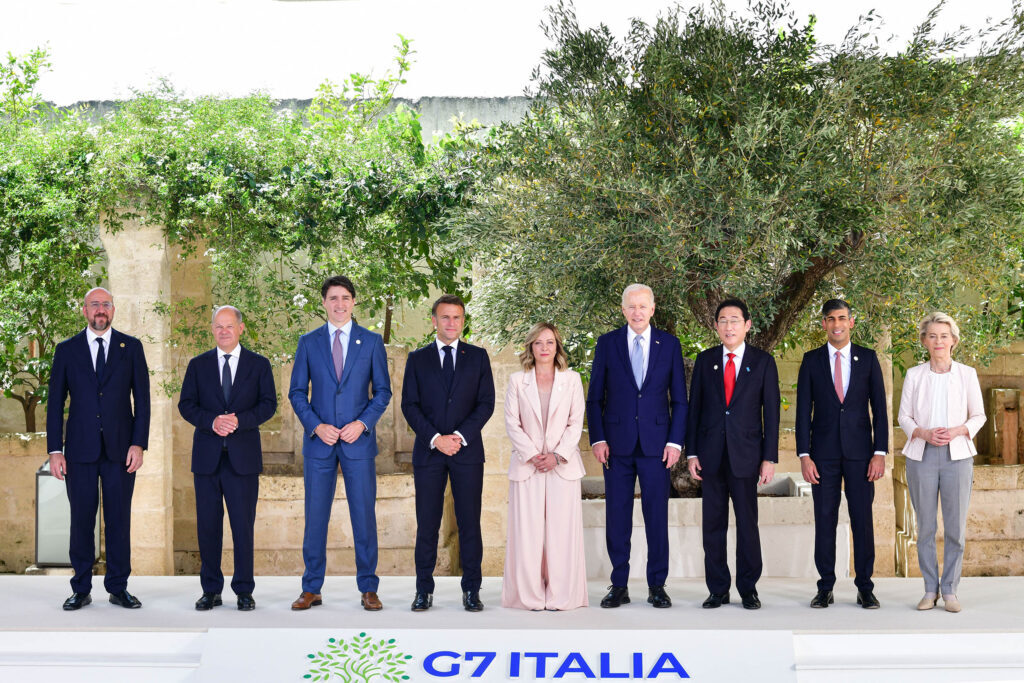
Highly discussed in the past few months, and from Borgo Egnazia (Fasano, Brindisi) received confirmation: during the 50th G7 summit, an agreement was reached to send 50-billion-dollar in aid to Ukraine by the end of 2024.
G7 plan and EU
How are the G7 and the European Union planning to use confiscated Russian asset from February 2022 to finance Ukraine’s reconstruction?
Apulia, 13th-15th of June. Even before beginning their summit, G7 leaders reached an agreement to send 50 billion dollars to Kyiv. The amount, to be transferred to Ukraine by the end of the years, will be financed with interests generated by Russian assets “frozen” in Europe since the beginning of the invasion. Technical details will be further discussed in the next few weeks, and the flow of money is expected to reach the Ukrainian capital by the end of the year. The multi-year plan should then provide sustained support to Kyiv for post-war reconstruction, regardless of who will be leading the G7 or of the Western coalition.
Despite other topics being discussed, such as the Middle East and AI, the main topic of this Italian G7 presidency was Ukraine.
Italy G7 2024
The event was held in Borgo Egnazia, in the town of Fasano in Apulia, and saw the participation of Heads of State or Government from the seven member states, as well as the President of the European Council and the President of the European Commission representing the European Union. As per tradition, representatives of counties and international organization invited by the host country, Italy this year, also attended. For the first in the history of the summit, the 50th G7 summit was held in the presence of a pontiff, Pope Francesco.
The Group of Seven (G7) is an informal forum that brings together Italy, Canada, France, German, Japan, United Kingdom and the United States of America, that is, the world’s seven major democracies. Created as an economical and financial cooperation platform in response to the energetic crisis in 1973, over the years the G7 has progressively expanded its main objectives and thematic focus. From meeting ad hoc to discuss financial challenges, it has transformed in the new millennium into a more formal and prominent venue where major global issues are addressed.
On January 1st, 2024, Italy assumed its presidency of the G7 for the seventh time in its history, succeeding Japan, and will hand it over to Canada on December 31, 2024. Unlike international organization, the G7 operates without a permanent organized structure. The country holding the presidency functions as temporary secretariat, hosting the group’s meeting and the Leader’s Summit. Above all, the Presidency plays a fundamental role in defining the agenda and identifying priorities.
This year, the backdrop of the seventh Summit held in Italy is the Mediterranean Sea, the “middle sea” where Italy has historically and culturally held a central position. The Mediterranean links the two great maritime spaces of the world – the Atlantic Ocean on one side and the Indo-Pacific on the other – touching three continents.
Challenges for the future
Beyond the Apulian G7, Ukrainian president Zelensky, present at the summit, achieved an important success: the signing of a bilateral security agreement between Ukraine and the United States. This alliance, lasting 10 years, involves Washington providing assistance and military equipment to Kyiv, which and is presented as a potential precursor to Ukraine’s entrance the Atlantic Alliance. This agreement shortens the distance between Ukraine and its entrance into NATO. However, like the previous bilateral agreements signed by Ukraine, this one does not obligate the US the intervene in defense of the ally in case of attack. The bilateral agreement’s objective is to guarantee support for Kyiv, even under future American administration, most likely to be led by Republicans, with the hope that it will transcend the sharp political divisions in the United States. Since it is not properly a treaty – so it will not be submitted for ratification in Congress – Trump or any other future president are allowed to withdraw from the agreement at any moment. An ephemeral victory for Kyiv?
Another initiative led by the United States is the expansion of economic sanctions (particularly secondary sanctions) to all companies and banks supporting the “Russian war economy”. This measure primarily targets the network of Countries– from the Balkans to the Middle East and Central Asia – that act as intermediaries to bypass sanctions against Kremlin.
And while Giorgia Meloni in Apulia seeks her consecration on the international stage, “western weakened leaders are reunited in Italy to discuss an ungovernable world”, declares the New York Times, echoed by the foreign press. In fact, many of the political figures gathered in Apulia are already grappling with problems of support in their own countries, following significant electoral defeats. The uncertain result of November American election further weights on the western coalition, which has never been so weak and divisive, and so exposed to the risk of a sudden turnaround in Washington. This coalition appears unable to govern an increasingly ungovernable world, which has been waiting too long for a dangerous and decisive turn - a turn that will come instead from the East.
Mondo Internazionale APS - Riproduzione Riservata ® 2024
Share the post
L'Autore
Giuliana Băruș
Studi in Giurisprudenza e Diritto Internazionale a Trieste.
Oltre che di Diritto (e di diritti), appassionata di geopolitica, giornalismo – quello lento, narrativo, che racconta storie ed esplora mondi – fotoreportage, musica underground e cinema indipendente.
Da sempre “permanently dislocated – un voyageur sur la terre” – abita i confini, fisici e metaforici, quelle patrie elettive di chi si sente a casa solo nell'intersezionalità di sovrapposizioni identitarie: la realtà in divenire si vede meglio agli estremi che dal centro. Viaggiare per scrivere – soprattutto di migrazioni, conflitti e diritti – e scrivere per viaggiare, alla ricerca di geografie interiori per esplorarne l’ambiguità e i punti d’ombra creati dalla luce.
Nel 2023, ha viaggiato e vissuto in quattro paesi diversi: Romania, sua terra d'origine, Albania, Georgia e Turchia.
Affascinata, quindi, dallo spazio post-sovietico dell'Europa centro-orientale; dalla cultura millenaria del Mediterraneo; e dalle sfaccettate complessità del Medio Oriente.
In Mondo Internazionale Post è autrice per la sezione “Organizzazioni Internazionali”.
Categories
Tag
G7 Italia Puglia EU NATO Russia Sanzioni internazionali