
Translated by Martina Ravasi
The Horn of Africa and Somalia as the strategic epicentre between jihadist and geopolitical rivalries
The Horn of Africa is again at the core of global geopolitical competitions. It's a sea hub between the Red Sea and the Indian Ocean as well as an energy crossroads and an access point to routes to the Gulf, and today this area is in the middle of tensions combining rivalries between States, internal instabilities and jihadist threatens.
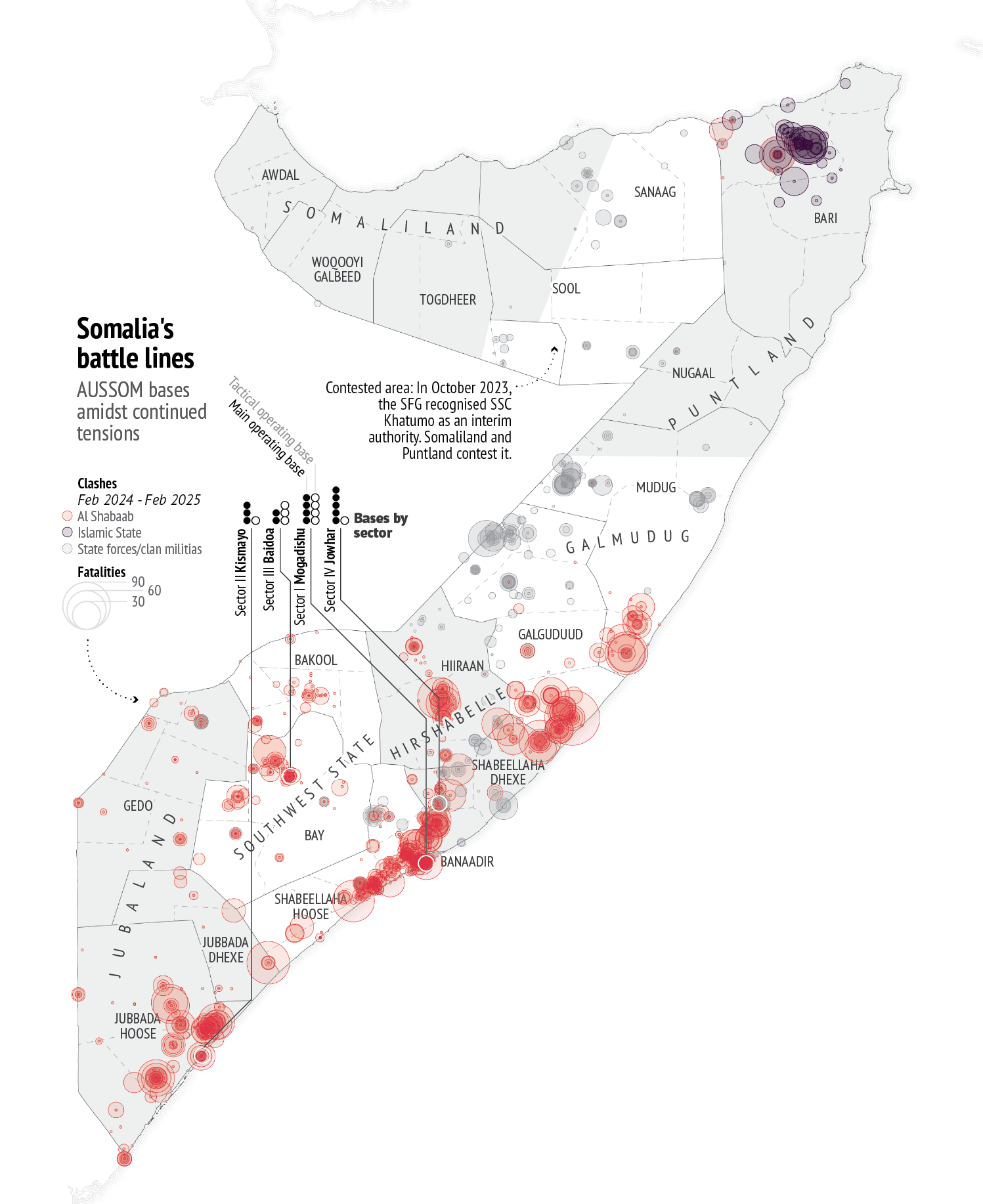
In particular, Somalia is a unique geopolitical laboratory. Everybody knows about some news regarding a possible recognition of Somaliland and military agreements with Türkiye as well as army sales and the increasing involvement of the US and the United Arab Emirates. However, under this surface of diplomatic and military dynamics there’s a deeper structural level, namely the fact that in Somalia there are two different jihadist groups with different agendas, networks and capabilities. On one hand we have Al-Shabaab - affiliate to Al-Qaida and dominant actor in the country – and on the other hand there is the Islamic State – ISIL Somalia. The latter is smaller, but it’s expanding and has transnational ambitions. Understanding Somali 2026 means analysing this double threaten within a wider regional framework.
The geopolitical dimension: Somalia between middle powers and big actors
Over the last few years several countries have increasingly drawn their attention to Somalia. Firstly, Türkiye has strengthened its presence through military cooperation and army supplies. Moreover, the UAE have backed security operations in Puntland. Additionally, the US keeps targeted surveillance and strike capabilities. Lastly, the UN Security Council has extended the African Union support and stabilisation mission (AUSSOM) until December 31st, 2026. These elements are crucial, but they don’t solve the core issue. As a result, jihadist threatens keep being structural.
Al-Shabab: the dominant threat
According to the UN Panel of Experts (November 2025), Al-Shabab remains the main threaten to peace and stability in Somalia and in the whole region, especially in Kenya. Indeed, this group is capable of asymmetric and complex attacks, even in Mogadishu. Moreover, it has a sophisticated extortion system and a systematic forced recruitment as well as an effective propaganda apparatus.
The attack against the presidential convoy on March 18th, 2025 showed that the operative capability of the group isn’t neutralized. In Kenya, in 2025 Al-Shabab carried out about six attacks per month on average, especially in the Mandera and Lamu regions, thus strengthening the regional dimension of threatens.
The strategy of the group is not only insurrectional, but also political-ideological. Their main purpose is the creation of a “Big Somalia” under a strict Islamic control.
ISIL-Somalia: the emerging threat
While Al-Shabab prevails in terms of territorial extension and military capability, ISIL-Somalia is a different qualitative threat. According to a UN report, at the end of 2024 this group had more than 1,000 fighters, and at least 60% of them were foreigners. This combination is a symptom of a strong transnational attraction as wells as connections with external jihadist network and a potential role as a regional hub.
ISIL-Somalia is mainly active in the Puntland region, benefitting from mountain areas that are hard to control. The presence of foreign fighters modifies the typology of the threat, making it less local and more interconnected.
Internal rivalries: Al-Qaida vs the Islamic State
Somalia is one of the few African realities where two global rival jihadist groups coexist. This competition consists in recruitment, coercive economic control, ideological legitimacy and access to financial network. Now Al-Shabab maintains clear superiority. Nevertheless, the expansion of ISIL – Somalia introduces an element of potential fragmentation in the militant landscape.
The Somali answer in 2026: between offensives and structural vulnerability
Reactions to IS
Since December 2024 Puntland has launched significative offensives against ISIL – Somalia (Hillac Operation) with successful progress in 2025. These operations include a reconquest of strongholds, destruction of bases and international air support. However, the mountainous environment and local networks make a definitive destruction of the group hard.
Reactions to Al-Shabab
In January 2026, Somalia announced some military operations in Middle Shabelle with international support. However, they required not only military pressure, but also stable governance and public services as well as food security and the interruption of extortion networks.
The destabilizing factor – the humanitarian crisis
In February 2026, about 6.5 million people risk suffering from acute hunger due to drought and lack in humanitarian financing. This element is crucial, since socio-economic instability reinforces the resilience of armed groups and facilitates the recruitment process. Additionally, it weakens State control.
A fragile balance in the middle of the Horn of Africa
In 2026, Somalia is facing an ambivalent position. Indeed, it’s geopolitically relevant and increasingly more integrated in international cooperation networks. However, it’s still internally vulnerable to two different jihadist threatens.
Al-Shabab remains the main threaten in terms of operational volume and territorial rooting. ISIL – Somalia is an emerging threat, and its transnational dimension may become increasingly relevant in a middle term.
The stability of the Horn of Africa will depend not only on the intensity of military operations, but also on the capability of the Somali State to consolidate its governance as well as its legitimacy and economic resilience.
Although 2026 isn’t a definitive turning point, it’s a containment and competition phase.

Internal rivalries: Al-Qaida vs the Islamic State
Somalia is one of the few African realities where two global rival jihadist groups coexist. This competition consists in recruitment, coercive economic control, ideological legitimacy and access to financial network. Now Al-Shabab maintains clear superiority. Nevertheless, the expansion of ISIL – Somalia introduces an element of potential fragmentation in the militant landscape.
The Somali answer in 2026: between offensives and structural vulnerability
Reactions to IS
Since December 2024 Puntland has launched significative offensives against ISIL – Somalia (Hillac Operation) with successful progress in 2025. These operations include a reconquest of strongholds, destruction of bases and international air support. However, the mountainous environment and local networks make a definitive destruction of the group hard.
Reactions to Al-Shabab
In January 2026, Somalia announced some military operations in Middle Shabelle with international support. However, they required not only military pressure, but also stable governance and public services as well as food security and the interruption of extortion networks.
The destabilizing factor – the humanitarian crisis
In February 2026, about 6.5 million people risk suffering from acute hunger due to drought and lack in humanitarian financing. This element is crucial, since socio-economic instability reinforces the resilience of armed groups and facilitates the recruitment process. Additionally, it weakens State control.
A fragile balance in the middle of the Horn of Africa
In 2026, Somalia is facing an ambivalent position. Indeed, it’s geopolitically relevant and increasingly more integrated in international cooperation networks. However, it’s still internally vulnerable to two different jihadist threatens.
Al-Shabab remains the main threaten in terms of operational volume and territorial rooting. ISIL – Somalia is an emerging threat, and its transnational dimension may become increasingly relevant in a middle term.
The stability of the Horn of Africa will depend not only on the intensity of military operations, but also on the capability of the Somali State to consolidate its governance as well as its legitimacy and economic resilience.
Although 2026 isn’t a definitive turning point, it’s a containment and competition phase.
Mondo Internazionale APS - Riproduzione Riservata ® 2026
Share the post
L'Autore
Filippo Zangheratti
Categories
Tag
Africa ISIS Somalia