
Translated by Silvia Toro
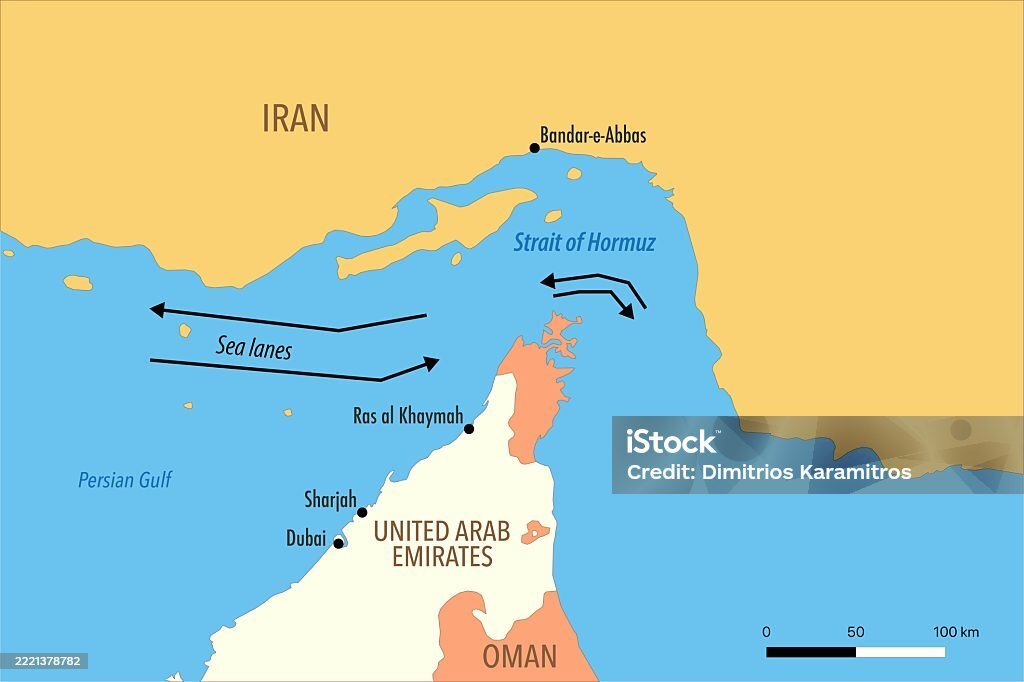
Geography does not merely accompany politics — it determines it. In the Persian Gulf, there is a point where this truth becomes evident. It is the Strait of Hormuz, a body of water just over 30 kilometers wide at its narrowest point, through which a decisive portion of the world’s energy passes. Here, the global flow is not guaranteed: it is negotiated.
And in this chokepoint, a game is being played involving the United States, Iran, China, and the Gulf monarchies. But above all, it is being played out through a seemingly marginal player: Oman.
The Chokepoint That Holds the System Together
The Strait of Hormuz is not merely an energy corridor. It is a systemic chokepoint. According to data from the International Energy Agency and converging analyses by Reuters and Business Insider, up until the 2026 crisis, between 17 and 20 million barrels of oil passed through the strait daily—about 20% of global consumption.
Added to this is a significant volume of liquefied natural gas, particularly from Qatar, which relies almost entirely on this passage to reach Asian and European markets.
This means that Hormuz is irreplaceable in the short term. Alternative routes exist—Saudi pipelines to the Red Sea, Emirati infrastructure to Fujairah—but they are not sufficient to compensate for a prolonged closure. The vulnerability remains structural.
And it is precisely this vulnerability that generates power.
The 2026 Crisis: From Threat to Tool of Power
For decades, the closure of the Strait remained a rhetorical threat from Iran. In 2026, for the first time, it became a concrete reality.
Following the escalation between the United States and Iran, which culminated in targeted attacks against Iranian strategic targets, Tehran responded not so much by formally closing the Strait as by making it impassable. Naval mines, drones, selective hijackings, and threats drastically reduced traffic.
According to Reuters, during the most acute phases of the crisis, the number of ships authorized to pass was limited to about 15 per day, compared to over 100 under normal conditions. Business Insider reported that, even after the truce, traffic remained extremely low, with many companies reluctant to transit due to insurance costs and operational risks.
The point is crucial: you don’t need to close the Strait of Hormuz to control it. You just need to make it uncertain.
Iran: The Power of Interdiction
Iran does not formally control the strait, but it controls its instability. It is a negative form of power, yet one that is extremely effective: the power to prevent.
Tehran has gradually developed a strategy of asymmetric interdiction, based on relatively inexpensive assets—drones, coastal missiles, and light naval vessels—that are nonetheless capable of striking high-value targets such as oil tankers and commercial ships.
During the crisis, this strategy evolved further: no longer just a threat, but selective traffic management. According to sources cited by Reuters, Iran even considered introducing a system of transit permits or “tolls,” effectively transforming Hormuz into a tool for geopolitical rent-seeking.
This represents a structural shift: from a vulnerable chokepoint to a permanent lever of economic and political pressure.
United States: Ensuring the Flow
For the United States, Hormuz symbolizes a historic function: ensuring freedom of navigation and, with it, the stability of global markets.
The U.S. military presence in the Gulf—from the Fifth Fleet in Bahrain to bases in Qatar and the Emirates—follows precisely this logic. However, the 2026 crisis revealed the limits of this model: military superiority is not enough to ensure the flow when the risk becomes widespread and constant.
In other words, Washington can reopen the strait, but it struggles to normalize the situation there. This weakens its systemic position and opens the door to other actors, primarily China, the main importer of energy from the Gulf.
Oman: The Power Concealed
In this context, Oman occupies a unique position. It controls the southern shore of the strait via the Musandam Peninsula and, unlike the other Gulf states, maintains stable relations with both the United States and Iran.
This stance is not ideological, but strategic. Over time, Oman has built a foreign policy based on operational neutrality and discreet mediation, serving as a channel of communication between Tehran and Washington even during moments of peak tension.
During the crisis, this role has become even more significant. According to analyses by international geopolitical institutes and think tanks, Muscat has been involved in efforts to informally coordinate maritime traffic and manage the ceasefire.
However, this position carries a risk: if Oman appears too close to Iran, it loses credibility with the United States and its Western partners; if it aligns too closely with Washington, it risks compromising its relationship with Tehran, which is essential for the stability of the strait.
For this reason, it is a reluctant guardian: indispensable, but lacking the ability to unilaterally impose the rules of the game.
Global Consequences
The Hormuz crisis is not confined to the Gulf. It has systemic effects.
According to UNCTAD, even partial disruptions to traffic through the strait have immediate impacts on energy prices, marine insurance, and global supply chains. Rising logistics costs quickly translate into inflation, especially for energy-importing economies.
For Europe, which is heavily dependent on imports, the crisis has been an additional source of vulnerability. For Asia—and China in particular—it has highlighted the need to diversify routes and supplies.
But no alternative is immediately available. And that is the point: Hormuz remains irreplaceable.
Impossible Stability
The truce between the United States and Iran has reopened the strait, but it has not restored normality.
Traffic has returned only partially, companies remain cautious, and perceived risk continues to influence the markets.
The real transformation is psychological and strategic: the world knows that Hormuz can be shut down. And what can be shut down can be used.
Conclusion: The Power of Geography
In the contemporary international system, power is no longer merely military or economic. It is infrastructural and geographical. Whoever controls the nodes controls the flows. Oman is not a power in the classical sense. It does not project force, it does not dominate, it does not impose. Yet, without it, the Strait of Hormuz would already be the scene of open conflict.
It is a balancing power, forced to navigate between larger actors, striving to keep open a passage that no one can afford to lose. In a world tending toward fragmentation, the Strait of Hormuz remains one of the few points where global interdependence manifests itself in its purest—and most fragile—form.
And Oman remains its guardian, not by choice, but by position.
Mondo Internazionale APS - Riproduzione Riservata ® 2026
Share the post
L'Autore
Giorgia Cremona
Categories
Middle East & North Africa Ambiente e Sviluppo Società Peace, justice and strong institutions
Tag
oman ordine mondiale stretto di hormuz Golfo persico Iran #USA Mar Rosso economia globale conflitto Iran-USA