
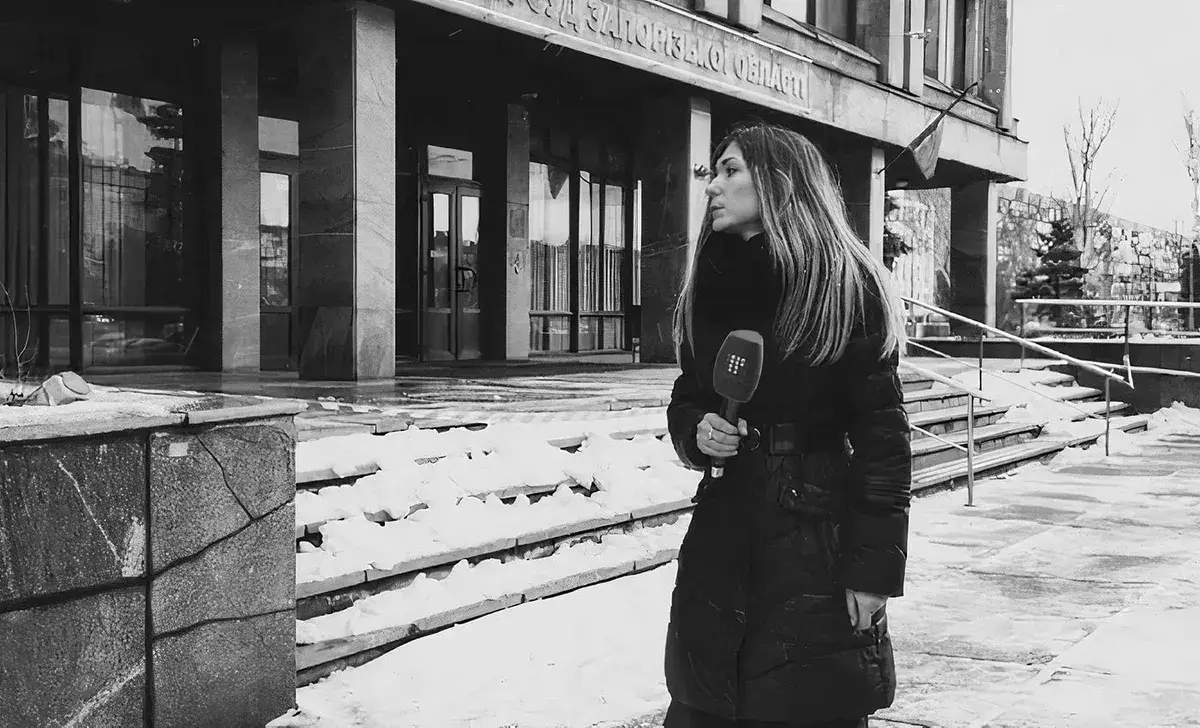
Victoria Roshchyna. Photo via Facebook
Translated by Aurora Forlivesi
In July 26, 2023, Victoria Roshchyna, an investigative journalist for Ukrainska Pravda and Radio Free Europe, decided to travel to Zaporizhzhia, in southeastern Ukraine under Russian occupation, to report on the siege and destruction of the Kakhovka dam.
Victoria “Vika” Roshchyna was born in Zaporizhzhia on October 6, 1996, and knows well the territories occupied by Russian troops. As early as March 2022, when Mariupol was under siege by the Russian army, the journalist, along with her cameraman, rushed to report on the situation in the city. There, she was arrested for the first time, spending ten days in the federal prison of Berdiansk.
Once released, she wrote an article for Index on Censorship denouncing what had happened and recounting her detention as a journalist. For her work, Roshchyna received the Courage in Journalism Award from the International Women’s Media Foundation. However, Vika did not attend the award ceremony — she was already in the field, reporting once again.
From Occupied Territories to Russian Imprisonment
In the summer of 2023, Victoria told her parents she had organized her reporting trip safely, traveling through Poland and then Russia, and contacted them on August 3 to say she had passed border controls and was now in the occupied territories. That was the last call — from that moment, she disappeared without a trace. Alarmed, her family reported her missing on August 12. Her father, Volodymyr, made a public appeal to the media to pressure the Ukrainian government to try to free his daughter.On September 21, 2023, Victoria’s parents filed an official missing person report with the Security Service of Ukraine, the Ministry for the Reintegration of Temporarily Occupied Territories, and the Ombudsman. A few days later, the Roshchyn family received confirmation of her detention.
“The Ukrainian security services confirmed that Victoria had been captured by Russia. Public officials told us there are many Ukrainian detainees in Russian prisons, and she might be among them,” Vika’s father told The Daily Beast.
Confirmation of Kidnapping and Torture
Only on April 22, 2024, the family received a letter from the Russian government confirming that Roshchyna was being held in Russian custody. However, the charges against her and her place of detention remained unknown.
No further information emerged until October 10, 2024, when news of her death was announced. The journalist, imprisoned just across the border in Taganrog — known as “Russia’s Guantanamo” — was said to have died on September 19, 2024, of “natural causes.”This information came in a letter to the Roshchyn family from Petro Yatsenko, of the Coordination Headquarters for the Treatment of Prisoners of War.
Victoria Roshchyna’s body was returned to the Red Cross only in February 2025, following a body exchange between Russians and Ukrainians. Her remains were found among 757 other war prisoners, tagged with the label “NM SPAS 757”, a coded acronym meaning “unidentified male.
Only DNA testing confirmed that the body — delivered in a white plastic bag, with a shaved head, a broken rib, burns, signs of electric shocks, and with the brain, eyeballs, and larynx removed — was indeed Victoria Roshchyna.
Experts believe the organs were extracted to erase further evidence of torture and to conceal the cause of death, likely strangulation or suffocation.
On August 8, 2025, nearly two years after her abduction, Vika Roshchyna’s funeral was held in Kyiv.
War Crimes Against Journalists and Civilians
On October 3, 2025, Antoni Lallican, a 37-year-old French photographer, was killed by a Russian drone in the Donbas region, while his Ukrainian colleague George Ivanchenko suffered a leg amputation.
The only “crime” committed by Roshchyna — like that of other journalists and photo-reporters killed or wounded in Ukraine, and of the 247 killed in Gaza — was that of trying to do their job: to tell the world about the atrocities of a war devastating their homeland and the crimes committed by the occupying forces.
For the Russians, Victoria Roshchyna was a threat because she was documenting what was happening — the war crimes perpetrated against Ukrainian civilians in the occupied territories, who were illegally detained and tortured.
But killing the journalist did not kill the story she was telling — a story of which she herself became a victim.
Vika’s story is that of thousands of Ukrainian civilians, the so-called “ghost detainees”: between 16,000 and 20,000 Ukrainian civilians are believed to be imprisoned (in 29 different sites) in occupied Ukrainian territories and among the Russian Federation, subjected to torture, and denied of freedom and rights.
Mondo Internazionale APS - Riproduzione Riservata ® 2025
Share the post
L'Autore
Giuliana Băruș
Studi in Giurisprudenza e Diritto Internazionale a Trieste.
Oltre che di Diritto (e di diritti), appassionata di geopolitica, giornalismo – quello lento, narrativo, che racconta storie ed esplora mondi – fotoreportage, musica underground e cinema indipendente.
Da sempre “permanently dislocated – un voyageur sur la terre” – abita i confini, fisici e metaforici, quelle patrie elettive di chi si sente a casa solo nell'intersezionalità di sovrapposizioni identitarie: la realtà in divenire si vede meglio agli estremi che dal centro. Viaggiare per scrivere – soprattutto di migrazioni, conflitti e diritti – e scrivere per viaggiare, alla ricerca di geografie interiori per esplorarne l’ambiguità e i punti d’ombra creati dalla luce.
Nel 2023, ha viaggiato e vissuto in quattro paesi diversi: Romania, sua terra d'origine, Albania, Georgia e Turchia.
Affascinata, quindi, dallo spazio post-sovietico dell'Europa centro-orientale; dalla cultura millenaria del Mediterraneo; e dalle sfaccettate complessità del Medio Oriente.
In Mondo Internazionale Post è autrice per la sezione “Organizzazioni Internazionali”.
Categories
Tag
Russia guerra russia-ucraina war crime giornalismo Free press Zaporizhzhia Prigionieri di guerra