
Biníam, the cartoonist released after 15 years in prison
Translated by Celeste Valentini
The Eritrean cartoonist Biníam “Cobra” Solomon, labeled an enemy of Isaias Afewerki’s regimen, was released in early March 2026 after 15 years in prison without knowing the reason behind his imprisonment.
Biníam was a satirical cartoonist, first hostile towards Menghistu’s Ethiopian regime and then, after Eritrean independence from Ethiopia in 1993, to Isaias Afewerki’s regime too. During his imprisonment he couldn’t see his family. He was arrested in 2011 and imprisoned in Asmara – the capital of Eritrea – without being put on trial, just like thousands of other political prisoners who were hostile towards the regime.
Isaias Afewerki’s Prison State and Eiraeiro prison
Eritrea has been ruled by Isaias Afewerki’s dictatorial regime since 1993. He was celebrated as a liberator after the victory over the Derg’s communist regime in 1991. He formally consolidated the regime in 1993, after the Eritrean independence. Since 2001, he has established a regime of terror, outlawing opposition parties, independent media, religious groups and civil society organizations, in addition to imprisoning the political opponents.
In Eritrea there are not standard prisons, but literal concentration camps, such as the Eiraeiro prison. An OSINT analysis of the complex satellite imagery from Google Earth Pro shows that the structure is situated in a mountainous and isolated area, approximately 40 km north of the capital of Asmara as the crow flies. The maximum-security prison of Eiraeiro appears to have been active since 2003. In fact, according to the satellite imagery history of Google Earth Pro, the current planimetry was already visible in 2005. It is therefore plausible that the facility was built within the previous two years.
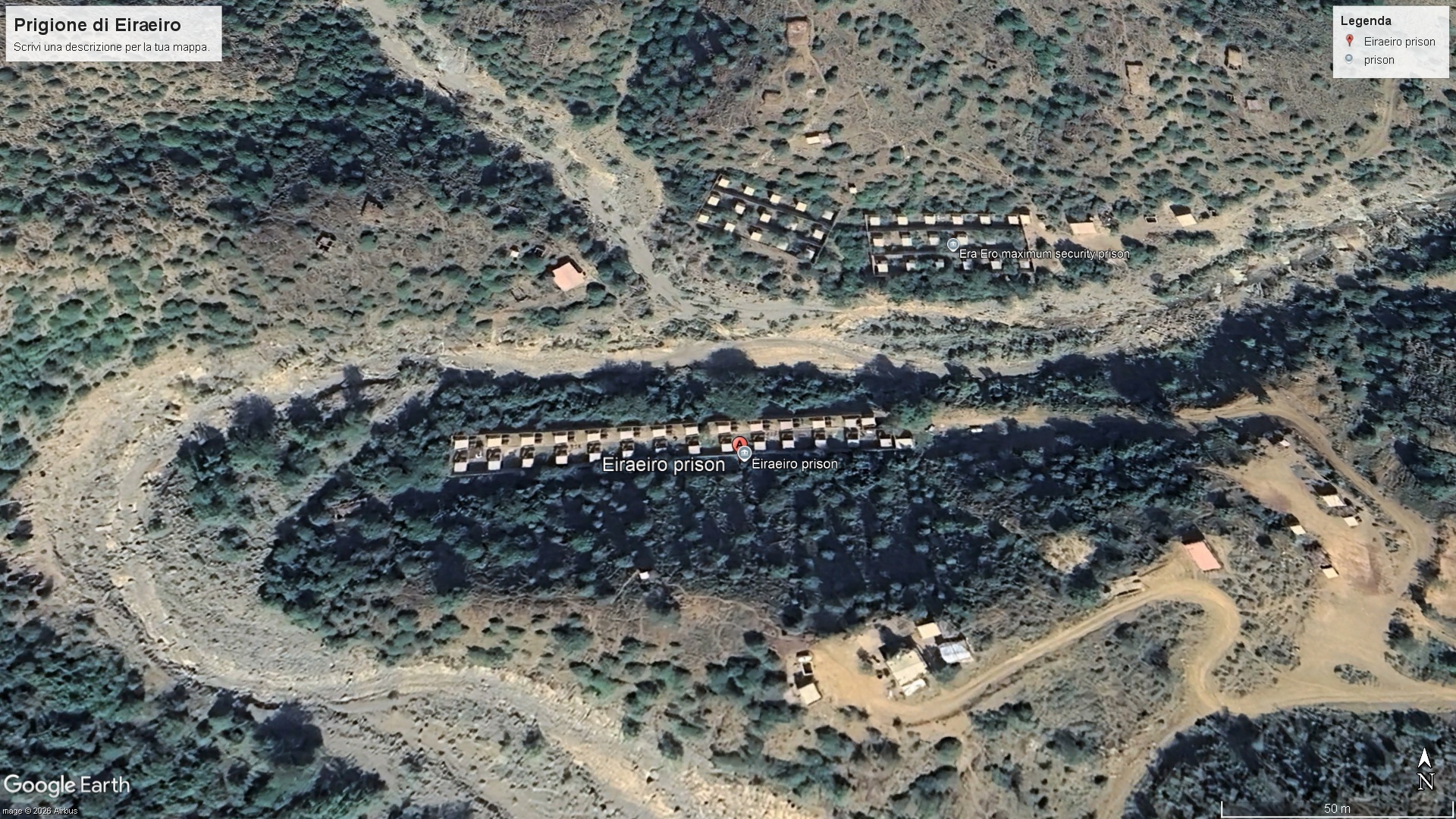
Satellite analysis of Eiraeiro (Coordinates: 15°42’32.97”N 38°57’28.19”E - Imagery generated via Google Earth Pro) reveals the prison blocks of the structure surrounded by an arid landscape to prevent prison breaks or contact with the outside world.
Dawit Isaak, an Eritrean-Swedish journalist, was among those arrested in 2001; no information regarding his whereabouts or condition has been received since then: “During the early years of his detention, reports emerged that the journalist was frequently hospitalized. While this was deeply concerning, the current lack of any news is even worse”, declare the UN Special Rapporteurs.
According to the testimony of an Eritrean refugee – dating back to April 2010 - who worked in that prison, Dawit Isaak could be detained in the maximum-security prison of Eiraeiro, together with other high-ranking prisoners such as former ministers opposed to the Isaias Afewerki government. However, other sources suggest that Dawit Isaak passed away in Eiraeiro. Unfortunately, the exact year of his death is unknown.
Biníam and Dawit Isaak are not two isolated cases
The stories of the cartoonist Biníam and the journalist Dawit Isaak are not isolated cases: despite their different outcomes, they are part of a repressive system that detains thousands of people without trial, in a country that has long been accused of human rights violations. On September 17, 2021, Amnesty International called on the Eritrean authorities to release the journalists and politicians arrested 20 years earlier, launching a campaign titled “#WhereAreEritreasDissidents”.
The release of Biníam is not an isolated case, but part of a series of recent releases that took place between 2025 and 2026 at the behest of Afewerki’s regime. In December 2025, 13 prisoners who had been held without charge or trial were released. An attempt to gain support from regional countries and to break Eritrea’s diplomatic isolation in the Horn of Africa. By doing so the Eritrean government projects an image of apparent moderation to neighboring nations and new international partners, without actually undermining its decades-long repressive framework. Essentially, Eritrea aims to regain respectability among its regional partners by masking its authoritarian nature behind minor, superficial domestic policy concessions. This strategy fits into a context of intense tensions in the Horn of Africa – the civil war in Sudan and Darfur, the Houthi attacks in the Red Sea, where Eritrea has over 1,000 km of coastline along that very stretch of water.
Eritrea aims to present itself as a credible player in a context marked by a profound instability.
Human rights under siege
According to the UN report published on May 12, 2025, covering the period from April 2024 to April 2025, authored by the UN Special Rapporteur Mohamed Abdelsalam Babiker on the situation of human rights in Eritrea, the state of the rule of law in the country remains highly critical, with a complete absence of democracy/civic space. The freedom of expression, association and religion are being suppressed. On this matter, the Afewerki’s government harshly represses religious faiths, such as Jehovah's Witnesses, evangelical Christians, Muslim clerics, and leaders of the Orthodox Church.
The report denounces the Eritrean government’s total lack of will to cooperate and permit independent investigations within the country.
Detailed evidence is provided of ongoing systemic human rights violations: arbitrary detention of political prisoners who are held in inhumane conditions and denied the possibility of seeing their families. Mandatory military conscription is condemned: in Eritrea it is applicable to both men and women and, due to its indefinite duration, it creates a system that the UN considers to all intents and purposes a form of forced labor.
The most vulnerable groups of population are also victims of abuse: women and girls are subjected to gender-based violence during military service, and serious violations against the rights of people with disabilities, minorities and indigenous groups are also reported.
Eritrean refugees and asylum seekers face significant challenges even outside their home country, as many fall victims to international human trafficking networks, enduring kidnapping, torture and exploitation, in particular along migratory routes toward North Africa, the Middle East and Europe.
Because of the Eritrean regime’s repression, almost 18% of the Eritrean population was forced to flee into exile, facing dangers even abroad. In Sudan, Eritrean refugees are victims of sexual abuse by the Sudanese paramilitary forces (RSF); in Ethiopia, too, Eritrean refugees don’t have access to the asylum procedures and they are victims of violence by the Addis Ababa police.
Epilogue: the tragedy of Eritreans in the world’s silence
The general picture shows the never-ending persecution for Eritrean refugees, who are targeted both in their home country and abroad, where they are subjected to violence and abuses. The stories of Biníam – despite the recent release – and Dawit Isaak – whose fate remains mysterious, though many presume him dead – demonstrate that under Afewerki’s regime, there is no room for dissent. The persecution of political opponents continues in the world’s silence.
Mondo Internazionale APS – All Rights Reserved ® 2026
Share the post
L'Autore
Gabriele Bellono
Autore per l'area tematica "Diritti Umani" di MI POST
Categories
Tag
eritrea Isaias Afewerki Osint Stato-Prigione Eiraeiro