
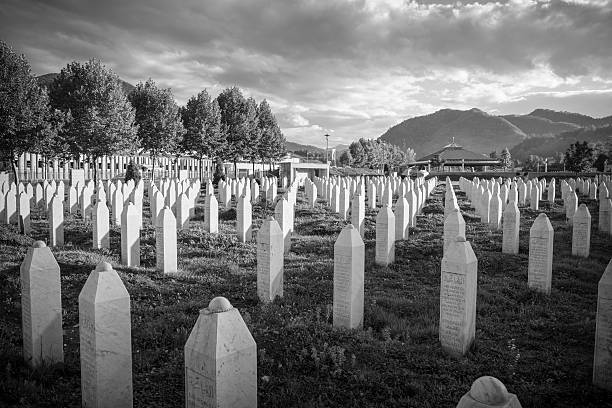
“The resolution is not directed against any country, including Serbia, but if at all, it is directed against perpetrators of genocide
”
- Antje Leendertse, Ambassador and Permanent Representative of Germany to the United Nations
Translated by Andrea Solazzo
The resolution was written by Germany and Rwanda. This is the second attempt to adopt a resolution on the Srebrenica genocide. The first attempt dates back to 2015, which failed due to a veto by Russia, Belgrade's historical ally, in the United Nations Security Council.
The resolution, supported by all the major Western powers, was opposed by Serbia, arguing that the real aim of the decision was to burden the Serbs with the stigma of being a “genocidal people”. Belgrade rejects the accusation, believing that heinous crimes were also committed against Serbs in Srebrenica, and that in no case can one speak of genocide against the Bosnian Muslim population, as has been established by international justice. In July 1995, over eight thousand Muslim civilians were killed in Srebrenica and the surrounding villages by Ratko Mladic's Bosnian Serb troops, thousands were dispersed, and entire communities were destroyed.
The UN also established 11 July as the International Day of Reflection of the 1995 Genocide in Srebrenica. The resolution condemns any denial of the genocide and any exaltation of war criminals and urges the 193 UN member states to preserve the established truths - also through their educational systems - in order to prevent revisionism and avoid future genocides.
The Srebrenica massacre
In July 1995, Bosnian Serb forces invaded Srebrenica, previously declared a safe zone by the UN Security Council. Here, the army of Republika Srpska brutally slaughter 8,372 men and boys, expelling over twenty thousand people from the city. The killing of the Bosnian Muslims in Srebrenica - one of the darkest chapters of the war that broke out after the breakup of the former Yugoslavia - has been recognised as an act of genocide by the International Court of Justice (ICJ) and the International Criminal Tribunal for the former Yugoslavia.
Western Balkans, an unresolved issue
In a land still caught "in the vortex of historical revisionism", the most concrete risks are represented by genocide denial and secessionism: both are part of a big strategy to distort the future of the former Yugoslavia. The aim would be to erase historical responsibility and overturn the narrative about the past.
Pronounced almost thirty years after the massacre, the UN decision aims to stabilize the region and “promote unity in diversity” in Bosnia and Herzegovina: it is hoped it will provide an opportunity to initiate new processes of reconciliation and catharsis.
However, the power of ethnonationalists and their ability to cause armed conflict should not be underestimated: a scenario in which special police units, trained in Russia, or paramilitary formations, like those in action in Kosovo, would be mobilised.
Collective responsibility of the Serbs?
Reactions in Serbia
By opposing the resolution on Srebrenica and Kosovo's adhesion to the Council of Europe, Serbian President Aleksandar Vučić is pursuing a precise political (and propaganda) goal: to court the right and silence the opposition for the upcoming local elections in June, as well as to present himself to his electorate as the main “protector of the Serbian people”. According to Vučić, the pronouncement will be useful to increase divisions in the Balkans, instead of promoting reconciliation.
However, the UN resolution is based not only on the judgments of the International Criminal Tribunal for the former Yugoslavia, but also on those of the Court of Bosnia and Herzegovina. The rulings established that the genocide was committed by members of the Army and Ministry of Interior of Republika Srpska and by some paramilitary units, including the Serbian Scorpions formation. Finally, the International Court of Justice ruled that Serbia, although not directly responsible for the genocide in Srebrenica, was responsible for not preventing it.
However, in both Serbia and Republika Srpska, trials against war criminals are slow (with over 1,700 cases where investigations have never begun), and people convicted of war crimes continue to hold public office and enjoy visibility. In the search for justice, truth and guarantees of non-repetition, it remains the responsibility of political leaders to engage in constructive dialogue to create peaceful societies “where people can live in security and freedom, without discrimination or fear of conflict and violence”. Aspirations unfortunately not supported by the incendiary reality of the “Balkan powder keg”.
Mondo Internazionale APS - Riproduzione Riservata ® 2024
Share the post
L'Autore
Giuliana Băruș
Studi in Giurisprudenza e Diritto Internazionale a Trieste.
Oltre che di Diritto (e di diritti), appassionata di geopolitica, giornalismo – quello lento, narrativo, che racconta storie ed esplora mondi – fotoreportage, musica underground e cinema indipendente.
Da sempre “permanently dislocated – un voyageur sur la terre” – abita i confini, fisici e metaforici, quelle patrie elettive di chi si sente a casa solo nell'intersezionalità di sovrapposizioni identitarie: la realtà in divenire si vede meglio agli estremi che dal centro. Viaggiare per scrivere – soprattutto di migrazioni, conflitti e diritti – e scrivere per viaggiare, alla ricerca di geografie interiori per esplorarne l’ambiguità e i punti d’ombra creati dalla luce.
Nel 2023, ha viaggiato e vissuto in quattro paesi diversi: Romania, sua terra d'origine, Albania, Georgia e Turchia.
Affascinata, quindi, dallo spazio post-sovietico dell'Europa centro-orientale; dalla cultura millenaria del Mediterraneo; e dalle sfaccettate complessità del Medio Oriente.
In Mondo Internazionale Post è autrice per la sezione “Organizzazioni Internazionali”.
Categories
Tag
Serbia srebrenica Bosnia and Herzegovina balcani United Nations Assemblea Generale Consiglio di Sicurezza #genocide